What are you afraid of?

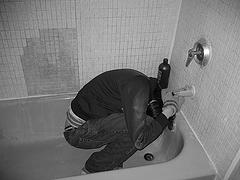
FearLooking into those several week old containers of leftovers in the fridge? Analyzing data for an experiment you’ve now done a third time looking for a tie-breaker? Walking into that small conference room with your thesis committee hoping to graduate? Each of these things can cause the body to enact the fear response.

A great deal of evidence has implicated the portion of the brain called the amygdala in fear and recall of fear and behaviors associated with it. It is incredibly rare for a human to have damage to their entire amygdala but these cases do exist. One example is Patient SM who has a rare condition called Urbach-Wiethe disease. This disease causes a build-up of calcium in blood vessels which can damage particular parts of the brain, in the case of Patient SM, both portions of her amygdala have been destroyed by these calcifications. This woman exhibits no fear response to normally frightening stimuli like snakes, spiders, haunted houses, or scary movies. She cannot recognize fear in the faces of others. She and a few other patients have been critical to studies of how the amygdala modulates fear in humans. Are these people truly fearless? Continue reading “What are you afraid of?”

Meet the Texas Blind Salamander

TX Blind Salamander picture 1The Texas Blind Salamander (Eurycea rathbuni) is a cave salamander that has adapted to life living in the dark. With extremely underdeveloped eyes, unpigmented skin, and the retention of its juvenile aquatic form, this salamander is perfectly suited to live in the underground cave streams. Found only in caves around San Marcos, Texas these salamanders are actually considered endangered on the State level. Because they live only in specific areas and rely on the Edwards aquifer, the Texas blind salamander is extremely susceptible to changes in water quality. Their size reaches between 3 and 5 inches and they eat a diet of most aquatic invertebrates. Continue reading “Meet the Texas Blind Salamander”

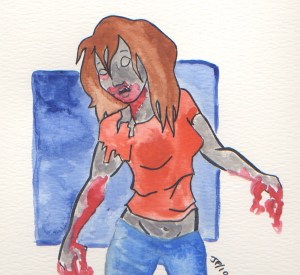
The Walking Dead’s Bloody Mess 3

Did you know that there is research showing that being exposed to “spoilers” increases enjoyment of a story? True. Do I think you believe me or the research? No. In fact, I think you will treat this evidence with the same condescension political pundits applied to the predictions of Nate Silver. Furthermore, I think you will completely ignore the object lesson afforded you by the 2012 election forecasting. Is this the most overwrought and evidence-laden spoiler alert ever? Yes. You have been warned.

Let’s get the first major spoiler out of the way. At the end of The Walking Dead season 2, we discover that you do not need to be bitten by a zombie to become a zombie. You merely have to die. This leads to a lot of scenes of survivors sticking pointy objects into the brain cases of their recently deceased or mortally wounded friends in a practical act of mercy.

If you die, you kind of lie there for a little bit – just long enough for a father and son to share a moment – then you rise up and get your zombie on. This means that everyone in The Walking Dead universe has been exposed to the zombie pathogen. All survivors are carriers – zombies in potentia. This also means that the zombie pathogen is even weirder than it already had to be. Continue reading “The Walking Dead’s Bloody Mess 3”

Meet the Arboreal Salamander

There is a recent natural history article in the Journal of Herpetology (click here for the link from D. E. Lee et al., 2012) describing the Arboreal Salamander (Aneides lugubris). The authors have characterized the basic life history traits of this salamander by capture-mark-recapture studies covering a 4 year span. This information is important for many areas of future research, but specifically this will aid in future conservation endeavors.

Oh yeah and this little guy has TEETH!

Basic life-history information like this is still lacking in many species because it is difficult to find funding. Check out the link above to read more about this salamander or click here to see more California salamanders.

“Meet the…” is a collaboration between The Finch & Pea and Nature Afield to bring Nature’s amazing creatures into your home.

The Walking Dead’s Bloody Mess 2 [repost]

Originally posted on 17 May 2012, we are reposting this piece to make sure you are adequately prepared for The Walking Dead to return from hiatus on AMC Sunday, 10 February 2013 at 9PM (ET). We’ll have a third post in this series for you on Saturday. 

*SPOILER ALERT*

Previously on The Walking Dead’s Bloody Mess. . .

. . .we discussed how incredibly unlikely it would be that Rick would be the only available blood donor for Carl among the group of survivors on Hershel’s farm1. This led us2 to wonder what the blood type of his mother, Lori Grimes, might be. It is not at all unusual for a parent to not be a compatible donor for their child, especially for a direct transfusion. Lori is pregnant and her blood type could be important to the health of the wee baby Grimes (WBG). Continue reading “The Walking Dead’s Bloody Mess 2 [repost]”