
ENCODE is devouring the rest of biomedical science

A new NIH RFA:

PsychENCODE: Identification and Characterization of Non-coding Functional Elements in the Brain, and their Role in the Development of Mental Disorders (R01)

The Encyclopedia of DNA Elements (ENCODE) project, by systematically cataloging transcribed regions, transcription factor binding sites, and chromatin structure, has recently found that a larger fraction of the human genome may be functional than was previously appreciated. However, our understanding of the role of these functional genomic elements in neurodevelopment and mental disorders is at an early stage. This funding opportunity will support studies that identify non-coding functional genomic elements and elucidate their role in the etiology of mental disorders.

Suddenly, the ENOCDE model is now the way to do science. It’s hard to disagree with Dan Graur on what the consequences are: Continue reading “ENCODE is devouring the rest of biomedical science”
Great scientists don’t need math

So says E.O. Wilson in the Wall Street Journal.

But don’t just read the headline – be sure to catch the nuance in Wilson’s piece. He’s saying don’t let fear of math drive you from science, because you don’t need straight A’s through four semesters of calculus to be a good scientist.

I don’t quite agree with Wilson when he says you can always find a mathematician as a collaborator to handle the math you need. A mathematically illiterate biologist working with a biologically illiterate mathematician is usually not a fruitful combination. But good scientists pick up the necessary mental toolkit as it’s needed, including mathematical and statistical knowledge (as long as they’re willing to put some serious effort into gaining that knowledge, as opposed to, say, figuring out how to mindlessly apply t-tests).

Sean Eddy calls this approach “ante-disciplinary science”: Continue reading “Great scientists don’t need math”

How to reference a rejected paper on your CV

From Rob Phillips’ list of publications on his lab website:

A First Exposure to Statistical Mechanics for Life Scientists. (with Hernan G. Garcia, Jane’ Kondev, Nigel Orme and Julie A. Theriot), Rejected by Am. J. Phys., 2007. [online full text]

The paper itself is a great read, with some important ideas for anyone who thinks about how to incorporate more quantitative/physical concepts into our program of biology education. It also tells you that stat mech is almost effortless once you understand the Boltzmann distribution: Continue reading “How to reference a rejected paper on your CV”

Doolittle disagrees, politely

The rebuttal to the ENCODE project’s claim to have vanquished junk DNA by Graur et al. got a lot of attention for its scathing rhetoric. If you already have enough troubles in your life, W Ford Doolittle penned a cogent, but polite rebuttal of the claim in PNAS.

…what would we expect for the number of functional elements (as ENCODE defines them) in genomes much larger than our own genome? If the number were to stay more or less constant, it would seem sensible to consider the rest of the DNA of larger genomes to be junk or, at least, assign it a different sort of role (structural rather than informational)…A larger theoretical framework, embracing informational and structural roles for DNA, neutral as well as adaptive causes of complexity, and selection as a multilevel phenomenon, is needed.

Unfortunately, you need a subscription to read the full length article, which I do not. Therefore, I’m not endorsing all of Doolittle’s arguments, but I do like that he seems to agree with my assertion from “Decoding ENCODE” that evolutionary theory expects junk DNA in species with the population and genomic characteristics of humans.

*Hat tip to Leonid Kruglyak.

Breaking in Order to Build

Image courtesy of the Journal of Cell Biology
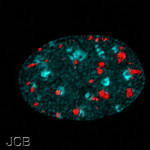
Image of labeled (red) DNA breaks in a single cell courtesy of the Journal of Cell Biology

Do you ever think about how every time you encounter something new your brain adjusts and rewires and makes molecular changes so you can remember this new object in the context of what you already know? I know I do, though that may be a by-product of my neuroscience upbringing. Even if you don’t think about it, it’s happening. Complex changes in the numbers and amounts of gene expression are critical to developing and maintaining memories. And as it turns out, breaking the DNA in your brain cells into pieces is also part of the process.

Continue reading “Breaking in Order to Build”