Astronomy + Poetry from CosmoAcademy

As you know*, we like to mix our science and our poetry. Mike has generously loaned this Philistine the reins to the Sunday Science Poem franchise, which I promptly moved to Tuesday; but I had to move it to Tuesday because I don’t want you to miss out.

CosmoQuest is offering an online course (via Google+ Hangouts) looking at the intersection of astronomy and poetry:

Astronomy has played a role in human culture for thousands of years and appears in literature from every era.  We can see not only the influence of the heavens on our writings, but also the influence of language itself on our conception of astronomy. Heralding the dawn of the International Year of Light in 2015, join us now to explore how light from the stars has been important to humans for millennia.  We will begin with Gilgamesh and Homer, and continue through Shakespeare, Robert Frost, Maya Angelou, and into contemporary music and literature.  Along the way, we will also examine how the structure of language has influenced the perception of astronomical phenomena. – CosmoQuest Academy

The classes start on Monday, 17 November 2014 at 9PM (ET). Sign-ups (cost $99) are open until Monday, but there are only 8 spots left.

HT: Matthew Francis

*Frankly, I’m tired of coddling you newbies**.

**Have we decided on a sarcasm font***?

***I imagine all those exchanges are constantly derailed by people writing, “I think this one really works” in a proposed font, and then wondering, “Do they really like it or are they being sarcastic****?”

****…which may actually be a sign that it is working.

Would you outsource your gel to a gel-informatician?

Sean Eddy explains why sequencing is replacing many older assays, and why biologists need to learn to analyze their own data.

“High throughput sequencing for neuroscience”:

If we were talking about a well-defined resource like a genome sequence, where the problem is an engineering problem, I’m fine with outsourcing or building skilled teams of bioinformaticians. But if you’re a biologist pursuing a hypothesis-driven biological problem, and you’re using using a sequencing-based assay to ask part of your question, generically expecting a bioinformatician in your sequencing core to analyze your data is like handing all your gels over to some guy in the basement who uses a ruler and a lightbox really well.

Data analysis is not generic. To analyze data from a biological assay, you have to understand the question you’re asking, you have to understand the assay itself, and you have to have enough intuition to anticipate problems, recognize interesting anomalies, and design appropriate controls. If we were talking about gels, this would be obvious. You don’t analyze Northerns the same way you analyze Westerns, and you wouldn’t hand both your Westerns and your Northerns over to the generic gel-analyzing person with her ruler in the basement. But somehow this is what many people seem to want to do with bioinformaticians and sequence data.

It is true that sequencing generates a lot of data, and it is currently true that the skills needed to do sequencing data analysis are specialized and in short supply. What I want to tell you, though, is that those data analysis skills are easily acquired by biologists, that they must be acquired by biologists, and that that they will be. We need to rethink how we’re doing bioinformatics.

I would add this: it takes some time to learn, but in the end it’s not that hard, people. Students in chemistry and physics routinely learn the requisite skills. We need to educate biologists who expect to do programming, math, and statistics.

What a cute baby. . .solar system

The folks at Atacama Large Millimeter/Submillimeter Array (ALMA) just released an insanely detailed image of a developing star and the surrounding disc of material that may become its planetary system.

Credit: ALMA (NRAO/ESO/NAOJ); C. Brogan, B. Saxton (NRAO/AUI/NSF)

Phil Plait explains why this image is more than aesthetically interesting at Slate.

From what we understand of planet formation, a star and disk this young shouldn’t have a planetary system evolved enough to create these gaps. That’s a bit of a shock. Research published in 2008 also indicated the presence of a new planet, and I’ll be curious to see how this new observation fits in with that work as well. – Phil Plait

HT: Amy Shira Teitel

Trick or Treat! – Mullerian Mimicry Edition

photo (16) copy
Photo Credit: Jennifer Taylor (All Rights Reserved; Used with Permission)

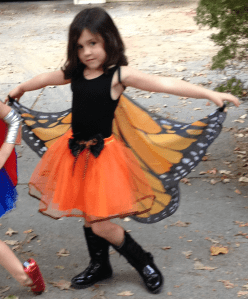
You are never to young for a meta-costume*.

To the untrained eye, it may look like my daughter is dressed as a monarch butterfly for Halloween. To the trained eye, you will recognize that half of her parental set is extremely dorky.

She is actually going as the concept of Müllerian Mimicry instantiated in the form of a viceroy butterfly. This costume is occassionally mistaken for Batesian Mimicry by novices.

Butterfly (monarch) on a Penta by Arturo Yee (CC BY 2.0)
Viceroy by Rodney Campbell (CC BY 2.0)

Continue reading “Trick or Treat! – Mullerian Mimicry Edition”

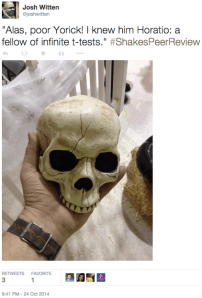
#ShakesPeerReview

Screenshot 2014-10-26 19.47.29It has oft been our wont on a Friday to indulge in a bit of sciencing of movie quotes – a practice we have saddled with the Twitter sobriquet #SCInema. This Friday, however, was not like most Fridays. For, on this Friday, my friends at the Science for the People podcast released a show featuring interviews with author Dan Falk and scholar Stanley Wells entitled “Science and Shakespeare.

So, instead of putting the science in movie quotes, we brought the science to the works of The Bard with the hashtag #ShakesPeerReview. It was met with great enthusiasm by science-y folk who were eager to show-off that their knowledge of Shakespeare and their senses of humor (these things do not always go together).

My favorite effort, among many potential favorites, may be this one from Shane Caldwell.

Screenshot 2014-10-26 19.43.13

You can find a storify of #ShakesPeerReview tweets here.