Announcing the Finch and Pea book club

I know what you’re asking – is a book club appropriate at a pub? Certainly at this one, where we like books as much as we like beer. And hey, pubs have always been a place to have great conversations.

And so, on the second Tuesday of each month we’ll discuss a fantastic book that is at least tangentially related to science. Continue reading “Announcing the Finch and Pea book club”

Turing asked the most interesting questions in science

Turing biographer Andrew Hodges writes in today’s issue of Science:

But more deeply, anything that brings together the fundamentals of logical and physical description is part of Turing’s legacy. He was most unusual in disregarding lines between mathematics, physics, biology, technology, and philosophy. In 1945, it was of immediate practical concern to him that physical media could be found to embody the 0-or-1 logical states needed for the practical construction of a computer. But his work always pointed to the more abstract problem of how those discrete states are embodied in the continuous world. The problem remains: Does computation with discrete symbols give a complete account of the physical world? If it does, how can we make this connection manifest? If it does not, where does computation fail, and what would this tell us about fundamental science?

Personally I find this the most interesting question in science. It’s what drew me to biology, and it is what drives my current research in gene regulation. The problem of gene regulation is a problem of computation, and what is remarkable is the fact that genetic information is stored digitally as a string of discrete, two-bit chemical units. It didn’t have to be that way, and people* didn’t think that way until Schrödinger’s speculations on aperiodic crystals and the discoveries of molecular biologists in the 50’s and 60’s.

*To be fair, geneticists were thinking digitally, beginning with Mendel, and continuing, after a hiatus, with the early 20th century pioneers. But these geneticists didn’t really didn’t care about the physical implementation of genetic information. Those who did think about it weren’t thinking in terms of digits.

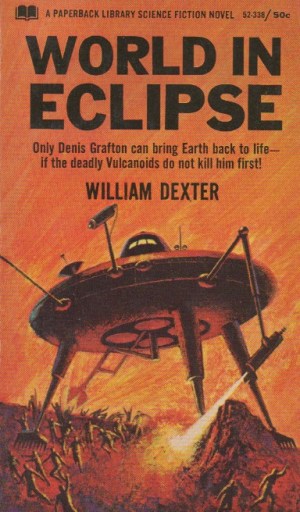
Apocalypse 1954: Flying Saucers, Vulcanids, and Thorium Bombs

World in Eclipse, William Dexter (1954)

World in Eclipse is a mildly entertaining but second-rate cosy catastrophe story that leaves you with an itch to go read some Day of the Triffids or No Blade of Grass. It’s one of those ‘aliens save a small human remnant from armageddon and return them later to the devastated earth’ stories. (The worst book in this field has got to be A.J. Merak’s abysmal, 1959 The Dark Millennium.) Dexter’s plot could be mistaken for a parody of 50s sci-fi clichés, as you can see from the following brief plot summary (mild spoilers ahead):

The perennially dismissed reports of flying saucers turn out to be accurate accounts of visitors from planet Vulcan, which is undiscovered by humans because it is hidden in the asteroid belt. Continue reading “Apocalypse 1954: Flying Saucers, Vulcanids, and Thorium Bombs”

Cancer quote of the day

or maybe of the year:

More than half of the cancer occurring today is preventable by applying knowledge that we already have. Tobacco, obesity, and physical inactivity are the modifiable causes of cancer that generate the most disease. Cancer burden can be reduced by alterations in individual and population behaviors and by public health efforts as long as these changes are driven by sound scientific knowledge and social commitment to change. The obstacles to these efforts are societal and arise from the organization of institutions, including academia, and in the habits of daily life.

Applying What We Know to Accelerate Cancer Prevention
Graham A. Colditz, Kathleen Y. Wolin and Sarah Gehlert
Sci Transl Med 28 March 2012

Stochastic gene expression and Prussian cavalry kicked by horses

Now this is morbidly entertaining. Apparently our understanding of Poisson processes, such as many of the events involved in gene expression, are derived from a study of fatal encounters with horses in the Prussian cavalry:

“Effects of Molecular Memory and Bursting on Fluctuations in Gene Expression”, Juan M. Pedraza and Johan Paulsson:

Similar Poisson statistics have been observed in a wide range of physical systems, starting with Bortkewitsch’s classic study on the number of Prussian cavalry officers kicked to death by horses (12).

Continue reading “Stochastic gene expression and Prussian cavalry kicked by horses”