The link between information and entropy on Azimuth

Mathematical physicist extraordinaire John Baez digs in to Shannon entropy and coding over at Azimuth:

So, I want to understand Shannon’s theorems and their proofs—especially because they clarify the relation between information and entropy, two concepts I’d like to be an expert on. It’s sort of embarrassing that I don’t already know this stuff! But I thought I’d post some preliminary remarks anyway, in case you too are trying to learn this stuff, or in case you can help me.

Continue reading “The link between information and entropy on Azimuth”

Former climate skeptic finally catches up to current science

LA Times: Koch-funded climate change skeptic reverses course

WASHINGTON – The verdict is in: Global warming is occurring and emissions of greenhouse gases caused by human activity are the main cause.

This, according to Richard A. Muller, professor of physics at UC Berkeley, MacArthur Fellow and co-founder of the Berkeley Earth Surface Temperature project. Never mind that the United Nations Intergovernmental Panel on Climate Change and hundreds of other climatologists around the world came to such conclusions years ago. The difference now is the source: Muller is a long-standing, colorful critic of prevailing climate science, and the Berkeley project was heavily funded by the Charles Koch Charitable Foundation, which, along with its libertarian petrochemical billionaire founder Charles G. Koch, has a considerable history of backing groups that deny climate change.

Continue reading “Former climate skeptic finally catches up to current science”

Sunday Science Poem – Nature’s Law

Inspired by this morning’s brunch of toad in the hole and baby bridies at St. Louis’ great Scotch bar, I’ve chosen Robert Burns’ “Nature’s Law” (1786) as this Sunday’s poem. The poem is about reproduction, and instead of God’s command to multiply and replenish the Earth, the drive to reproduce is here presented as Nature’s Law. Assigning the attributes of God to Nature (with a capital N, naturally) became a common tactic of the Romantics, who avoided traditional symbols of piety, as well as the hyper-rational Deism of Age of Enlightenment.

Recognizing “nature’s law” of reproduction is the first step towards Malthusian logic, the second step being the recognition of the consequences of unbridled reproduction. Malthus published his groundbreaking An essay on the principle of population twelve years after this poem, and of course Malthus’ writing was a direct influence on Darwin and his discovery of natural selection.

“Great Nature spoke: observant man obey’d” – Pope

Let other heroes boast their scars,
The marks of sturt and strife:
And other poets sing of wars,
The plagues of human life:

Shame fa’ the fun, wi’ sword and gun
To slap mankind like lumber!
I sing his name, and nobler fame,
Wha multiplies our number.

Great Nature spoke, with air benign,
“Go on, ye human race;
This lower world I you resign;
Be fruitful and increase.
The liquid fire of strong desire
I’ve pour’d it in each bosom;
Here, on this had, does Mankind stand,
And there is Beauty’s blossom.” Continue reading “Sunday Science Poem – Nature’s Law”

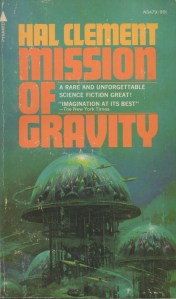
Hal Clement’s Mission of Gravity

Classic Hard Sci-Fi By The Book

Charles Lackland is far from home, holed up in an isolated outpost on the inhospitable planet Mesklin. Inhospitable to humans anyway, but not to the methane-based, centipede-like natives who are adapted to the enormously high and remarkably variable gravity, the fierce cold, and the extreme storms of this gigantic, disc-like planet. Lackland’s mission is to assist a crew of Mesklinite natives on a journey to recover mission data from an unmanned rocket that crashed near one of Mesklin’s poles. With a gravity 700 times that of Earth, the pole is a place no human can survive. But the natives, Captain Barlennan and his methane sea-faring crew of the Bree, can make the journey. Continue reading “Hal Clement’s Mission of Gravity”

Library of America Sci-Fi Smorgasbord

In preparation for the Library of America’s forthcoming volumes of vintage American Sci-fi, they’ve put up an amazing online companion with reviews of the books, additional stories, essays on the historical context, and a gallery of great covers.

If you’re like me and are struggling to sit tight until the books are released, the web site will keep you busy for awhile.