The law of supply and demand applied to NIH funding

Demand for funding has increased, but something tells me that the supply is not going to adjust. From the AAAS this week:

NIH Blog Highlights Increases in Research Grant Applications. On her blog Rock Talk, NIH Deputy Director for Extramural Research Sally Rockey posted data on NIH grant applications over the past decade-plus—specifically, competing applications for investigator-initiated research project grants (meaning they were not submitted in response to a specific request for applications). Total direct costs requested in such applications went from $4.4 billion in FY 1998 to $13 billion in FY 2011. The amount of money awarded in that pool doubled, from $1 billion to $2 billion. Put another way, in FY 1998 the demand for research dollars was 3.6 times the supply. By FY 2011, demand was 6.5 times the supply. The largest factor in this change is a rise in the number of applicants — from 19,000 to 32,000.

The solution – reduce demand by attrition, as people realize this career path is insane.

“Science writing in the Age of Denial”

I don’t know how I missed news of this April event at the University of Wisconsin, but no matter – video is online:

Science writers now work in an age where uncomfortable ideas and truths meet organized resistance. Opposing scientific consensus on such things as anthropogenic climate change, the theory of evolution, and even the astonishingly obvious benefits of vaccination has become politically de rigueur, a litmus test and a genuine threat to science. How does denial affect the craft of the science writer? How can science writers effectively explain disputed science? What’s the big picture? Are denialists ever right?

“The Failure of the Science Fiction Novel as Social Criticism”

I’ve been digging into my new Library of America copy of The Space Merchants. The book is an outstanding example of science fiction as social criticism. And so it’s interesting to read C.M. Kornbluth’s thoughts on the failure of the science fiction novel as social criticism:

I suggest from this that there is very little fundamental material in the “Skylark” universe which is congruent with adulthood. I suggest that there is much fundamental material in that universe congruent with the attitudes and emotions of a boy seven or nine years old tearing off down an alley on his bike in search of adventure. The politics of this boy are vague, half-understood, overheard adult dogmatisms. His sex-life is a bashful, inhibited yearning for unspecific contact. His cultural level is low; he has not had time to learn to like anything seriously musical. Around the corner there lurks the impossibly malignant black-haired bully who may be all of twelve, and his smart little toady. But Dicky Seaton has a loyal pal, Marty Crane, and together they will whip the bully and toady in a fair, stand-up fight.

What are these wild adventures of Seaton and Crane, then? These mighty conquests, these vast explorations, these titanic battles? They are boyish daydreams, the power of fantasies which compensate for the inevitable frustrations of childhood in an adult world. They are the weakness of the Smith stories as rational pictures of the universe and society, and they are the strength of the stories as engrossing tales of Never-Never Land. We have all been children.

Continue reading ““The Failure of the Science Fiction Novel as Social Criticism””

Sunday Science Poem: Modernists and Darwin

Modernist writers and artists were heavily influenced by the remarkable series of heavily popularized, late 19th, early 20-th century scientific findings that can still stir controversy today. The work of Darwin and Einstein in particular, as well as the less scientific work of Freud contributed to the notion that human nature was not what it used to be. The mechanized mass slaughter of World War I appeared to verify the modern picture of humans as driven by unconscious drives and primordial animal urges.

T.S. Elliot’s poem “Sweeney Among The Nightingales” can be read as a disturbed response to Darwin. The main character, Apeneck Sweeney, “the silent vertebrate” is portrayed as an ape who eats ‘oranges bananas figs and hothouse grapes’ in a café while being hit on by prostitutes. Against these animal images Eliot placed allusions to and images from classical literature – a literature which, despite the rampant violence and depravity it depicts, portrays humans as noble and heroic.

 
Apeneck Sweeney spreads his knees	
Letting his arms hang down to laugh,	
The zebra stripes along his jaw	
Swelling to maculate giraffe.	
 
The circles of the stormy moon	       
Slide westward toward the River Plate,	
Death and the Raven drift above	
And Sweeney guards the horned gate.	
 
Gloomy Orion and the Dog	
Are veiled; and hushed the shrunken seas;	        
The person in the Spanish cape	
Tries to sit on Sweeney’s knees	
 
Slips and pulls the table cloth	
Overturns a coffee-cup,	
Reorganized upon the floor	        
She yawns and draws a stocking up;	
 
The silent man in mocha brown	
Sprawls at the window-sill and gapes;	
The waiter brings in oranges	
Bananas figs and hothouse grapes;	        
 
The silent vertebrate in brown	
Contracts and concentrates, withdraws;	
Rachel née Rabinovitch	
Tears at the grapes with murderous paws;	
 
She and the lady in the cape	        
Are suspect, thought to be in league;	
Therefore the man with heavy eyes	
Declines the gambit, shows fatigue,	
 
Leaves the room and reappears	
Outside the window, leaning in,	        
Branches of wistaria	
Circumscribe a golden grin;	
 
The host with someone indistinct	
Converses at the door apart,	
The nightingales are singing near	        
The Convent of the Sacred Heart,	
 
And sang within the bloody wood	
When Agamemnon cried aloud,	
And let their liquid droppings fall	
To stain the stiff dishonoured shroud.

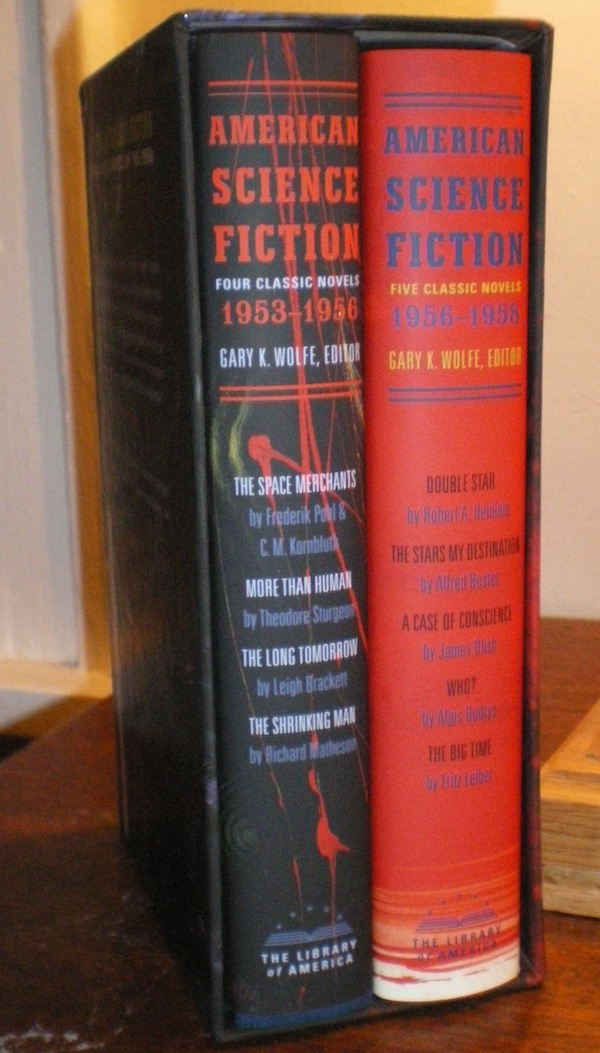
Feast your eyes on Library of America Sci-Fi Cover Art

My Library of America volumes of classic 1950’s science fiction have arrived:

The first volume features a perfectly appropriate cover by Richard Powers. I can’t trace the date of this cover, but it seems more like Powers late 50’s, early 60’s style: Continue reading “Feast your eyes on Library of America Sci-Fi Cover Art”