
Aristotle wrestling with the concept of haploid gametes & diploid organisms

He takes on the problems of Pangenesis to boot, 2,100 years before Darwin adopted it as his theory of heredity.

On the Generation of Animals, 722b:

Again, if the semen come from all parts of both parents alike, the result is two animals, for the offspring will have all the parts of both. Wherefore Empedocles seems to say what agrees pretty well with this view (if we are to adopt it), to a certain extent at any rate, but to be wrong if we think otherwise. What he says agrees with it when he declares that there is a sort of tally in the male and female, and that the whole offspring does not come from either, ‘but sundered in the fashion of limbs, some in man’s…’ For why does not the female generate from herself if the semen comes from all parts alike and she has a receptacle ready in the uterus? But, it seems, either it does not come from all the parts, or if it does it is in the way Empedocles says, not the same parts coming from each parent, which is why they need intercourse with each other.

Yet this is impossible…

– Translation by Arthur Platt, from The Basic Works of Aristotle, Richard McKeon, ed., Modern Library (1941).
Sunday Science Poem: Outward Exploration and Our Inner Passage to India

Walt Whitman’s “Passage to India” (1871)

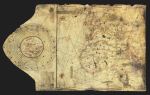
ColombusMapWhat does our drive to explore and discover tell us about our inner landscape?
Walt Whitman’s poem “Passage to India” takes as its launching point three astoundingly ambitious projects to connect the world in the mid-19th Century: the transatlantic telegraph cable, the Suez Canal, and the U.S. transcontinental railroad. These are “the great achievements of the present,” but to understand their full meaning, Whitman tells us we need to turn to the past – to the dreams and aspirations of earlier explorers and visionaries, who launched us into the present, and whose restlessness tells us about our own psychic composition.

The past shows us that humans have always been dissatisfied with boundaries, “Wandering, yearning, curious, with restless explorations,/ With questionings, baffled, formless, feverish, with never-happy hearts”: prehistoric humans expanding out of Africa into Asia and Europe; following mammoths over the frozen Siberian tundra; trekking across to what is now Alaska and down the entire Western Hemisphere; sailing to remote Pacific Islands in what to us seem like insanely inadequate vessels that are are little more than rafts. Are these external explorations a manifestation of our struggles with some unexplored internal landscape?

Continue reading “Sunday Science Poem: Outward Exploration and Our Inner Passage to India”

Peer reviewers rejected Fisher’s paper that defined variance

The rejection of R.A. Fisher’s groundbreaking paper defining variance seems to be one of the bigger mistakes of peer review:

Fisher completed his paper on Mendelism and biometry by June 1916 and submitted the paper to the Royal Society of London for publication. The referees suggested it be withdrawn. He subsequently submitted the paper to the Royal Society of Edinburgh, which with his financial assistance published it on 1 October 1918 under the title “The Correlation between Relatives on the Supposition of Mendelian Inheritance.”

The Origins of Theoretical Population Genetics, William Provine (1971), p. 144

This paper has 2439 citations according to Google (which sounds extremely low), as well as its own Wikipedia page. I’d call that a success.

In addition to its importance in statistics, the paper was a key landmark in the synthesis of genetics, evolution, and biometry.

The 6 Million Dollar Man would have been made with optogenetics

I was reading this 2010 review of optogenetics (PDF) by Karl Deisseroth, a pioneer in the field, and was struck by this sentence:

Optogenetics is a technology that allows targeted, fast control of precisely defined events in biological systems as complex as freely moving mammals.

Then I read this in a recent paper in Science:

Successful integration of advanced semiconductor devices with biological systems will accelerate basic scientific discoveries and their translation into clinical technologies. In neuroscience generally, and in optogenetics in particular, the ability to insert light sources, detectors, sensors, and other components into precise locations of the deep brain yields versatile and important capabilities.

My immediate thought was: cyborgs.

Over at Pacific Standard, you can read the results: Our Cyborg Overlords May Arrive Sooner Than Expected.

It’s shocking how fast biotech is growing. For a long time we had restriction enzymes, ligases, PCR. Now we have GFP, RNAi, ZFNs and TALENs, optogenetics, CRISPRs…

Sunday Science Poem: The Two Apes of Brueghel

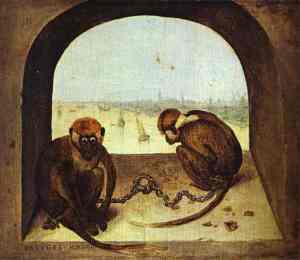
pieter-bruegel-the-elder-two-chained-monkeys-1I’ve discussed this poem before, but you may have missed it, in which case it will be, as NBC says, new to you. The Sunday Poem will be back next week with completely new material.

This is one of my favorite poems by the Polish Nobel laureate Wisława Szymborska (1923-2011). All I have to say about this poem is that a monkey rattling a chain is never a good thing, especially at a thesis committee update.

The Two Apes of Brueghel (1957), 

So appears my big graduation exam dream:
In a window sit two monkeys fixed by chains,
Beyond the window the sky flies
And the sea splashes.

The subject is the history of mankind.
I stammer and flail.

One monkey, gazing at me, ironically listens,
The second seems to doze -
But when after a question comes silence,
It prompts me
By softly clinking the chain.

Translation from the Polish by yours truly.
Image: Pieter Bruegel’s “Two Chained Monkeys” (1525)