Sunday Science Poem: Defying the Outer Black

Robert Frost’s “A Loose Mountain” (1942)
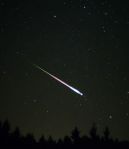
Leonid_MeteorA Balearic slinging competition, as I learned from slinging.org, involves slinging rocks at an iron disk fastened to the center of a board. In “A Loose Mountain,” Frost suggests that the Earth may be the target of a cosmic slinging game played with loose mountains instead of small stones, and that the major contestant, the Outer Black, is just waiting for the perfect shot.

Frost plays on the tension between our remarkable achievements as a species and our apparent insignificance in the universe. We can stand outside and ooh and aah over the incineration of high velocity rocks during the Leonid meteor shower, and then walk back inside, out of the night and into our well-lit homes, no longer at the mercy of the diurnal cycle. And yet there is no reason we can’t be snuffed out with one well-placed asteroid, just like the dinosaurs.

Continue reading “Sunday Science Poem: Defying the Outer Black”

Sunday Science Poem: People Are Organisms Too

Seamus Heaney’s “Death of a Naturalist” (1966)

In honor of Irish Nobel Laureate Seamus Heaney, who died Friday, we’re reading “Death of a Naturalist”, from Heaney’s first poetry collection.

Haeckel_frogs_with_labelsAs the old cliché goes, children are natural scientists, and of those who do grow up to be professional scientists, their childhood obsessions reveal what kind they’ll become. Physicists grow up tinkering with radio sets (or more recently, computers), while biologists roam the woods catching frogs and snakes, or in Darwin’s case, beetles. There are exceptions, of course (and in fact, I suspect that childhood obsessions poorly predict career outcomes), but Edward O. Wilson’s childhood pursuit of venemous snakes in the Alabama swamps fits the cliché:

A swamp filled with snakes may be a nightmare to most, but for me it was a ceaselessly rotating lattice of wonders. I had the same interest in the diversity of snakes that other 15-year-old boys seemed automatically to develop in the years and makes of automobiles. And knowing them well, I had no fear. On each visit I found something new. I captured live specimens, brought them home to cages I had constructed of wood and wire mesh, and fed them frogs and minnows I collected at the hatchery.

Even after a nearly lethal encounter with a Cottonmouth as big as he was, Wilson was not deterred, and he grew up to be a renowned naturalist. Not so the boy in Heaney’s poem, whose shocking first encounter with unsentimentalized biology ends his budding career as a naturalist. Instead, he becomes a great poet. Continue reading “Sunday Science Poem: People Are Organisms Too”

Sunday Science Poem: The Future Will Be Like Disney World

IBM Pavilion New York World's Fair 1964-65May Swenson’s ‘The People Wall’ (1967)

In 1965, if you wanted to see what the future was going to look like, you could go to the New York World’s Fair. Under the giant green Moon Dome of the Transportation & Travel Pavilion, you could see the future of space travel; at the DuPont exhibit, you could see futuristic fabrics featured in a musical comedy about chemistry; at the Hall of Science, kids could play radioactive waste disposal in Atomsville, USA; and at the General Motors Futurama II exhibit, you could watch vacationers lounging in underwater cities, and see how in the future trees will be felled with laser beams.

One of the more spectacular exhibits was IBM’s People Wall, a giant grandstand that lifted the visitors into a spectacular “gunite-spayed steel egg, about the size of a Navy blimp,” where they would be bombarded with futuristic images on 14 different screens in what was supposed to be a visual display of state-of-the-art computer data processing. (I have no idea what gunite is, but it sounds futuristic.) Continue reading “Sunday Science Poem: The Future Will Be Like Disney World”

We still don’t know why children resemble their parents

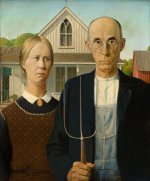
AmericanGothicBack in May, the St. Louis Post-Dispatch held a mother-daughter look alike contest. In their write-up of the results, they turned to a geneticist, Barak Cohen, for some expert commentary on why daughters look like their mothers:

We asked Dr. Barak Cohen, professor of genetics at Washington University Medical School, to explain this phenomenon.

“They are just the ones, who in a sense of the word, won the genetic lottery,” he said. In these cases, most of the mother’s genes are dominant.

(Barak tells me this quote was the outcome of a 30 minute conversation.)

The real truth is, we still don’t understand why children look like their parents, or rather, we don’t understand how DNA builds complex traits. Over at Pacific Standard this week, I discuss the case of the missing heritability and recent evidence that genetic variants with small effects might be a big deal. Go check it out. (And please don’t come back and talk to me about epigenetics.)*

A few more (largely personal) thoughts on genetic variation below the fold: Continue reading “We still don’t know why children resemble their parents”

The Finch and Pea is conceived

How did the sleek and polished Public House for Science known as the Finch and Pea come to be?

Well, I was digging around in my Gmail All Mail folder trawling the NSA mainframe (don’t ask) and ran across some early records. What follows is an abridged version of the genesis of the present establishment:

Chat with Josh Witten, 6/4/10

11:03 AM
me: In any case, if you’re up for it, I’m ready to start group blog – with a good name, and a decent spot (maybe wordpress?), and perhaps one other person we trust to write.

Josh: one or two more could be better, but not essential at the start
for both name and other writers i think we need to consider what we see as the blog concept

me: Just tossing out some ideas regarding the concept: explaining/applying good scientific thinking to current biology, to junk science, or to cool phenomena. Plus sophisticated references to culture… Continue reading “The Finch and Pea is conceived”