
End of the World 1843: The Disease of Civilization

Nathaniel Hawthorne’s “The New Adam and Eve” (1843)

Before we move on to the 20th century works of what Josh has aptly named the “post-apocalyptome,” let’s recap what happened in the 19th. Basically, early writers of post-apocalyptic fiction came up with just about all of the major themes, plots, characters, and settings of the genre that we know and love today (the zombie apocalypse excepted). Plagues, comets, environmental catastrophes, or a dying sun lead to ruined cities, collapsed civilizations, and roving bands of marauders; there is the next evolutionary step, a reversion to barbarism and superstition, and the lonely Last Man.

It all pretty much started in 1805 with de Grainville’s The Last Man, a Miltonian, futuristic religious fantasy authored by a French priest. At first this book seems to have little to do with science fiction — it’s an inversion of Genesis, featuring a Last Couple that has to choose whether to obey God and fulfill his plan or pursue their own desires. But despite the heavy Gothic atmosphere, The Last Man is one of very first futuristic romances of the century: there are airships, great engineering projects, and scientific discoveries of unlimited sources of power. It’s as much a vision of scientific progress as it is one of religion, and is the first solid entry in the Dying Earth sub-genre. Humans, through their technology, control nature until God decides to wrap it all up. Continue reading “End of the World 1843: The Disease of Civilization”
It’ll take more than tweaking NIH review to promote young scientists

The NY Times ran an op-ed by a Maryland Congressional representative arguing that younger biomedical investigators, who are at what should be the most creative time of their careers, are getting screwed in the current funding climate. He suggests that Congress should force the NIH to change this:

Congress should also mandate that the median age of first research awards to new investigators be under 40 within five years, and under 38 within 10 years. Failure to meet these benchmarks would result in penalties for the N.I.H., including possible funding cuts.

But people aren’t just getting funded later – it looks like they’re getting their first tenure-track jobs later as well. There are probably proportionally fewer younger investigators that the NIH could fund. The average age at which people get their first assistant professorships at U.S. medical schools appears to have climbed steadily, closely tracking the rise in age of investigators getting their first R01s. (There are some conflicting data; my guess is that it’s important to distinguish between first tenure-track job at any institution (NSF survey), and first tenure-track job at medical schools (AAMC data), where most people who apply for R01’s work.) This shouldn’t be surprising – competition for faculty jobs is growing, and as the economist Paula Stephan has argued, there is some evidence that those who go on to tenure track jobs do longer postdocs than those who don’t. This isn’t a problem that will be solved by forcing the NIH to fund more younger investigators.

Pinker explains why academics can’t write

Ahead of tomorrow’s release of Steven Pinker’s new book on writing, The Chronicle features a teaser essay – “Why Academics’ Writing Stinks”:

An insight from literary analysis and an insight from cognitive science go a long way toward explaining why people who devote their lives to the world of ideas are so inept at conveying them.

Bad academic writing shouldn’t be so surprising. During your training as an academic, you get almost no training in writing after your undergrad studies. Sure, you are required write, but you’re not formally trained to do it well. In fact grad students in the sciences generally don’t write very much anyway – a thesis proposal, and a couple of papers, so maybe 4-5 relatively short manuscripts during your entire 5-7 years of PhD training.

I won’t make any grand claims for my own writing, but I have to plug my favorite style guide: Joseph Williams’ Style beats Strunk & White, hands down.

UPDATE: Link fixed!!!

Apocalypse 1898: The Victorian Alien Invasion

H.G. Wells’ The War of the Worlds (1898)

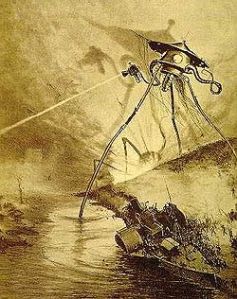
250px-War-of-the-worlds-tripodDuring the new wave of future fiction of the last decades of the 19th century, stories of catastrophic future wars were especially popular. The trend began in 1871 with George Chesney’s “The Battle of Dorking”, a story about a surprise invasion of England by something that sounds like the Prussian military. Writers continued to present increasingly elaborate visions of ever more destructive weaponry right up through the outbreak of World War I. And then there was H.G. Wells, who in 1898 took this popular and overworked late-Victorian genre and completely transformed it into modern science fiction with the classic story of alien invasion.

Swapping Martians with Germans isn’t the only feature that makes The War of the Worlds so different from what came before. Most writers were largely interested with the military and geopolitical aspects of future war, but Wells was interested in the civilians. In fact, War of the Worlds isn’t really about the Martians or their advanced technology; it’s about our cosmic insignificance, and how we react when the security of civilization is demolished. Continue reading “Apocalypse 1898: The Victorian Alien Invasion”

Doctors Without Borders: Don’t wait for Ebola magic bullets

Earlier this week I argued that hand-wringing over the lack of Ebola vaccines and drugs is misguided. We have effective tools to fight Ebola right now.

This week in the New England Journal of Medicine, physicians from WHO and Médecins sans Frontières make a similar argument much more eloquently:

There has recently been immense media, public, and medical attention to specific treatments for Ebola virus infection. Although these experimental interventions represent important potential treatments, they also reflect our seemingly innate focus on developing magic bullets. It seems that focusing on reducing mortality in the existing “control group” by applying the current standard of care is less interesting, even if much more likely to be effective. Though we recognize the potential incremental value of new antiviral options, we believe that EVD requires a greater focus on available basic care…

Public health interventions including characterizing the outbreak epidemiology, contact tracing, social mobilization, and public education are essential steps in stopping Ebola and will ultimately save many more lives than can be saved by individual patient care…

Excellent clinical care and improved outcomes will result in improved community compliance, will help to break transmission chains, and will lead to a greater willingness of health care workers to engage in care delivery. To quote William Osler, “The best preparation for tomorrow is to do today’s work superbly well.”