
No, evolutionary biology doesn’t need a rethink

Suggestions that we need a new evolutionary synthesis because of phenomenon X pop up like weeds in biology. It’s nice to see some of my favorite evolutionary geneticists – Greg Wray, Hopi Hoekstra, Douglas Futuyma, Richard Lenski, Trudy Mackay, Dolph Schluter and Joan Strassman – make a strong case that the fundamentals of evolutionary theory can accommodate the hot new phenomenon of the day (e.g, epigenetics), and that genes are not passé:

The evolutionary phenomena championed by Laland and colleagues are already well integrated into evolutionary biology, where they have long provided useful insights. Indeed, all of these concepts date back to Darwin himself, as exemplified by his analysis of the feedback that occurred as earthworms became adapted to their life in soil…

Finally, diluting what Laland and colleagues deride as a ‘gene-centric’ view would de-emphasize the most powerfully predictive, broadly applicable and empirically validated component of evolutionary theory. Changes in the hereditary material are an essential part of adaptation and speciation. The precise genetic basis for countless adaptations has been documented in detail, ranging from antibiotic resistance in bacteria to camouflage coloration in deer mice, to lactose tolerance in humans…

All four phenomena that Laland and colleagues promote are ‘add-ons’ to the basic processes that produce evolutionary change: natural selection, drift, mutation, recombination and gene flow. None of these additions is essential for evolution, but they can alter the process under certain circumstances. For this reason they are eminently worthy of study.

h/t Ed Yong
This year’s chemistry nobel in context

One of my favorite science historians, Daniel Kevles, has a brief, insightful New Yorker piece that puts this year’s chemistry Nobel Prize in context:

Trying to see the fine structure of a cell with a light microscope is akin to attempting to discern the individual trees in a forest from a jetliner at thirty thousand feet.

Kevles explains how Betzig and Hell were obsessed with breaking the “Abbe limit,” the physical principle that the resolution of light microscopes is limited to the wavelength of light. Each of them figured out how to “argue with the laws of physics,” using some brilliant tricks with fluorescence. To someone outside of biology it may sound strange, but the development of fluorescent imaging and tagging technologies is turning out to be one of the most important developments in the history of biology, at least as revolutionary as the initial development of the microscope.

Sunday Science Poem: George Herbert and our psychic connection with nature

George Herbert’s “The Storm” (1633)

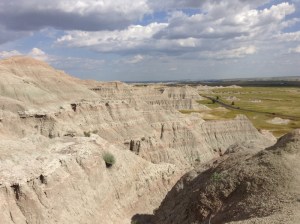
Badlands2Why does nature move us? Driving through the South Dakota Badlands this summer was a moving experience. The bare, jagged landscape evoked feelings of calm, happiness, and awe — how can a bunch of rocks have such emotional resonance?

Neurobiologists have struggled to understand the biological basis of a sense of beauty. As Bevil Conway and Alexander Rehding wrote:

Insofar as beauty is a product of the brain, correlations between brain activity and experiences of beauty must exist. At what spatial scale, and within what brain regions, do we find these correlations? What functions do the brain regions implicated serve in other behaviors? What signals during development and experience are responsible for wiring up these circuits? And perhaps most critically, how does the activity of these circuits integrate across modalities and time to bring about the dynamic, elusive quality of beauty?

We don’t know what it is about natural beauty that specifically activates those circuits, or even what those circuits are. But an psychological link between nature and our brains seems to be a universal trait.

In “The Storm,” the great English metaphysical poet George Herbert links the awe-inspiring action of a thunderstorm with the movement of his conscience.

The Storm

If as the winds and waters here below
                                    Do fly and flow,
My sighs and tears as busy were above;
                                    Sure they would move
And much affect thee, as tempestuous times
Amaze poor mortals, and object their crimes.

Stars have their storms, ev'n in a high degree,
                                    As well as we.
A throbbing conscience spurred by remorse
                                    Hath a strange force:
It quits the earth, and mounting more and more
Dares to assault thee, and besiege thy door.

There it stands knocking, to thy music's wrong,
                                    And drowns the song.
Glory and honour are set by, till it
                                    An answer get.
Poets have wronged poor storms: such days are best;
They purge the air without, within the breast.

Image credit: Badlands National Park, Michael White, 2014.

The Music of Climate Change

Here’s something to listen to over the weekend: On NPR, composer John Luther Adams explains the science and art behind his Pulitzer-winning orchestral work, Become Ocean, which I’ve listened to at least ten times in the past week.

I believe deeply in the inherent power and mystery, the imperative, for music in our lives. And it’s my hope that you can listen to this music without knowing anything about what the composer had in mind…

At the same time — and this is me talking out of the other side of my mouth — most of us these days, think a lot about the future of the present state of the Earth, the future of the human species and specifically about climate change. As I composed Become Ocean, I had in my mind and my heart this image of the melting of polar ice and the rising of the seas. All life on this Earth emerged from the ocean. If we don’t wake up and pay attention here pretty soon, we human animals may find ourselves once again becoming ocean sooner than we imagine…

And maybe that’s the Alaskan in me: 40 years living in the presence of raging wildfires and river ice breaking free in the springtime. I’ve been in touch for most of my life — pretty directly in touch — with these elemental forces that are so much bigger and more powerful, not only than I am, but than I can even imagine. And that can be both terrifying and profoundly reassuring.

Watch the performance by the Seattle Symphony:

Perpetuating the PhD pyramid scheme

This kind of thinking drives me up a wall – scientists who are unwilling to approach the PhD labor market from a scientific perspective:

Living Science: Looking out for Future Scientists, Eve Marder, eLife:

I wonder at those who think they can predict which of our graduate applicants is likely to become a great scientist, and am dismayed by the hubris of those who think we should restrict access to PhD programs to a select few…

Ever since I can remember (and that is a long time), there have been wise heads who have counseled that we should drastically decrease the size of our PhD classes because there are not enough academic faculty positions to accommodate all of the able and interested candidates…

While these authors show a deep understanding of how increased competition for positions and funding have deleterious effects on the biomedical research and teaching enterprise, every time I think about substantially restricting access to graduate programs I wince…

There are some who argue that students who finish their PhDs (or spend years as postdocs) and then move into other careers have wasted their time. I disagree…

Society would be enriched if more of the people making decisions in industry, law, medicine, education and politics had lived through the rigors of a PhD program, and knew first-hand how difficult it is to extract knowledge from our imperfect measurement and analytical tools…

Continue reading “Perpetuating the PhD pyramid scheme”