The Art of Science: The Lure of Lead

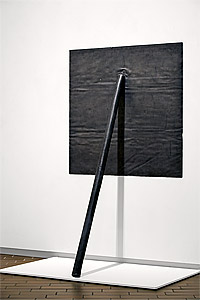
Lead is heavy. Not just in terms of physical density, but also of cultural weight.  Malleable, ductile and resistant to corrosion, lead has been used for over 8,000 years for many purposes. The Romans, who gave the element its name (Pb, for plumbum) built their famous water and sewer system of lead pipes, and used it to make statues, sarcophagi, cooking pots, and wine vessels.   In the middle ages, lead was used in roofing and plumbing, as well as for statues and ornaments, including the strips joining the pieces of colored glass in church windows. Up until the 20th century, lead was still widely used in paint and solder and as an additive in fuel. Continue reading “The Art of Science: The Lure of Lead”

The Art of Science – Crowdsourcing Sheep

Aaron Koblin is an American tech-design prodigy who gave a TED talk in his 20s and now has an amazing job with Google. So why was he paying people 2 cents a pop to draw pictures of sheep on computers? I’ll let him explain in his own words.

“The Sheep Market is a collection of 10,000 hand-drawn sheep from online workers collected through the Mechanical Turk. The Mechanical Turk is a web service created by Amazon to provide “artificial artificial intelligence,” now known more commonly as “crowdsourcing.” I was immediately intrigued by the concept of using thousands of idle brains, and have long been impressed by projects like SETI@home, which use idle CPU time on people’s computers to tackle problems too big for a single machine or cluster. This however, was different; these aren’t idle boxes, these are people. I wanted to visualize this and think about this kind of system, which will inevitably become more common.”  (source)

Koblin created a tool for recording drawings and posted the tool online paying $.02 (USD) for each worker’s sheep.  He was able to view, approve, and reject each sheep (662 drawings didn’t meet “sheep-like” criteria). Finally, he gathered all 10,000 sheep into a matrix on a website, which he describes as “a market place for inspecting and collecting the individual sheep.”

The resulting artwork has been exhibited in Spain, Japan, the US, the Netherlands and Australia. You can examine it at the macro and micro level (even see how each sheep was drawn) at the Sheep Market website and see many more projects at Koblin’s own site.

The Art of Science – Water Flea Circus

Let’s say you’re an artist who wants to explore the effects of global warming on the Arctic environment. The first idea that would spring to mind is to recreate a centuries-old circus sideshow act, right? OK, it might not have been the first idea, but Ars Bioarctica, a group of artists and scientists in Finland, ran with it, using water fleas, or daphnia, to create the Water Flea Circus, a multi-media spectacle starring translucent planktonic crustaceans.

The first Water Flea Circus, in 2009, was a fairly simple show, mainly projected images of live water fleas doing tricks (actually, just being themselves, flipping around and waving their legs) to musical accompaniment.  Water Flea Circus 2010 was much more elaborate, with 10 live performances featuring live projections as well as performers dressed as water fleas and researchers.  Yeah, just watch the video.

Ars Bioarctica, a long term art/science initiative with a focus on the Arctic environment, was started in 2008 in Finland by the Finnish Bioart Society and the Kilpisjärvi Biological Station of the University of Helsinki.  Its aim is to support joint projects between artists and scientists to develop new kinds of scientific and artistic thinking, specifically on the relationship of man and nature. If you think this sounds like the best thing ever, they have a residency program that will allow you to go to sub-Arctic Lapland to hang out with scientists and make art.

The Art of Science – Particle Accelerator Art

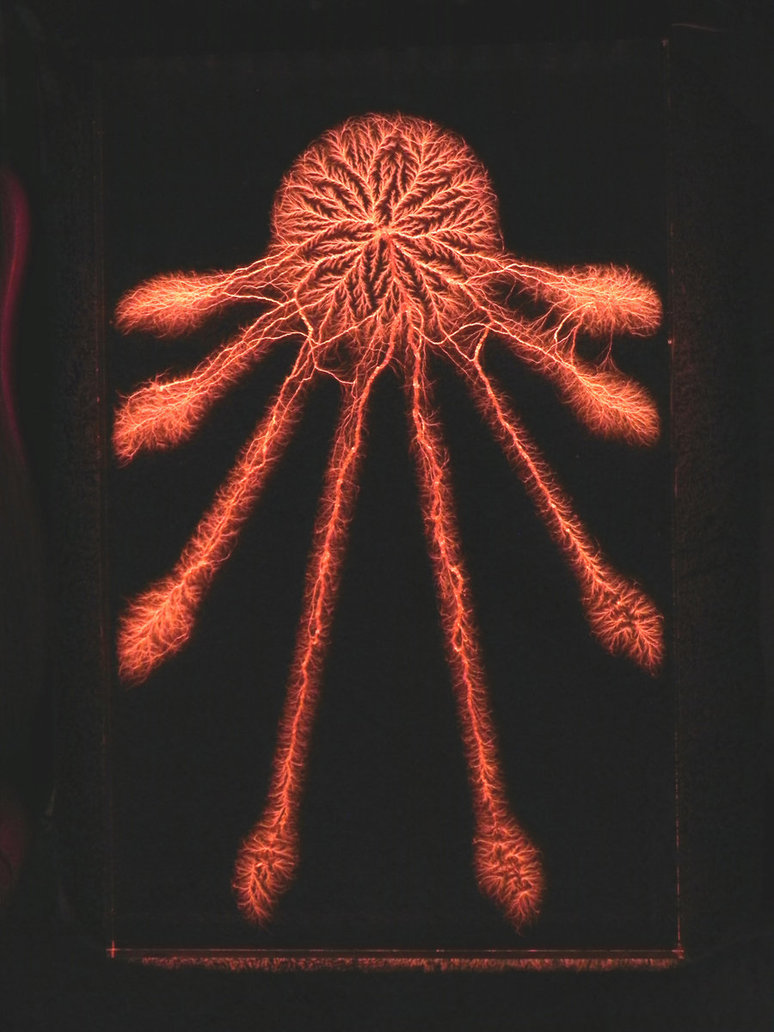
Aten by Todd Johnson

There’s more to do with a particle accelerator than find the Higgs Boson. Artist Todd Johnson uses electron beams to create amazing fractal artworks on acrylic slabs . He calls them “shockfossils”.   Johnson described the process briefly on DeviantArt:

“These pieces are created with the help of a particle accelerator. This machine produces up to five million volts and is used to accelerate a beam of electrons. The electrons are fired at pieces of acrylic plastic and penetrate deep within the slabs, resulting in a pool of electrons trapped under tremendous electrical potential within each piece.

The trapped charge is then carefully released by applying mechanical shock with a sharp insulated tool, and the electrons escape with a bright flash and loud pop. As the charges leave the plastic, they gather into channels following fractal branching rules just like river deltas, plants, and capillaries.

Controlling the energy and placement of the electron beam determines the final shape and character of the resulting figure.”

More information on the process and lots more art here.  It’s worth looking at the larger images for the amazing detail. (H/T to Cory Doctorow at BoingBoing)

The Art of Science – Berenice Abbott at MIT

Berenice Abbott, A Bouncing Ball in Diminishing Arcs

One of the leading photographers of the 20th century, Berenice Abbott is best-known for her scenes of Paris and New York in the 30s and 40s. But in the late 1950s, Abbott began spending time in the labs at Massachusetts Institute of Technology (MIT), which hired her to create new photographic images for the teaching of physics.

Abbott spent two years at MIT creating photographs to document and illustrate the principles of physical science – mechanics, electromagnetism, and waves. She developed innovative techniques for capturing scientific phenomena, including one for very detailed, close-in photography that she called Super Sight.

So it is fitting that the MIT Museum chose to inaugurate its new Kurtz Gallery for Photography with an exhibit of over seventy images by Abbott taken during her time at MIT.  The Show, “Berenice Abbott, Photography and Science: An Essential Unity” is at the MIT Museum in Cambridge, MA, through Dec. 31.

Abbott said of her work in illustrating physics, “The science made its own design.  But just patterns and just beautiful design wasn’t it at all. The principle had to come through first and foremost, and that’s a hard thing to do, really.”

More information about the exhibit is here. More images are here.