
One of the most fun and rewarding ways that artists can play with science is by exploring transitions between states of matter in their materials. Solid rocks can be turned into liquid paints, spread on paper or canvas and dried to a solid again. That paint can be formed into droplets and sprayed at walls. Wax is melted down for encaustic and formed again stronger than before. And humble silica pellets can be liquified and then poured into molds or blown through tubes to make marvelous, airy forms in glass. Continue reading “The Art of Science: Altered States”
Author: michelebanks1
Artist and blogger
Science Caturday: Geokittehs
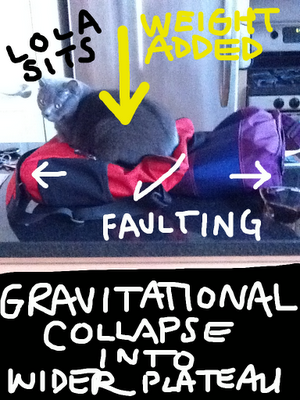
We’ve had biology, physics and genetics lolcats here at the Finch & Pea, but we must admit that our personal feline friends don’t know much about geology. Luckily, there’s a whole blog to help people learn about rocks with the help of kitties. It’s called Geokittehs, and it’s run by geologists and bloggers Evelyn Mervine and Dana Hunter. With the assistance of some very clever cats, they explain geological phenomena such as weathering, subduction, lava flows and stream capture. Here, guest cat Lola illustrates normal faulting.
Want more geology cats? Follow on twitter @geokittehs.
Photo by Callan Bentley via Geokittehs
The Art of Science: Protect-a-Bear Workshop
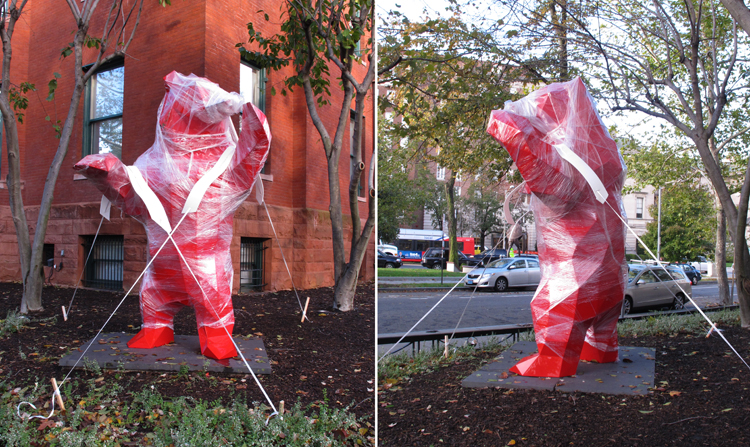
Outdoor public art is built and installed to withstand a tremendous beating from the elements, which is why you rarely see a statue topple even in the worst storms. But this shiny red resin bear is only a temporary visitor to Washington, DC, so its hosts at the Phillips Collection were understandably concerned for its safety in the face of an expected hurricane earlier this week.
So they did some old-fashioned storm-proofing, covering The Bear (by Xavier Veilhan, whose steel shark was featured here a few weeks ago) with sheets of plastic and tying it with ropes attached to stakes in the ground.
Fortunately, although the storm produced heavy rain and strong winds, The Bear came through it unscathed and is currently standing guard at the intersection of 16th and Q Streets, NW. Veilhan’s show at the Phillips opens on November 3 and runs through February 10, 2013.
Photos by Sarah Osborne Bender via the Phillips Collection Blog
Science Caturday: Weak Interaction
They even pass through the dog and then through you. That’s just unacceptable.
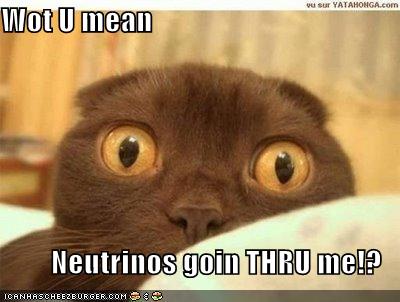
via Cheezburger.com
The Art of Science: Two Ways of Looking at an Earthquake

Earthquakes are dramatic and frightening events. They literally shake our foundations, and large quakes can cause massive damage and disruption, revealing faults in societies, not just in the earth, as seen recently in China, Haiti and Japan. So it’s not surprising that artists are drawn to earthquakes as both an inspiration and a metaphor.
Luke Jerram, an English artist who mainly works in glass and often explores scientific themes in his work, made this Tohoku Earthquake Sculpture to commemorate the devastating 2011 earthquake and tsunami in Japan. Continue reading “The Art of Science: Two Ways of Looking at an Earthquake”
 The Finch and Pea