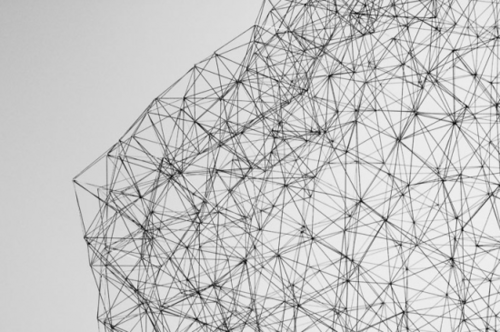
As an artist looking at other people’s work, I am always intrigued by artists doing things that I couldn’t possibly do myself. Things, for example, requiring extraordinary patience, dexterity and complicated geometry. Things like the work of New Zealand artist Peter Trevelyan, who makes “built drawings” – fragile, airy sculptures made of fine graphite rods (the lead from mechanical pencils) held together with glue.
Trevelyan’s work is informed by a broad range of influences. His interest in mathematics, drawing and architecture are evident in his sculptures. Less obvious, perhaps, is his fascination with theories of social systems. Some of his sculptures look at social systems as a collection of individual decisions – each individual pencil lead – which combine to form a structure that can be symmetrical and beautiful or oddly misshapen and rather menacing.
You can find more images and information on the website of Trevelyan’s gallery, Bartley + Company.
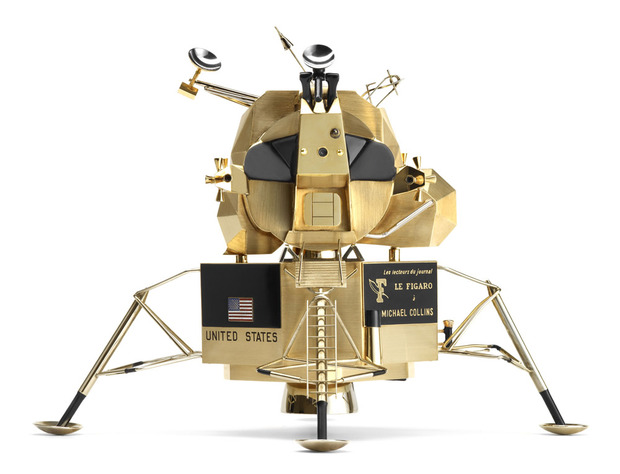
Surely a strong contender for best trip souvenir ever, this solid gold Lunar Excursion Module is one of three made by Cartier and presented to Apollo 11 astronauts Michael Collins, Neil Armstrong and Buzz Aldrin. This stunning piece is now on display at the Forbes Galleries in New York through September 7 as part of an exhibit entitled “Out of This World: Jewelry in the Space Age”.
According to exhibit curator Elyse Zorn Carlin, “Space has always been in our consciousness and often expressed in jewelry. The ancients wore amulets depicting the moon; in Georgian and Victorian jewelry we see numerous depictions of the moon, stars, and Halley’s Comet. The mid-20th century saw an explosion of “space age jewelry” and corresponding couture, and today the “futuristic” look in fashion is “in” thanks to Lady Gaga and other entertainers.” (source)
The exhibit contains many stunning pieces inspired both by the mysteries of the cosmos and by the modern technology that allows us to see space and travel there. A gallery of images is here.
The passenger pigeon, a thriving species in the United States at the beginning of the 19th century, was extinct by the end of it. As Carl Zimmer wrote in National Geographic:
“In 1813, while traveling along the Ohio River from Hardensburgh to Louisville, John James Audubon witnessed one of the most miraculous natural phenomena of his time: a flock of passenger pigeons (Ectopistes migratorius) blanketing the sky. “The air was literally filled with Pigeons,” he later wrote. “The light of noon-day was obscured as by an eclipse, the dung fell in spots, not unlike melting flakes of snow; and the continued buzz of wings had a tendency to lull my senses to repose.”
When Audubon reached Louisville before sunset, the pigeons were still passing overhead—and continued to do so for the next three days. “The people were all in arms,” wrote Audubon. “The banks of the Ohio were crowded with men and boys, incessantly shooting at the pilgrims… Multitudes were thus destroyed.” (source)
Done in by a combination of over-hunting and habitat loss, the passenger pigeon is now the subject of study by a group of scientists, led by Stewart Brand, George Church and Ben Novak, who hope to revive the species through genetic engineering and cloning. (This article gives a brief explanation of the science involved)
The idea of reviving any extinct species is fraught with practical and ethical issues. (Here’s an interesting post about a few of them) So where, you ask, does art come into this issue? Well, when it comes to this particular species, what image of the passenger pigeon you look at might just color your opinion of whether we really want this particular bird back.
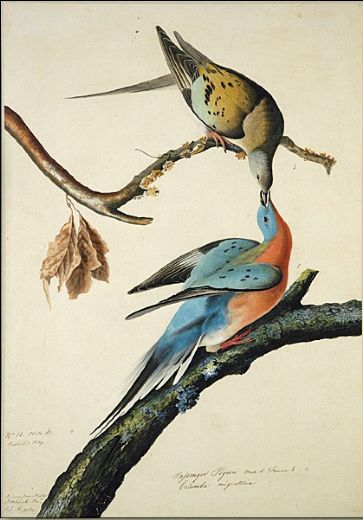
John James Audubon, from Birds of America, 1838
If you look at Audubon’s painting of a pair of billing passenger pigeons, one sleek, beautiful bird leaning down and appearing to kiss its mate on the bough below, you might just think, “Yes! Those are nice. We should bring back those birds.” Now look at Walton Ford’s 2002 painting, Falling Bough, (top) and read his description of it:
“The passenger pigeons were the most numerous birds that ever lived in the history of the planet. It’s almost disturbing how numerous- billions upon billions of birds. It was a fecundity that was almost disgusting. I started thinking about a blame-the-victim kind of attitude you could take to that…to make it seem like they had it coming, that there was this disgusting empire of birds and that it was corrupt like Rome…that it was bound to fall. So I invest the passenger pigeons with every kind of sin that I can imagine. And the bough, this gigantic branch, is falling under their tremendous weight. Meanwhile they go about their bickering and their lusts and foibles and all the disgusting things that they are doing.” (source)
Obviously, the artists had different goals: Audubon aimed to provide an accurate visual record of the passenger pigeon’s physical characteristics, while Ford set out to conjure a dramatic, violent fantasy. The reality of giant flocks of passenger pigeons undoubtedly fell somewhere in between these extremes. They were likely to have been somewhat more frightening, noisy and dirty than Audubon’s, but less menacing and dangerous than Ford’s. I recognize this, but I saw Walton Ford’s painting first. The image stuck. So I say no, no, no, don’t bring back these birds. At least not to any trees near me.
This week, tech writer Virginia Heffernan caused a stir by publishing an essay entitled “Why I am a Creationist“. Here at the Finch & Pea, we believe that everyone is entitled to their opinion, but when it comes to explaining stuff, we put our trust in Science Cat (and his friend Chemistry Cat), and leave Ceiling Cat to looking pretty and keeping mice out of the attic.




 The Finch and Pea