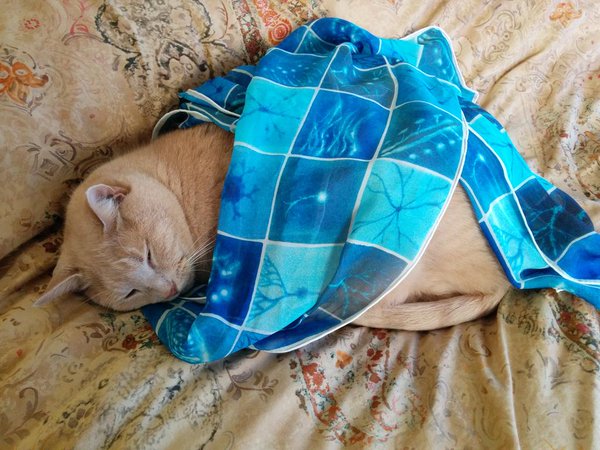
Teh science kittehs have a week off while I sell art at DC’s Downtown Holiday Market. Only Teapot the kitteh is still working, modeling one of my science scarves. If your cat (or hoomin) would like one too, you can find them here.

Teh science kittehs have a week off while I sell art at DC’s Downtown Holiday Market. Only Teapot the kitteh is still working, modeling one of my science scarves. If your cat (or hoomin) would like one too, you can find them here.
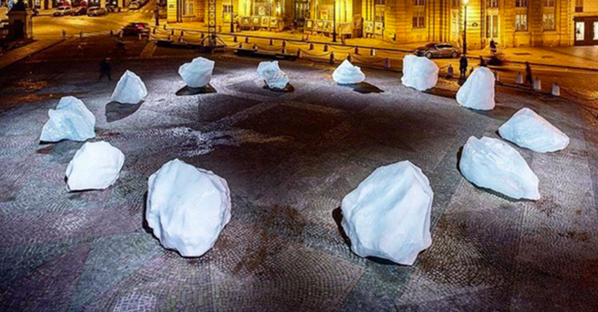
If you‘re hosting a big gathering, you can always count on Olafur Eliasson to bring the ice. Two years after he brought chunks of an Icelandic glacier to MoMA PS1 in New York, Danish-Icelandic artist Eliasson has trucked 80 tons of Greenland glacier to Paris, where the UN Climate Summit (COP21) is being held.
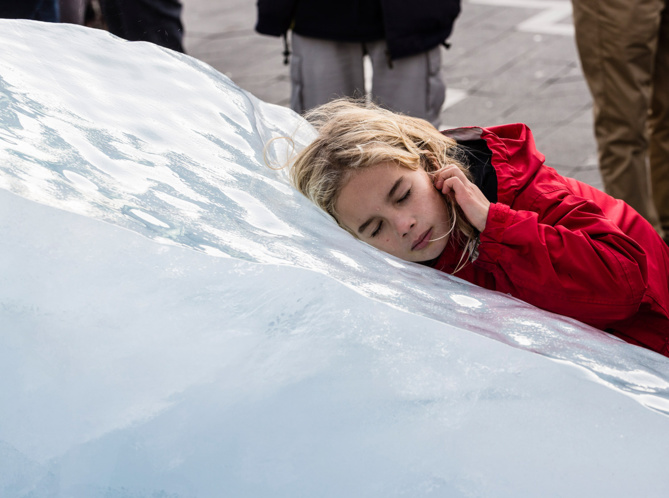
The installation, now melting slowly in front of the Panthéon , is called Ice Watch. The twelve boulders of ice are arranged like a watch, or clock face, to indicate the passing of time. Visitors can see the ice dwindle over the course of the summit, observing for themselves the disappearance of ice which has endured for centuries. You can see photos and video of the gradual melt on Studio Olafur Eliasson’s Instagram account. (So far they seem to be holding up pretty well.)
Eliasson, who created the work in collaboration with geologist Minik Rosing, specifically chose calved chunks of icebergs made of compressed snow for the installation, to highlight the importance of ice in preserving history. As Rosing explained to the New Yorker, “Inside the iceberg, you see snow layers in sequence as you go back in time. Because it is compressed, the air between the snowflakes that fell thousands of years ago is trapped in tiny bubbles.”
Besides watching the melting, visitors to Ice Watch can hear the ice cracking as it releases air that is thousands of years old. Says Eliasson, “It is a little pop that has travelled fifteen thousand years to meet you in Paris, and tell the story of climate change.”

Scientists, journalists and policy-makers gathered in Washington, DC this week for the International Summit on Human Gene Editing at the National Academies of Science. The meeting, which NAS co-hosted with the Chinese Academy of Sciences and the U.K.’s Royal Society, was billed as a global discussion of “the scientific, ethical, and governance issues associated with human gene-editing research.” In particular, the summit focused on the implications of the emergence of CRISPR, a new gene-editing technique which is cheaper, more versatile and more precise than any currently in use.
This topic is a little complex for cats, so we’ll let the experts help out. Ed Yong, in The Atlantic, outlines the basics of the technique and what scientists are working on to make it even better, while Tina Saey writes in Science News about the significant safety and ethical issues and the guidelines in place for further development.
While scientists work on the fancy new stuff, cats will continue to use their traditional techniques for editing your jeans – shedding, clawing and nomming.
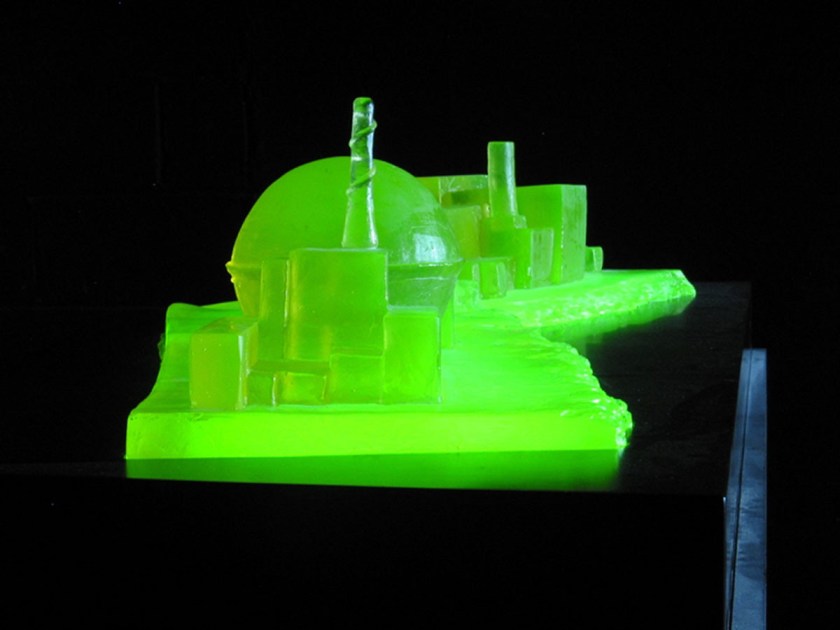
Kate Williams, a London-based sculptor, describes her medium as “glass and light”. She explores the scientific, cultural and artistic elements of both in her Glass Nuclear Power Station Project, a series of sculptures of nuclear power stations made from cast uranium glass in collaboration with John Lloyd.
Williams created small cast-glass replicas of four nuclear power plants. Three are real plants in Europe (Sizewell, Dounreay and Doel) while the fourth is Springfield, the fictional workplace of Homer Simpson. Says Williams, “We wanted to celebrate these post war monuments to cheap unlimited power. They act as eulogies to collective human desire and its consequent disenchantment. In their de-commissioning they are being eradicated from the landscape but their legacy lives on in our imaginations and memories” and of course also in the form of nuclear waste.
The sculptures are cast in uranium glass, which is pretty much what it sounds like – a type of glass to which uranium has been added for color and fluorescence. Williams describes the glowing yellow-green of the sculptures when lit as “both unsettling and attractive, which somehow represents our complicated relationship with radiation.”
The Glass Nuclear Power Station Project is on view at Compton-Verney in Warwickshire, England through December 13 as part of the exhibition Periodic Tales. You can read more about Kate Williams at her website.

This week, the US Food and Drug Administration approved its first genetically modified animal, the AquAdvantage salmon, as safe to eat. The FDA found that the GM salmon are “as safe to eat as any non-genetically engineered Atlantic salmon, and also as nutritious.” It will not require that stores label the salmon as genetically modified, although they may still do so.
The AquAdvantage salmon, created in 1989, is similar to the Atlantic salmon, but is modified so that it carries a growth hormone found in the Chinook salmon and a segment of DNA taken from the pout fish, which boost its growth. As a result, the AquAdvantage salmon grows much faster than normal Atlantic salmon, reaching a market-ready size in about half the time. Bigger fish faster? Our science cats give this genetic tweak two paws up.
 The Finch and Pea