The Art of Science: Robert Cannon’s People of Earth

Sculpture by Robert Cannon

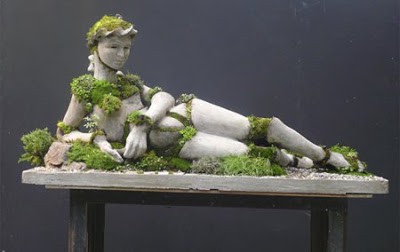
Robert Cannon refers to his sculpture technique as terraforming, a word used by scientists to describe the process of creating habitable, “earth-like” environments in places like the moon or other planets.  Cannon’s terraforms are much more, shall we say, down-to-earth. He builds them, often in the shapes of people, out of hollow shells of ferro-cement, adding pockets of earth and plants in the places where the pieces connect.  They look a bit like androids whose spaceship landed in the Garden of Eden.

Cannon says that his sculptures grow and change with the seasons, and reflect the natural and social qualities of their environments.  “They would over-grow themselves if left to return to nature, or wither and die if locked away in some storage room, or remain balanced if cared for in a healthy environment.”

You can see (and buy) more of his work here.


The Art of Science: Both Sides of the Cloud

Yuriko Yamaguchi, Cloud, 2014 (detail)

Yuriko Yamaguchi’s ethereal sculptures are mostly made of wire and resin, but she has also included LED lights, wood, minerals, and bits of electronics. Reminiscent of organic shapes such as clouds, swarms, and neural networks, they symbolize the interconnectedness of all human and organic systems.

Yamaguchi says that her work was influenced by the work of physicist and systems theorist Fritjof Capra, whose book “The Web of Life” explored the tension between the part and the whole in many different systems.

The artist described one of her recent sculptures rather poetically:  “Creative energy is in a way like rain that comes down from the sky when the accumulated humidity can no longer remain suspended in the air and drops to the earth.”

The cloudlike form refers not only to atmospheric phenomena but to the modern, technological meaning of “the cloud”, emphasizing Yamaguchi’s belief that science, nature and technology are intimately intertwined.

Several pieces of her recent work are on display in “Interconnected: Science, Nature, and Technologies” at the Adamson Gallery in Washington, DC through August 31.

You can see more of her work on her website.


Science Caturday: Advances in Catellite Technology

Sorry, Aereo, the Supreme Court said no to your model of picking up broadcast signals with tiny antennas and streaming them over the net. May we suggest a new technology?

catellite


The Art of Science: Most Agreeable Developments

janeIf Jane Austen blogged about science art, she would note that it is a truth universally acknowledged, that artists and scientists are rarely found in the same place. You don’t often find an artist in a lab, and you seldom see a scientist in a gallery. (Yes, yes, I know, there are exceptions! It’s not polite to interrupt Jane Austen.)

There are many reasons for this, involving various permutations of, well, let’s not say pride or prejudice exactly, but perhaps a difference of sensibilities.  Now comes an opportunity to get around at least a few of these, by having artists meet scientists where they are.

Two major annual meetings of scientific organizations, The American Public Health Association and the Society for Neuroscience, have created opportunities for science artists to display and sell their work to their thousands of attendees. Rather remarkably, both take place on exactly the same dates – November 15-19, 2014.

The annual meeting of the American Public Health Association (APHA), held this year in New Orleans, attracts 12,000 attendees in a wide variety of fields related to public health. As part of a new initiative called Art @ The Expo, they are looking for 20 artists or crafters whose work is health, medicine or science related to show and vend at the meeting. The $200 booth fee for 3 days is a fraction of what APHA charges its large commercial exhibitors.  More information and guidelines for applicants are here.

Do you delight in dendrites? The Art of Neuroscience, part of the annual meeting of the Society for Neuroscience (SfN), seeks artists whose work is directly related to neuroscience. For a $300 fee, artists can show their work at the gigantic gathering of some 30,000 neuroscientists in Washington, DC. Interested artists can find more information and a prospectus here  – the deadline for applications is August 29.

It’s really encouraging to see large scientific organizations take steps to include independent artists and crafters in their events. AAAS, ACS, ASM, please take note. If, to quote Jane Austen, “one half of the world cannot understand the pleasures of the other,” at least some people are making an effort to provide a peek over the fence. Perhaps others may be persuaded?

Science Caturday: Kevlar Kitteh says Thank You

kevlar

The science community is mourning the loss  of Stephanie Kwolek, a DuPont chemist who invented the synthetic fibers used in Kevlar body armor, who died this week at the age of 90.

Like many scientific breakthroughs, the invention of Kevlar at first seemed like a dud. As part of a DuPont team working to create a stronger synthetic fiber in 1965, Kwolek came up with a liquid crystal solution that could be cold-spun.

According to the American Chemical Society: “Most researchers would have rejected the solution because it was fluid and cloudy rather than viscous and clear. But Kwolek took a chance and spun the solution into fibers more strong and stiff than had ever been created.” By weight, Kevlar is 5 times stronger than steel.

Kwolek herself said “I never in a thousand years expected that little liquid crystal to develop into what it did.”

What it developed into, of course,  was Kevlar, a material that when made into light, strong body armor, has saved thousands of lives and has since been used in hundreds of different products.

So thank you, Stephanie Kwolek.

Please note that the cat in the photo above is not wearing a kevlar vest (looks like a knee pad), but many armed forces and law enforcement dogs do, and some of them undoubtedly also owe their lives to Stephanie Kwolek’s invention.