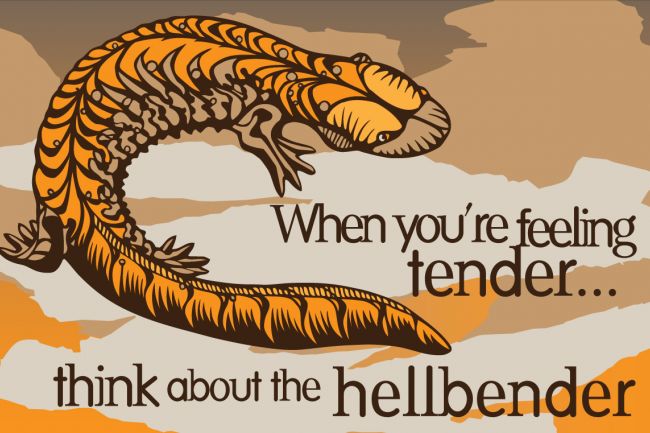
Ooooooooh baby (art by Roger Peet)
Humans are a successful species. But the growth of the human population has placed tremendous strain on many other species, causing thousands of extinctions through hunting and habitat loss.
The Center for Biological Diversity came up with a novel idea to bring more attention to this problem. Since 2009, the CBD has been distributing hundreds of thousands of free condoms across the United States. Wrapped in colorful, wildlife-themed packages with artwork by Roger Peet, Endangered Species Condoms explicitly push the message that creating fewer new humans leads to fewer species extinctions.
The 2014 series features the Florida panther, dwarf seahorse, hellbender salamander, Western snowy plover, leatherback sea turtle and polar bear.
The condom packages are distributed by a network of volunteers at concerts, bars, Earth Day celebrations and other events. Each package contains — along with two condoms — original artwork and information on the species featured, and facts about human population growth. For more information, see the Endangered Species Condoms page.
The first thing you need to know about Energy Duck is that Energy Duck does not exist. It’s just a design, an entry in the Land Art Generator Initiative (LAGI), a competition to design and construct public art installations that also serve as sources of large-scale clean energy generation. So for now, file it with the other wonderful, terrible things that live on the internet, like the trampoline bridge on the Seine and the city buses with roof gardens.
If it gets built, though, Energy Duck will have the ability not only to provide solar and hydro power to Copenhagen’s public grid, but to fuel the nightmares of Danish children for decades to come.
Common Eider by Jessica Dixon for Phylo: The Trading Card Game (CC BY-NC-ND 2.0)
A London-based team of artists, Hareth Pochee, Adam Khan, Louis Leger, and Patrick Fryer, modeled the sculpture on the common eider duck, which is found in the waters of Copenhagen. The Energy Duck, which is planned to be 12 stories tall (!) and constructed around a lightweight steel frame, with very lightweight steel supporting a skin of photovoltaic panels, would float in the city’s harbor. At night the duck would be lit by LED lamps that change color, with the color pattern undulating according to the output of the hydro turbines. Visitors would be able to move around the inside of the duck.
All this is well and good, I suppose. Sustainable energy produced by a plant floating offshore is a great concept. But as a person who lives in a 7-story building near a river, the idea of a huge, black, armored duckie larger than my apartment building floating nearby is somewhat less than appealing. It’s terrifying, in fact. The fact that it would turn into a glowing, pulsing, rainbow hippie duck by night helps matters not at all.
I do kind of hope that Energy Duck gets built. At the very least, it would provide endless entertaining photo ops of the “then Lancelot, Bedivere and I jump out of the duck” variety. Please, Just not in my backyard.
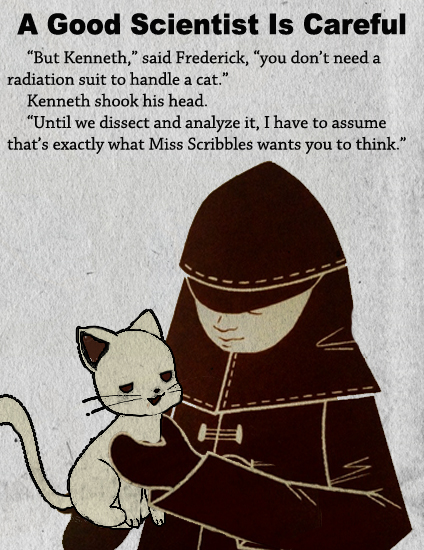
This week’s big science story was a major “oops” moment, as a scientist cleaning out a storage room last week at a lab on the National Institutes of Health’s Bethesda campus discovered a box containing vials of smallpox virus, a deadly pathogen. In light of this troubling incident, this week’s science cat, from the wonderful Fake Science, reminds us that smart scientists always use extreme caution when handling potentially dangerous things.





 The Finch and Pea