
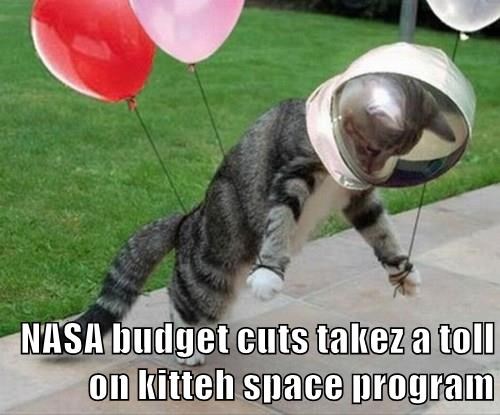
Science Caturday: Funding Lags for Cosmocats

nasabudget

NASA astronaut Scott Kelly and Russian cosmonaut Mikhail Kornienko lifted off Friday from Baikonur Cosmodrome in Kazakhstan to spend almost a year on the International Space Station.  Kelly’s long sojourn in space will beat the U.S. record for longest-duration spaceflight by more than 100 days. Kelly and Kornienko will be closely monitored for studies aimed at determining the effect of long-term spaceflight on the human body. Former astronaut Mark Kelly, Scott Kelly’s identical twin, will be monitored on Earth as a control subject for the unusual yearlong experiment.

Still no word on when a cat will get a chance to go to space, and from the looks of Commander Kibble (above), the technology and funding are still lagging for this important scientific endeavor.
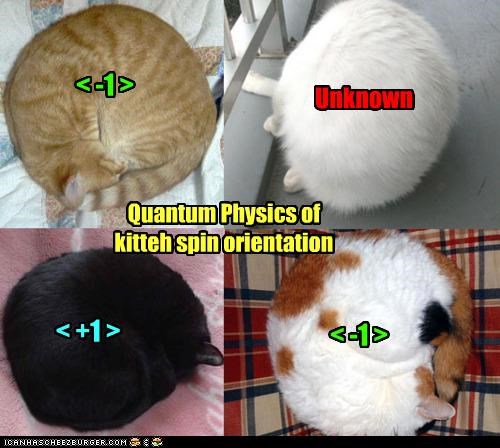
Science Caturday: Quantum Kitteh Spin

I’m just going to have to trust that the quantum physics here is correct.

quantumkitteh


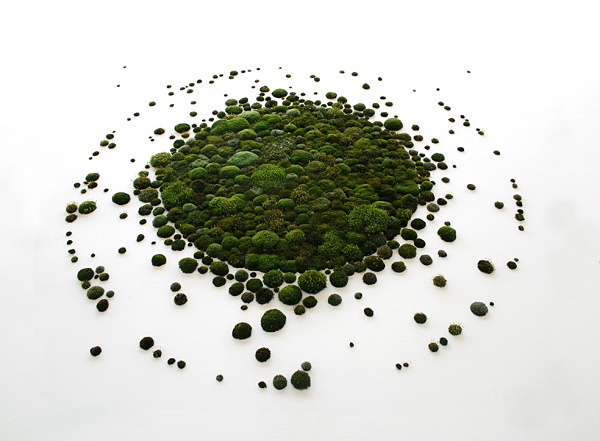
Art of Science: Anna Garforth’s Big Bang

Anna Garforth, The Big Bang, 2012

I like art and I like science. Most of the time, I think that getting the science right makes the art stronger. In this case, well, what the hell? Anna Garforth’s The Big Bang is an installation assembled from hundreds of moss tufts collected from stone walls around Hackney, London. According to Garforth, “the installation depicts Mother Earth as a seed shattering explosion.” So what if plants didn’t show up on our planet until billions of years after the Big Bang? Sometimes, it’s the feeling that counts, and Garforth nails the idea of a sudden eruption that brought forth life on earth.

You can see this piece and lots more of her work on her website.

Science Caturday: Pi Day Edition

frompi

It’s Pi Day! Today’s date, 3.14.15, rolls around only once every 100 years, making it an even more special Pi Day than usual. In fact, at exactly 9:26:53 AM, the date and time will describe pi to 10 digits  (π = 3.141592653). Since it’s Caturday, you may have slept in and missed it. But don’t worry, you can still celebrate by doing geometry problems, eating pie, and reading about why Josh thinks Pi Day should fall in February.

Art of Science: Dance, Opera and Particle Physics Combine on Film

symmovie

Dance, opera, digital art and particle physics unite in an intriguing new film, Symmetry, which was filmed partly inside CERN, the home of the Large Hadron Collider. The film, directed by Ruben van Leer, tells the story of CERN researcher Lukas (played by dancer and choreographer Lukas Timulak), who “is thrown off balance while working on the theory of everything and the smallest particle. Through Claron’s singing he rediscovers love.”  In the “endless landscape” of Bolivia’s salt flats, Claron (played by soprano Claron McFadden) takes Lukas back “to the moment before the big bang, when time didn’t exist.”

The film will debut at the EYE Film Institute in Amsterdam on March 14 as part of the Cinedans film festival and at the NewScientist CERN festival later that same week.

There’s much more information and a teaser for the film at The Creators Project and on the Symmetry website.