Big news in tiny particles: the Large Hadron Collider has set a new energy record ahead of its scheduled full restart in June. Scientists at CERN reported that on May 20, the LHC succeeded in smashing together protons with an energy of 13 trillion electron volts (TeV). That’s close to the 14 TeV maximum that the LHC is designed to achieve.
The record was reached during tests to prepare for a second run of experiments starting next month. The collider underwent a $150 million upgrade after its first run, which produced results that helped confirm the existence of the Higgs boson.
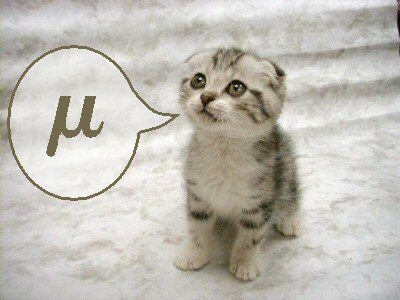
Our physics kitties tend to have substantially lower energy levels than that, but the Large Hairball Collider (pictured above) looks likely to yield important data on particles found under the sofa. The red dot, the so-called “holy grail” of kitty physics, remains elusive. Reached for comment, the head of the LHBC said:
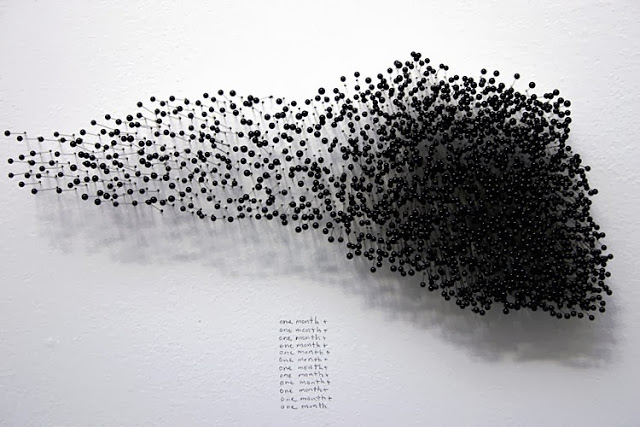
Katie Lewis uses simple materials like pins and thread to create her artworks, which are based on data she collects about her own “bodily sensations” – but she won’t tell you what sensations she’s measuring. Twinges in the back? Rumbles in the tummy, perhaps? She says she uses a very strict method to collect and visualize her data, but she won’t tell you what her method is, either. According to Lewis, it’s all about questioning medicine and science’s view of the body as a quantifiable and endlessly analyzable thing.
She organizes her data into “grid-like charts and diagrams mimicking science and medicine’s representations of the body as a specimen, visually displayed for the purpose of gaining knowledge” – a mindset she sees as false. “The artificially rigid organization of my materials alludes to control – of the individual body as an institutional domain, and of irrational experience as a manageable, concrete set of events.”
Color me conflicted. On the one hand, I understand the artist’s resistance to the idea that every aspect of the self and the human experience can be quantified, crunched and displayed in neat charts. On the other hand, a lot of it can be quantified, and creating art from the data can be beautiful and meaningful, if never the definitive measure of a life.
You can see more of Katie Lewis’ art at her website.
Scientists have made huge strides in understanding the human microbiome, and now they’re ready to move on to more advanced creatures – cats. A crack team* of microbiologists headed by Jonathan Eisen, Jennifer Gardy, Holly Ganz and Jack Gilbert** just launched KittyBiome, a citizen science project that aims to understand “how microbiomes differ among cats, whether those differences reveal insights into cat behavior and biology, and how the kitty microbiome depends on and may shape the health of your cat.”
Among the questions they plan to address are:
How do grumpy cats compare to happy cats?
How do athletic cats compare to couch potato cats?
Does it matter if you feed your cat a paleo-mouse diet?
How do indoor and outdoor cats compare?
They reckon the answers are in the poop. For a $99 donation to the KittyBiome Kickstarter, any cat owner can send in a fecal sample and answer a few questions about his or her cat’s health and diet. The researchers then sequence the DNA of the bacteria in the sample and, after a few weeks, share the type and concentration of the bacteria online. Participants (or their hoomins) can even compare their microbiomes to those of other cats, including some “celebrity kitties.”
Don’t have a cat of your own? For just a $25 donation, the researchers will sequence the microbiome of a shelter kitty. KittyBiome plans to expand beyond housecats, too – a pledge of $149 or more allows donors to see the microbiome profile of a wild cheetah, leopard, puma, or lion.
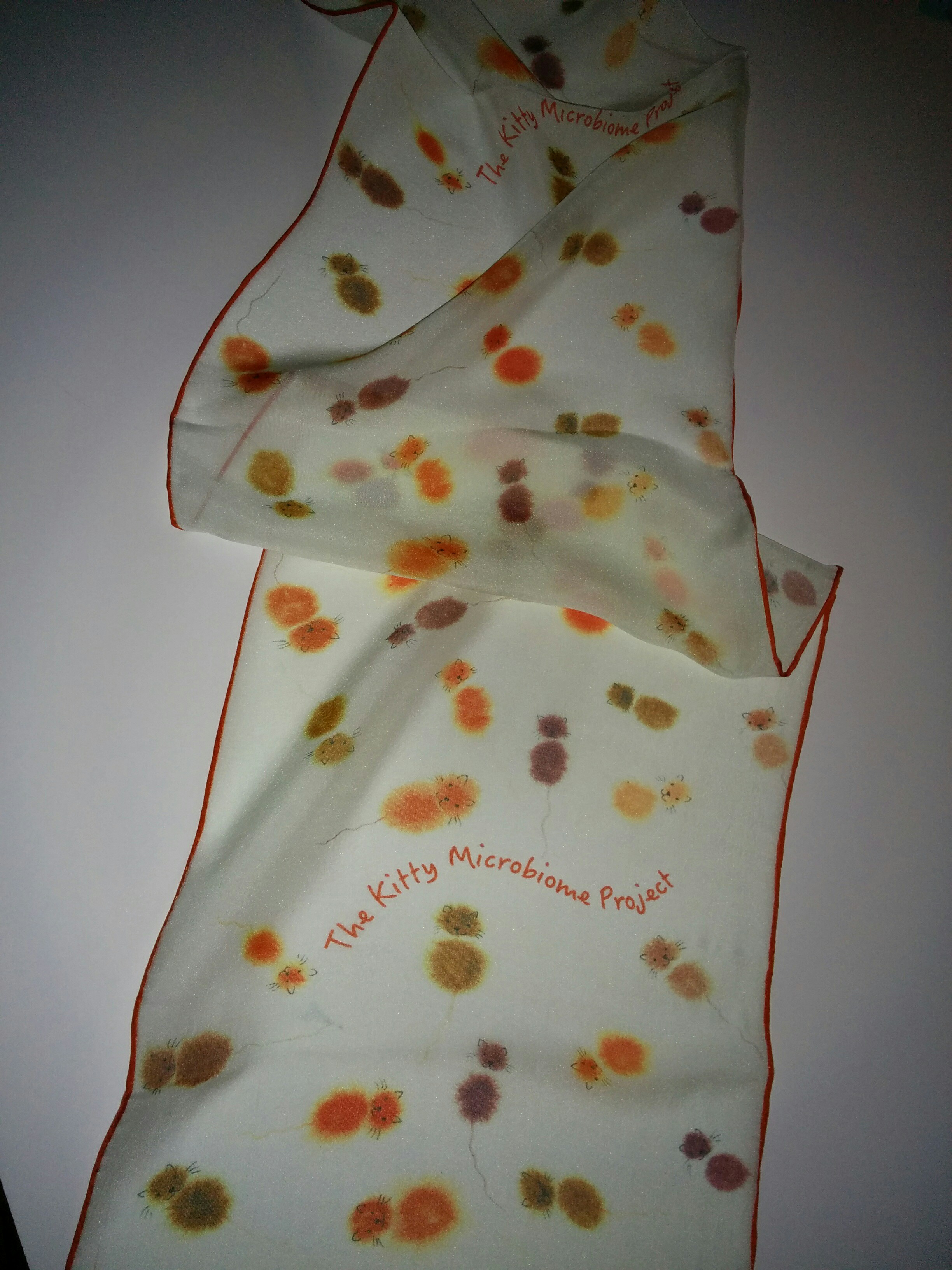
I would be remiss if I didn’t mention the other awesome perks the KittyBiome team is offering – they include a cool illustrated book about bacteria by Jennifer Gardy and an exclusive Kitty Microbe scarf, designed by me.
*Extra points for refraining from using the word “buttcrack”
**Noted dog person
For more information and microbiology-related lolcats, you can follow @KittyBiome on Twitter
I’m very excited about this opportunity and I’m asking for your help to make it happen. I just launched an Indiegogo campaign to help pay my expenses for this amazing experience.
Installation view of Culture Dishes at AAAS, 2014
The Ars Bioarctica Residency Program is a joint project of the Finnish Bioart Society and Kilpisjärvi Biological Station in sub-Arctic Lapland. The residency has an emphasis on the Arctic environment and art-science collaboration. I’ll have access to the station’s lab and equipment and I’ll be working side-by-side with scientists conducting research on vegetation, local fauna, and soil chemistry. Kilpisjärvi’s location near the Arctic Circle puts it on the front lines of climate change, a subject of much of my recent art.
Like most art residencies, this one is unfunded. I hope to raise enough money through Indiegogo to cover my travel and room and board and to buy some art supplies. To thank you for your support, I’ve come up with an array of amazing perks, including a scarf and print based on Reindeer Moss, a lichen native to the region.
There’s lots more information about the residency on my Indiegogo page. Please look, click, spread the word, and support sciart!
UPDATE: As of 5pm on May 14, this project is fully funded! Thank you so much for your support.
Centuries ago, when an artist wanted to depict an animal he hadn’t seen before, he had to rely on descriptions or travelers’ sketches. This led to the creation of many inaccurate images, perhaps the most famous of which is Dürer’s rhinoceros.
We’ve come a long way since the 16th century. But have the enormous advances in the capture and dissemination of images really brought us closer to the visual reality of animals in the wild? Shawn Smith’s exhibition Pixels, Predators and Prey at the Artisphere in Arlington, Virginia, explores this question to intriguing effect.
Smith’s show “examines the evolutionary collision between nature and the digital world through the creation of a pixelated natural world.”
Growing up in large cities, Smith’s interactions with nature were limited to the pixelated representations he viewed on television and on his computer screen. These images would later serve as inspiration for Pixels, Predators and Prey.
Smith examines how we experience nature through the lens of technology by creating three-dimensional sculptures of two-dimensional images sourced from the internet. Each nature sculpture in Pixels, Predators and Prey is built pixel-by-pixel with hand-cut, hand-dyed strips of wood in an overtly laborious process that is in direct contrast to the slipperiness and speed of the digital world.
The work in the exhibition draws inspiration from biology and the struggle a single cell must endure to remain alive. In the same way a cell plays a crucial role in the identity of an organism, Smith explores how each pixel plays an important role in the identity of the object. – Artisphere
Smith’s work is beautiful, original and thought-provoking. However many photographs we’ve seen online, can we honestly say we know what a shark or deer truly looks like? Although those large animals, like the Pronking Impala (above) are the most striking, perhaps the most creepily seductive piece in the show is the half-pixelated, half-naturalistically rendered brain and spinal cord, portentously titled Becoming. Are we? And if so, should we be afraid?
Pixels, Predators and Prey is on view at Artisphere’s Terrace Gallery until June 14. You can see more of his work at his website.






 The Finch and Pea