
 Our favorite coffee shop in Hartsville is The Midnight Rooster. It is home to “the crocodile table”, lattes made with a Southern sense of urgency, and delicious chocolate chip cookies. Today, my daughter, The Frogger, and I were passing some time between one errand and the next. The Midnight Rooster also has lots of art books from exhibitions. So, I got to read artist statements. Just back from ScienceOnline, my scientist soul is feeling properly chastised about the use of jargon.
Talk about jargon. We science nerds have nothing on these artists. The statements are impressive looking and may convey meaning to someone with extensive training in art history, theory, and technique*, but they don’t tell me much about why the artist does what they do or what their influences are. The way they write these statements**
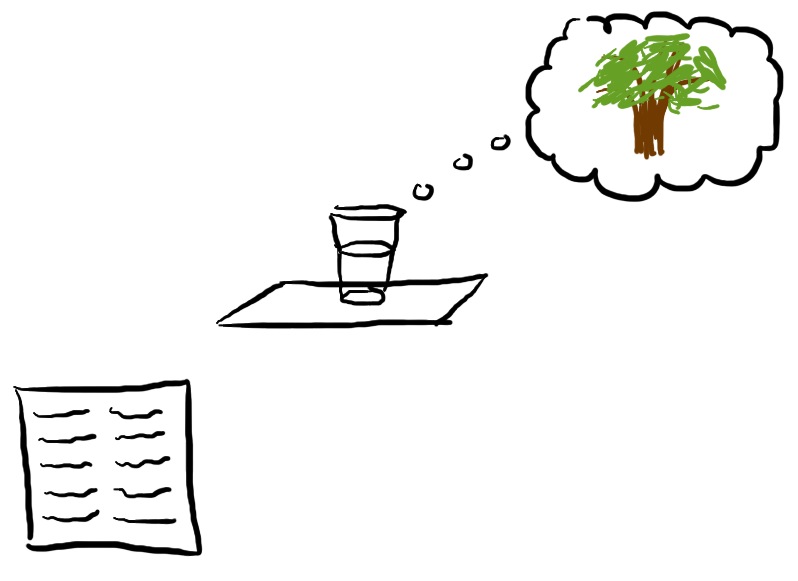
As an example, I have attempted to Up-Goer Five the first paragraph (using this tool) of the Tate Modern‘s description of Michael Craig-Martin‘s “An Oak Tree”. “An Oak Tree” is one of my favorite pieces of modern art as it is both ridiculous and evokes the philosophies of Neo-Platonism (upon which Catholic notions of transubstantiation are based). The original summary from the Tate Modern:
An Oak Tree consists of an ordinary glass of water placed on a small glass shelf of the type normally found in a bathroom, which is attached to the wall above head height. Craig-Martin composed a series of questions and answers to accompany the objects. In these, the artist claims that the glass of water has been transformed into an oak tree. When An Oak Tree was first exhibited, in 1974 at Rowan Gallery, London, the text was presented printed on a leaflet. It was subsequently attached to the wall below and to the left of the shelf and glass. Craig-Martin’s text deliberately asserts the impossible. The questions probe the obvious impossibility of the artist’s assertion with such apparently valid complaints as: ‘haven’t you simply called this glass of water an oak tree?’ and ‘but the oak tree only exists in the mind’. The answers maintain conviction while conceding that ‘the actual oak tree is physically present but in the form of the glass of water … Just as it is imperceptible, it is also inconceivable’. An Oak Tree is based on the concept of transubstantiation, the notion central to the Catholic faith in which it is believed that bread and wine are converted into the body and blood of Christ while retaining their appearances of bread and wine. The ability to believe that an object is something other than its physical appearance indicates requires a transformative vision. This type of seeing (and knowing) is at the heart of conceptual thinking processes, by which intellectual and emotional values are conferred on images and objects. An Oak Tree uses religious faith as a metaphor for this belief system which, for Craig-Martin, is central to art.
The Up-Goer Five:
“A Big Tree” is a glass of water placed on a small glass thing you set things on in a bathroom, which is stuck to the wall higher than the human head. The guy who made the art wrote a lot of questions and answers to put next to the things. In these, the guy who made the art says that the glass of water has been turned into a big tree. When “A Big Tree” was first shown to people, in 1974 at a Place For Showing Art, in the biggest city in this land surrounded by water, the words were shown to people written on a piece of paper. It was later stuck to the wall under and to the left of the thing you set things on and the glass. The guy who made the art’s words mean to say things that can not be said. The questions ask about the obvious can not be so of what the guy who made the art said with such apparently good problems as: ‘isn’t what you did to simply called this glass of water a big tree?’ and ‘but the big tree is only there in the mind’. The answers stick to what he said while admitting that ‘the actual big tree is really present but in the form of the glass of water … Just as it can not be seen, it also can not be thought about’. “A Big Tree” is taken from the idea of turning one thing into another without changing the way the one thing looks, the idea that is important to the way this one group thinks about stuff they can’t see in which it is believed that water and ground up bits from things like the green stuff covering the ground warmed up a lot and wet stuff that gets you drunk from a round thing on a green thing that grows in the ground are changed into the body and blood of a guy some people think was the son of god while still looking like water and ground up bits from things like the green stuff covering the ground warmed up a lot and wet stuff that gets you drunk from a round thing on a green thing that grows in the ground. Being able to believe that a thing is something other than the way it looks say it should be needs being able to look at things in a weird way that changes them. This type of seeing (and knowing) is at the heart of ways of thinking about thinking about things, by which things we think are important because we have thought about them and things we think are important because of the way we feel are put on to pictures and things. “A Big Tree” uses the way groups of people think about things they can’t see as a thing that stands in for other things thing for this way of thinking about things we can’t see which, for the guy who made the art, is really important to art.
I’m not saying it makes more sense***, very few of the Up-Goer Five explanations actually do; but I’m not sure it makes less sense.
*According to people I know with extensive training in art history, theory, and technique they do not convey meaning.
** I suspect many modern artist statements were influenced by things like Michael Craig-Martin’s “explanation” of “An Oak Tree”. I also suspect that artists like Michael Craig-Martin were “taking the piss” when they penned these things.
*** A real problem, for me, with the Up-Goer Five concept is that the ten hundred most used words have a very biased distribution that does not speak well of the conversations being conducted by my fellow English speakers, or their diets. “Fruit” does not make the list.

 The Finch and Pea
This blog hit the spot after viewing a Mark Rothko exhibition this weekend. It struck me that the artist’s statements and “philosphy” and the curator’s analyses were the intended art and the paintings were just a vehicle for them to exhibit their self-perceived depth and importance.
Yes. Art should be about the art, not the verbiage art directors and the artists attach to it; but the bottom line is, most people buy what pleases them and the resumes and artists’ statements aren’t for sale.