
Yes, I just served up a 15-minute Song of the Week. And I’m not sorry. An extended Neil Young guitar solo is totally worth it. It really starts to get good around the halfway mark. This thing of beauty, though, owes at least something to a largely unacknowledged pioneer: an electrical engineering student named Sidney Wilson.
Last week I was in Raleigh, NC, attending the National Association of Science Writers annual meeting. In between fascinating talks on dark matter and dark energy, I strolled past the archive exhibits at the back of the conference room. That’s where I stumbled upon this gem of music history.
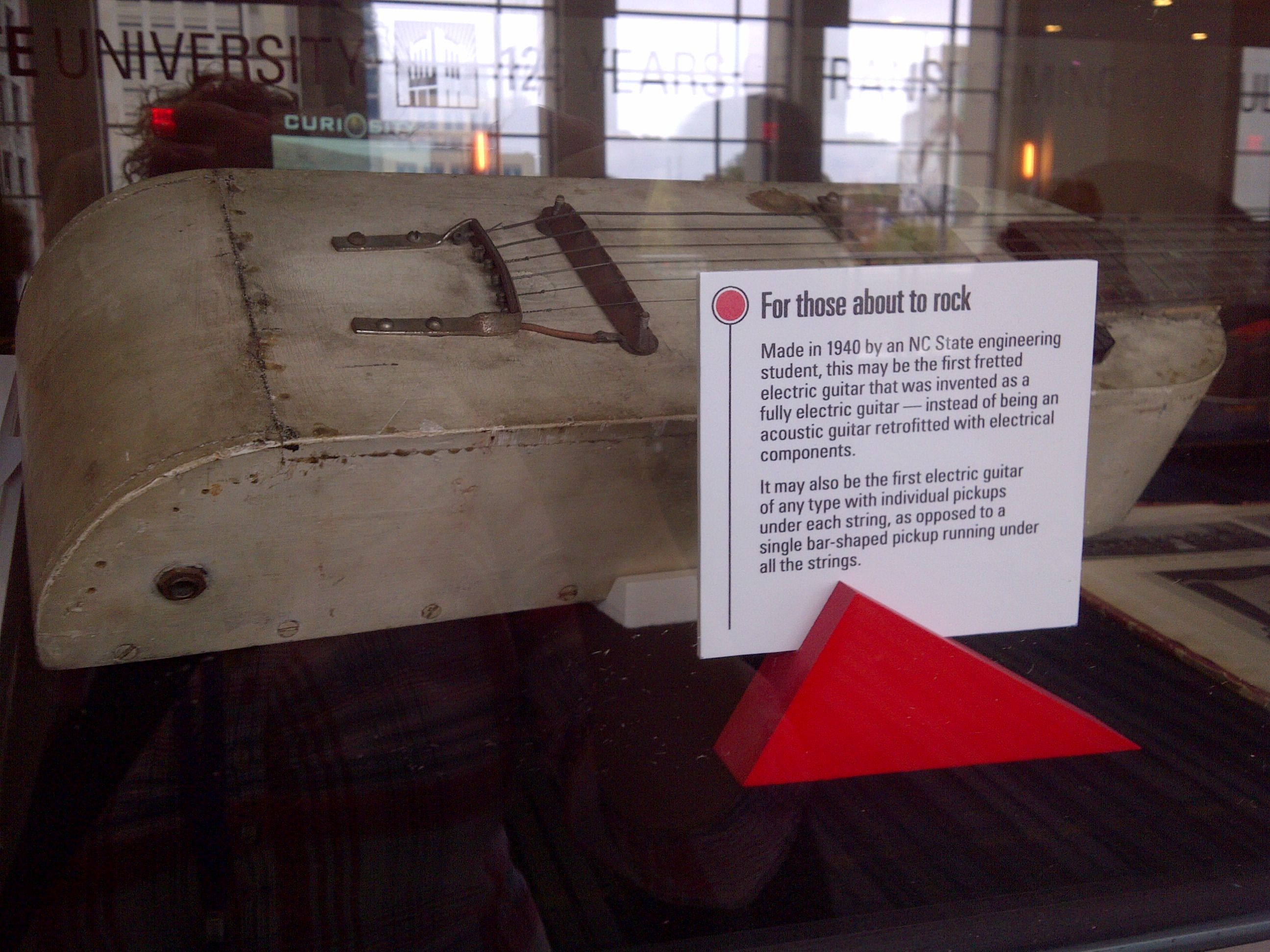
This is one of the guitars that Wilson entered in the 1940 NC State Engineering Fair. The idea of an electric guitar wasn’t new but they were typically acoustic guitars that had been retrofitted with a single bar that captured vibrations from all of the strings.
That bar, called a pick-up, consisted of a permanent magnet with a coil wrapped around it. The metallic guitar strings are also softly magnet, meaning they can can become magnetic in the presence of a magnetic field. When they vibrate near the pick-up, they change the magnetic field inside the coil causing the field to vibrate as well. And like any other situation where there is a changing magnetic field, an electric field is created. This results in a vibrating electrical signal in the coil that can then transmitted on to cables and amplifiers and speakers.
Wilson’s guitar was special in that it was designed to be electric, not a modified acoustic guitar* and, in particular, because he wanted to improve the sound of electric guitars by making a row of individual pickups, one for each string. This meant there would be six clean signals, each corresponding to a single string, that could be captured by the coil. It would sound much better than one messy signal caused by the combined vibrations of all six strings changing the field around a single bar or U-shaped magnet.
Wilson won the engineering fair but unfortunately never patented his pick-ups. A few years later most guitar manufacturers had developed the same idea. The iconic rock guitar sounds made by Gibson Les Pauls and Fender Stratocasters are all due to various types of pick-ups with magnetic posts that are placed individually for each string. And like Wilson’s they are built to be dedicated electric guitars, often with solid bodies.
Neil Young’s Old Black, on which he has relied for many years and is playing in Change your Mind above, is a modified 1953 Les Paul with a very cool relative of Wilson’s pick-up on its bridge: the humbucker. The humbucker was designed (patented in 1955) to reduce the hum created by background interference by placing pairs of magnets under each string with alternating poles and wound with two coils running in opposite directions. Any electrical interference that might cause a signal in the coil would now cause a signal in each coil but in opposite directions. They would effectively be canceled out leaving only signals created by the strings and a clean hum-less sound.
Next week, I’ll be seeing Neil Young live in Calgary. The last time I saw him there, in 2008, his closing cover of The Beatles’s A Day in the Life included a heart-stoppingly epic solo in which Young broke all six strings and continued on by throwing them at the pick-ups. It was noisy and spectacular (and thanks to the wonders of YouTube, you can catch it below). This time, in between moments of being blown away by a rock legend, I’ll be sure to take a break to remember Sidney Wilson and his winning engineering fair project.
_____
*Updated Nov. 6: Note that there were other dedicated electric guitars at the time but they were mostly lap guitars, such as the Rickenbacker “Frying pan” in production as of 1932, that were played in the Hawaiian style sitting across the musician’s knees or on a stand. I’ve also changed the word “unique” to “special” in this paragraph to acknowledge that there were, of course, many people experimenting with and building different types of electric guitars at the time, including Les Paul whom the Rock and Roll Hall of Fame credits with inventing the solid body electric guitar in 1941. His Log guitar prototype was built around the same time as Wilson’s and was brought to Gibson in 1946. Their iconic solid body guitar bears his name in recognition. Wilson’s was just one cool example in a rich development history. If you’re interested in reading more, check out Andre Millard’s (2004) “The Electric Guitar: A History of an American Icon” published by Johns Hopkins University Press.

 The Finch and Pea
It’s appropriate that you are using Neil Young to help illustrate an example of the development of the electric guitar. He has always been a perfectionist concerned with the sound reproduction of his music. He has recently developed a high resolution digital download service and player, that he says will provide better audio quality than other digital formats.
I cant put my finger on what it is, but I love neil young. To me his music truly is individual. He separated himself amongst the vast amount of folk rock talent. The new album is awesome. Great post keep up the hard work. Check these out IStillGotMyGuitar.