
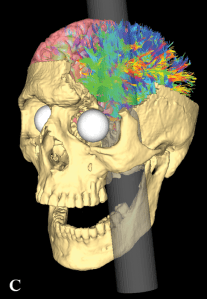
 Twitter was grumbling this morning about a paper in PLoS ONE titled, “Mapping connectivity damage in the case of Phineas Gage”. Phineas Gage is the legendary railroad worker that had a tamping spike driven through his skull and survived. The authors used a computer to model the damage done by the tamping spike, estimate how that would have disrupted Gage’s neural networks, and look for correlations with his reported behavioral changes.
Sounds gimmicky. Nerds don’t like gimmicks. Words like “useless” and “waste of time” were bandied about. Why study a dead guy instead of living people with brain injuries that you might help?
I am not equipped to pass judgment on the results of this study. I do, however, have experience with the issues raised by experiments that may require human subjects. This study may be fatally flawed, but it was not wasting resources and Phineas Gage was more than a gimmick.
 Choosing Phineas Gage as a subject for this in principle study has several advantages:
- He’s dead, which resolves many costly issues with consent, ethics, and personal privacy.
- He survived a penetrating, traumatic brain injury, which allowed behavioral changes to be observed.
- He was considered very interesting at the time, which means there are lots of data about his case available saving the costs of new data collection from scans, measurements, etc.
Not my field, but I’m blanking on any other potential subjects that have all these useful (and cheap) characteristics. The authors were not collecting new observations. They were applying their methodology to pre-existing observations to see if such an approach had any merit. It may not, but it is an honest and thoughtful attempt to contribute to the care of future victims of traumatic brain injuries (soldiers and civilians in war zones are exceptionally susceptible to all kinds, including penetrating). For that, it deserves more than snide dismissal.

 The Finch and Pea