
Samuel Arbesman reports for Wired with excitement about a year-old article in PLoS ONE (“Variable Cultural Acquisition Costs Constrain Cumulative Cultural Evolution” by Alex Mesoudi) that presents a dire scenario for the continued progress of human civilization. Apparently, we are getting full. According to the study, human knowledge is becoming so complex that it will eventually take so much time and energy to learn what we already know that there will be no time to discover anything else. Graduate students know this feeling.
I will tell you not to worry. The study proceeds from a specific set of assumptions that we have no reason to accept. One of these assumptions is the knowledge equivalent of the falsified evolutionary development aphorism, “ontogeny recapitulates phylogeny”.
This assumption is presented in such a way that it could look like a finding to some readers using this figure:
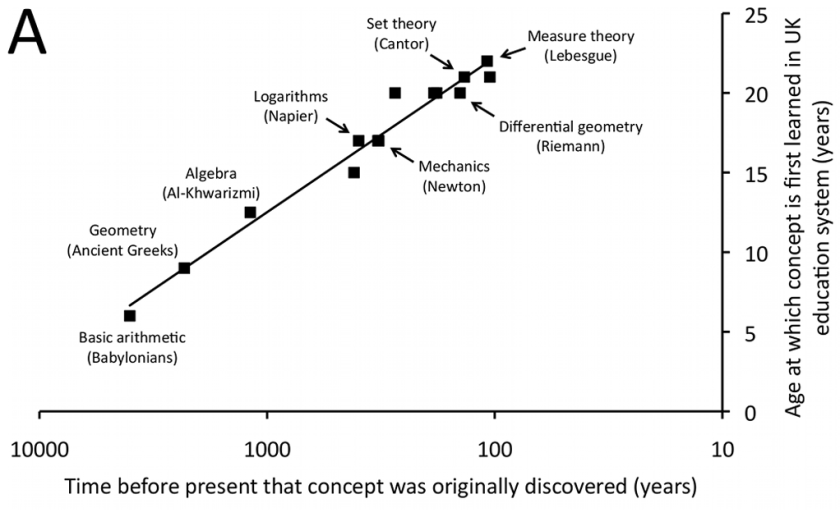
This figure shows that UK students learn math concepts in the same order that they were discovered throughout history. It appears that individuals learn concepts in the same order that culture discovered those concepts. It is as if each individual’s learning experience is a microcosm of the entire experience of humanity.
As if. What we need to do is ask some questions. Like, why are students taught math concepts in that order? It’s not like we are trying to teach them everything and those are the bits that stick at those ages. No, that order is set by curricula and standards. While education standards may be set because we think this is the best way to educate students, they are not set with the certain knowledge that this method is the best way to teach math, let alone the only path to understanding more complex mathematical concepts. Indeed, with math, it is mostly because this is the way we have always taught it.
We may even teach math in the order we do because that was the order in which we discovered the principles, but we still have no reason to believe that such an order is necessary for humans to understand math, nor is it even optimal. The order of presentation of math concepts remains hotly debated among education experts in the United States. I myself was taught algebra before geometry and have not yet noticed any significant problems.
The entire analysis is based upon the faulty assumptions that one must understand the entirety of basic knowledge to master complex principles in a field and that steps along the path of knowledge development cannot be skipped by individuals.
I also want to take a moment to discuss what PLoS ONE is and is not. PLoS ONE is a journal meant to publish technically sound work without regard to its impact. That means it is mostly the quality of the methodology that is screened. How well the study fits with prior literature and the plausibility of its starting assumptions are not that important. Those issues are supposed to be hashed out by the community after the fact. One should not treat a study in PLoS ONE like a study in PLoS Biology. They are doing different jobs and filling different niches. This allows PLoS ONE to produce a daily stream of potentially oddball papers upon which science journalists without research library subscription access can feast.
This study by Mesoudi appears to me to proceed without technical faults from a series of assumptions that are so unlikely that one might declare them to be faulty. Those assumptions are stated clearly, but I think they are flawed. Papers like this should absolutely be published in PLoS ONE, but they should also be read with a critical eye.
In short, I learned algebra before geometry, Ido not need to know how to build a Watt steam engine to repair my car, and ontogeny still does not recapitulate phylogeny.

 The Finch and Pea
One of the reasons that I love Feynman’s Lectures on Physics is that they break out of the standard chronological order used to teach physics. Feynman quickly gets into relativity, the uncertainty principle, and many other areas of physics that had typically been reserved for advanced students. Smart Freshman would come to Caltech eager to learn about the latest cool stuff in physics, and instead they’d be stuck going through a semester of frictionless inclined planes.