
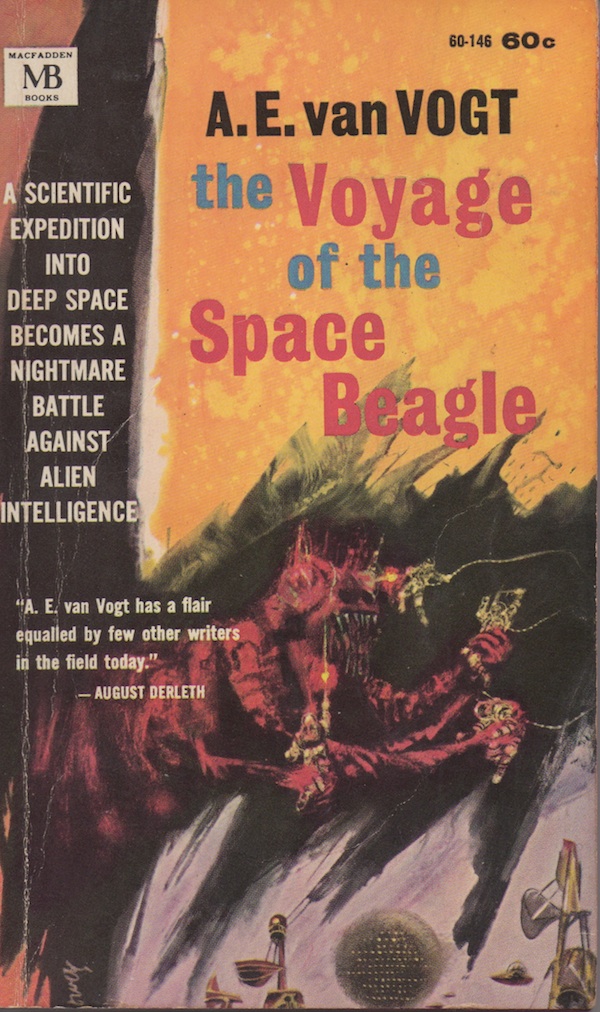
 If you like the pulp science fiction of the Campbellian Golden Age from the late 1930’s to the early 1950’s, you’re bound to run across A.E. van Vogt’s name on nearly every must-read list. (Incidentally, not everyone, including me, considers this era to be the real Golden Age of science fiction). For fans of vintage science fiction, van Vogt is essential because his works were crucial in the canalization of many of the core ideas that we now consider essential to science fiction. At the same time, van Vogt is infuriating because his writing is annoyingly juvenile, even when compared against the other writers who shared pages in the same magazines aimed at juveniles.
When you read van Vogt today, it’s hard not to wonder what people saw in this guy when they ranked his works as some of the greatest ever in science fiction. Continue reading “The Infuriating and Essential Science Fiction of A.E. Van Vogt”
 On March 1st, 1954, on the Bikini atoll of the Marshall Islands, U.S. scientists detonated a thermonuclear hydrogen bomb called Castle Bravo. The expected yield of Bravo was five megatons TNT, but the scientists had missed a crucial fusion reaction that took place in this particular bomb design. As one scientist
 1)
1)  The Finch and Pea