
There will be no survivors
 Exactly what nuclear world war would look like was a matter of diverse opinion in the nuclear apocalypse novels of the 1950‘s. Many post-apocalyptic novels of this decade portrayed World War III as an essentially known if more extreme extension of the destructive experience of World War II, much the way that World War II was like World War I jacked up a notch. At worst, large swaths of land would be rendered permanently uninhabitable for decades (The Long Tomorrow), centuries (The Chrysalids), or even millennia (Pebble in the Sky); nevertheless, the destruction of nuclear bombs was fundamentally the same as what came before. Death occurrs on a massive but not extinctive scale, and while there is some danger from fallout, the worst damage is primarily in those areas of direct hits. This was a logical view at the time – after all, the results of the bombing of Hiroshima, at first glance, weren’t much different from the firebombing of Tokyo.
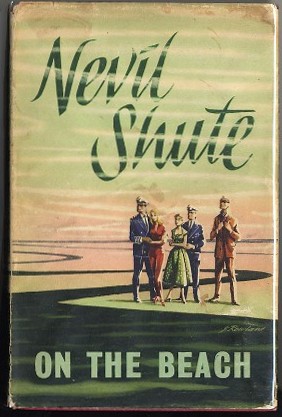
Along comes Nevil Shute in 1957 with a shocking book that thoroughly rejects the conventional picture of nuclear destruction. Continue reading “Apocalypse 1957: On The Beach”
 John Christopher’s 1956 No Blade of Grass is an extremely compelling page turner that portrays our moral traditions and social glue as being so fragile that they can be swept away in a day. Compassion, mercy, and even friendliness are not as hard-wired as we would hope, and they quickly dissolve when the urgency of survival forces us to view all other people as competitors.
 Post-apocalyptic Fundamentalism
 Nature is never inexplicable
 The Finch and Pea