
Career outcome numbers in biomedical sciences

Again from Paula Stephan’s How Economics Shapes Science, p. 179-180:

The evidence that problems exist is perhaps even more striking when one studies the over 400 National Institute of General Medical Sciences NIH Kirschstein National Research Service Awards (NRSA) fellows awarded during 1992-1994. Kirschtein fellows are supposedly the very best, selected for their research promise. This particular group of Kirschstein fellows also had the good fortune of launching their careers when the NIH budget was doubling.

What happened to their careers? By 2010, slightly more than a quarter of the former Kirschstein fellows had tenure at a university; 30 percent were working in industry. What about the others? A handful (about 6 percent) were working at a college; 4 percent were research group leaders at institutes. Another 20 percent were working as a researcher in someone else’s lab and a startling 14 percent could either not be located after extensive Google searches or had not published a paper since 1999. This was not exactly what one would expect from “the best” who came of professional age during the doubling of the NIH budget. If times were tough for them, times will be much tougher for those who have graduated since or will graduate in the near future.

That’s remarkable – there are more former fellows who are working as staff scientists in someone else’s lab or who seem to have left science (34% total) than have taken tenure track jobs (~25%), or than have taken jobs in industry (~30%).

Keep in mind that today, a Kirschstein fellowship or some other private fellowship is absolutely a minimum requirement for a faculty position these days.
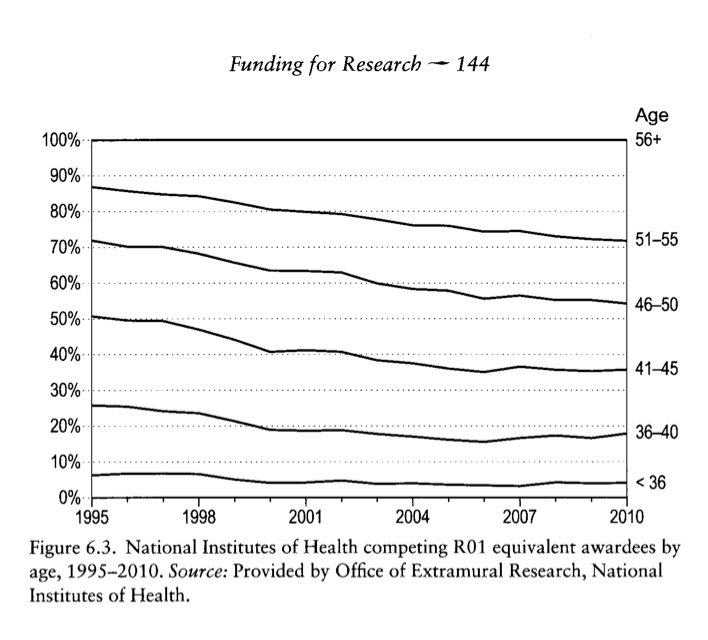
Aging of the scientific workforce

Another snippet from from Paula Stephan’s How Economics Shapes Science (Harvard University Press, 2012). Everyone interested in a science career should read this book.

This figure shows how younger scientists have been squeezed out of funding, while the over 55 group has grown:

The state of R01 funding and how we got here

A snippet from Paula Stephan’s How Economics Shapes Sciencep. 141-143, Harvard University Press, 2012:

“The NIH Doubling: A Cautionary Tale”

It is tempting to assume that money is the answer to many of the problems that plague peer review and, more generally, the university research enterprise…

But anyone who thinks so should be careful what they wish for. The doubling of the NIH budget between 1998 and 2002 ushered in a host of problems…

Faculty were spending more time submitting and reviewing grants. Although early in this century 60 percent of all funded R01 proposals were awarded the first time they were submitted, by the end of the decade only 30 percent were awarded the first time… [T]here is little evidence that the increase translated into permanent jobs for new PhDs, as had been the case in the 1950’s and 1960’s when government support for research expanded. Continue reading “The state of R01 funding and how we got here”

Being a science career realist

Apropos of yesterday’s quote about the science job market, here are some key points that anyone interested in pursuing a science career should keep in mind:

1) The number of independent research positions in academia, industry, and government has always been less than the number of qualified individuals who desire those positions, but the scarcity of such positions is much more severe now than it was 30 years ago, particularly in the biomedical sciences1. Whether we have the right number of independent research positions is a different issue. The purpose of independent research positions in not to provide employment for people who want such positions, and so the fact that many people want independent research positions but don’t have them does not indicate that we need more of these positions. Continue reading “Being a science career realist”

Science jobs gone missing

My 2006 PhD was clearly timed to perfection:

“U.S. pushes for more scientists but the jobs aren’t there”:

A glut of new biomedical scientists that entered the field when the economy was healthier. From 1998 to 2003, the budget of the National Institutes of Health doubled to $30 billion per year. That boost — much of which flows to universities — drew in new, young scientists. The number of new PhDs in the medical and life sciences boomed, nearly doubling from 2003 to 2007, according to the NSF.

But that boom is about to go bust, because an equal number of permanent jobs failed to follow. One big factor: Since 2004, federal research spending across all agencies has stagnated relative to inflation, according to an analysis by the American Association for the Advancement of Science.

Although the injection of $10 billion in federal stimulus funds to the NIH from the American Recovery and Reinvestment Act of 2009 “created or retained” 50,000 science jobs, according to the NIH, that money is running dry, putting those positions at risk.

The lack of permanent jobs leaves many PhD scientists doing routine laboratory work in low-wage positions known as “post-docs,” or postdoctoral fellowships. Post-docs used to last a year or two, but now it’s not unusual to find scientists toiling away for six, seven, even 10 years.

Note the particular accuracy of that quote – post-docs are left doing “routine laboratory work”, as opposed to the oft-made but mistaken claim that a seven year post-doc is about training and gaining new skills that wouldn’t be obtained in any other setting.