The Art of Science: Tamsin van Essen’s Charming Quarks

Tamsin Van Essen, Quarks (Back), 2008
Tamsin van Essen, Quarks (Black), 2008

Ceramic artist Tamsin van Essen uses a combination of novel and traditional techniques to produce thought-provoking pieces, including many drawn from science and medicine. For example, her Medical Heirlooms series comprised a series of vessels that seemed to have skin diseases, while the cups in her Contamination series appeared to have been colonized by various nasty bacteria.

I was particularly drawn to her Collection of Curious Objects, a series of less traditionally shaped objects inspired by theoretical physics.  On her website, Van Essen explains:

Physicists are busy developing sophisticated theories around the existence of things that are impossible for us to see, perfecting mathematical models of the ‘beyond-visible’ worlds of the very large and distant (using Einstein’s theory of relativity) and the very small (using quantum mechanics).

Focusing on this realm of the intangible, I wanted to explore how abstract theoretical ideas can be visually represented. I also wanted to play with the notion that today’s cutting-edge theories may one day be seen as quaint and curious museum pieces: theoretical antiques or abstract junk.

The objects might be found in someone’s dusty attic or perhaps turn up on Antiques Roadshow in the future: “Oh my! Look what they thought in 2008!”

Tamsin van Essen, “Curious Objects”

I love their simultaneous seriousness and playfulness – ceramic quarks and wormholes! – demonstrating van Essen’s willingness to engage with difficult and abstract ideas in an accessible but not dumbed-down way. And while I can admire the thought and craft that goes into a vase that appears to have syphilis, I’d much rather have a shiny quark.

If you’re in the UK, you can see some of van Essen’s work in the Subversive Design show at the Brighton Museum through March 2014.
The Art of Science: Crystal Blue Installation

Roger Hiorns, Seizure, 2008

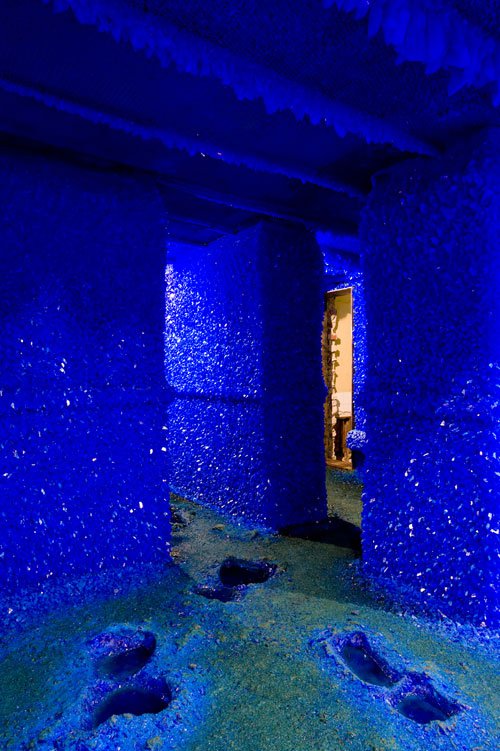
In 2008, British artist Roger Hiorns turned a derelict London flat into a major modern artwork. He created the piece, Seizure, by reinforcing and waterproofing a small, condemned apartment and then pumping in 75,000 liters of copper sulfate solution. After a few weeks, Hiorns pumped the liquid back out, and what remained was a glittering gem – the walls, floors and ceilings all covered with bright-blue crystals. Hiorns had previously created other crystal encrusted sculptures, so he knew how to work with copper sulfate. But he admits that the crystals in Seizure grew larger and quicker than expected – which was part of the art, allowing the natural process to happen in a way that was only partially controllable by the artist.

The finished work brings to mind the underground lair of some mythical creature, or perhaps the inside of a geode. Earlier this year, Seizure was moved to the Yorkshire Sculpture Park, where a special building was erected to house it. Because of the delicate chemistry of the piece, it cannot get wet or too hot. The new structure will allow many more people to visit the work, a good thing because Hiorns has said he has no interest in repeating himself by creating more crystallized pieces.

Want to make one yourself? Here’s a simple tutorial on how to grow copper sulfate crystals. Be sure to check with your parents, landlord, or spouse before coating entire rooms.

Hat tip to @Orthelious, whose Bearpope tumblr is fully of arty goodness

The Art of Science: Nature and Nurture Reversed

nurture9

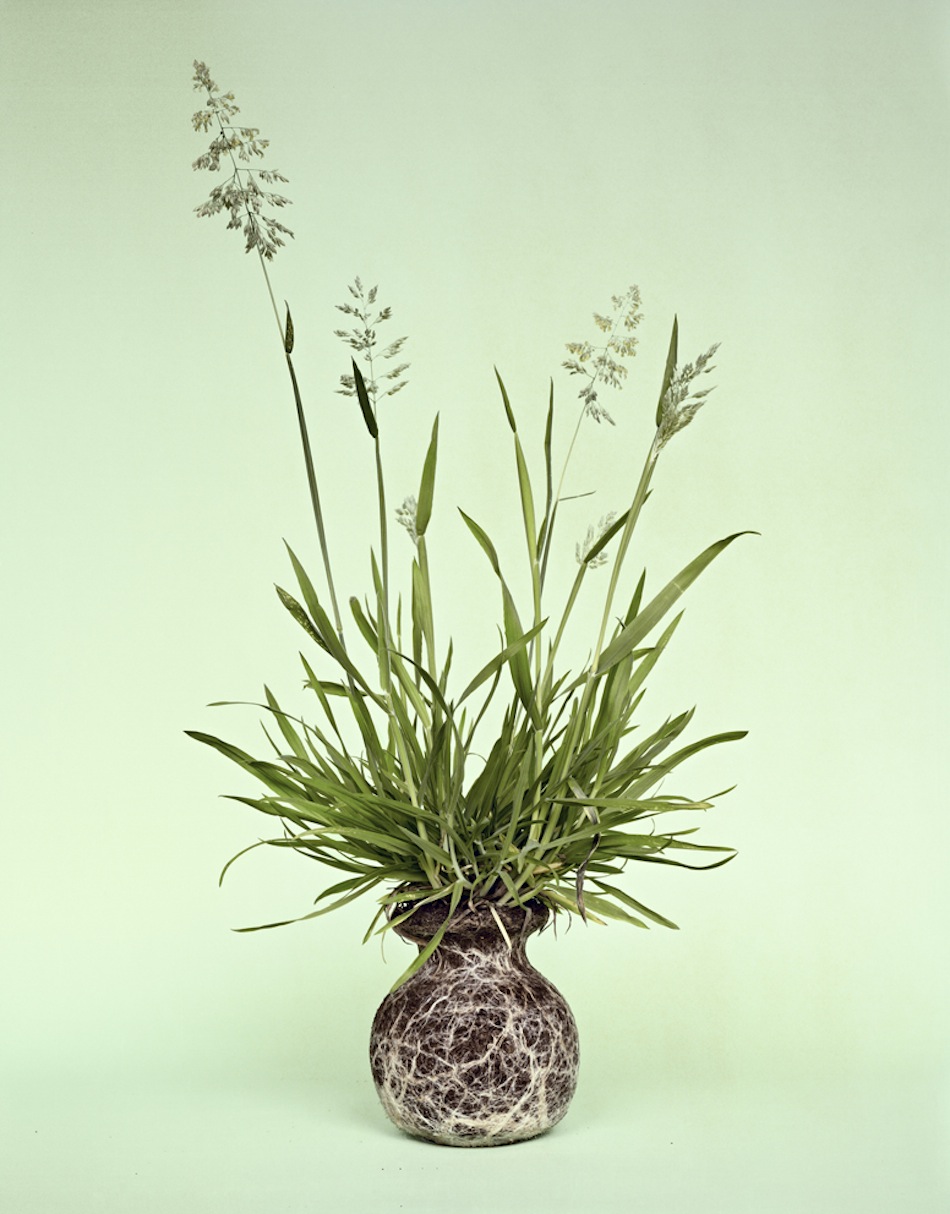
When cultivating a garden or taking photographs of plants, most people carefully tend to the top parts – the leaves and flowers – while letting nature handle the bottom – the roots and soil.  Artist Diana Scherer, in her Nurture Studies, turns that focus on its head. She takes seeds from her garden and grows plants in vases, carefully nurturing them for months, before breaking the vases and photographing the results.

It’s not a surprise that the roots of flowers and weeds are beautiful in themselves. What startles is the focus on what’s usually unseen.  Scherer, a German born artist living in the Netherlands, explains:  “Above ground, I let nature run its course. However, below the surface, by using a vase as a mold, I control the growth of the roots and the shape.”

Her photographs are simple, elegant and formal – the soil-coated roots of a dandelion are presented as if they were the blooms of an orchid. Says Scherer:

“I’m interested in the age-old human practice of manipulating nature. There is a certain ambiguity that I find intriguing; the idea of loving care and, at the same time, ruthless manipulation. For example, the gardener who loves nature and nurtures the plants he desires also ruthlessly cuts, snips and manipulates them.”
from “Review of Nurture Studies” in Hotshoe Magazine by Miranda Gavin

Scherer says that, once she is done photographing a plant, she replants it in her garden and once again allows nature to take over. The roots, having had their moment in the sun, so to speak, can return to their sometimes overlooked but crucial role beneath the surface.

You can see more of Diana Scherer’s work here.  A book of Nurture Studies is available here.

The Art of Science: Kendall Buster’s Parabiosis

Kendall Buster, Parabiosis IV, 2004

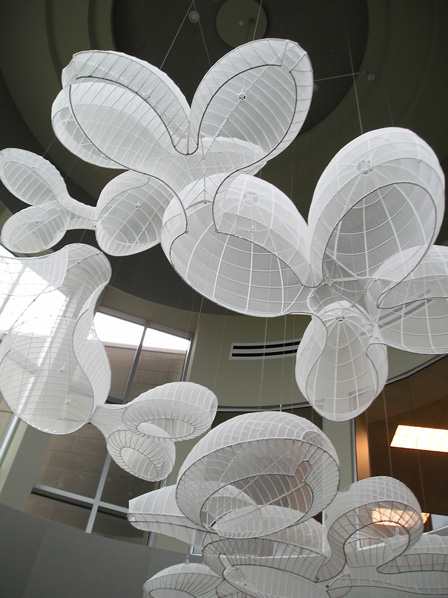
Kendall Buster was educated as a microbiologist and then became a sculptor. Her scientific training is manifest in her work: huge sculptures, often made of fabric over metal armatures, that refer directly or obliquely to the cells, vessels and biological processes of living creatures. I was drawn to this 2004 piece, Parabiosis IV, simply because of its intriguing beauty, but I had no idea what it meant. I discovered that parabiosis is a technique dating from the 19th century in which two living animals are joined together surgically and develop a single, shared circulatory system” (source). In recent years, researchers have used the technique in mice and found that giving old mice “young blood” through parabiosis may enhance neurogenesis (brain cell growth) and reverse age-related degeneration of the heart muscles.  So obviously, this is an exciting field of research – but it’s also deeply creepy, involving stitched-together “frankenmice”, which are quite unsettling to look at. So let’s thank Kendall Buster for presenting this thought-provoking concept, rich in history as well as promise for the future, in such an attractive (non-bloody, non-furry) way.

Much more at Kendall Buster’s website.

The Art of Science: Dude, Giant Shrooms

Tom Hare, Fungi Fairy Ring

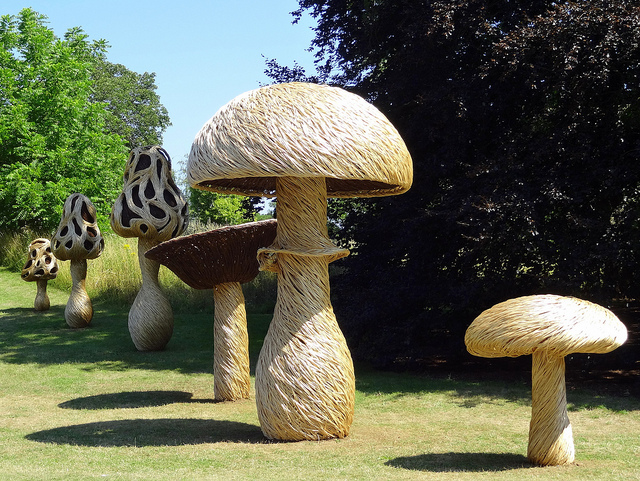
Gigantic fungi have sprouted in London’s Kew Gardens, thanks to sculptor Tom Hare, who created an installation called Fungi Fairy Ring for the IncrEdibles exhibit, a celebration of “autumn’s edible delights” that runs through November 3rd. Working with mycologists from Kew’s Fungarium, Hare created a series of sculptures made from woven willow, representing seven different species of native edible fungi. The sculptures,  which tower up to 12 feet, are based on close collaboration with scientists to ensure that they not only portray each type of fungus accurately, but also show various stages of their life cycles.  Not to mention that their giant size makes them ideal to use as backdrops for photos of full-sized humans as gnomes and fairies.

They also provide a perfect visual for the UK’s first National Fungus Day, which takes place this coming Sunday, October 13. It will be celebrated at Kew with a full program of events including tours of the Fungarium, fungi-spotting walks, model-building and mushroom soup.  Many other events are happening in other cities – see ukfungusday.co.uk for details