The Art of Science: A Machine that Vends DNA Samples Like Candy Bars

singlepack2
Gabe Baria-Colombo, DNA Vending Machine, 2013

Gabe Barcia-Colombo’ s DNA Vending Machine is an art installation blending the utterly mundane (a fairly primitive machine dispensing mostly crappy snack food) with the cutting-edge (DIY human genetics) to intriguing effect.

Barcia-Colombo, a 2012 TED fellow, collected DNA samples from a bunch of his friends using a basic swish-and-spit method. With the help of Oliver Medvedik of GenSpace, a community biotech lab in New York, he synthesized the samples in a liquid base.  Barcia-Colombo then created a pack-of-cards sized case for the vials and loaded them into a vending machine.

As the picture above indicates, the only labeling on the vials is a number.  Barcia-Colombo compares this to the concept of “blind box” collectible toys – sealed limited edition collectible figurines packaged randomly with many variations. As with human genetics, people have limited information on which to base their choices, and much depends on luck.

Each sample comes packaged with a collectable portrait of the human specimen as well as a unique link to a custom DNA extraction video. The DNA Vending Machine treats human DNA as a collectible material, exploring the question of who owns our DNA.  Can the person who bought a stranger’s DNA from a vending machine get it sequenced or potentially use it in other ways?

The DNA Vending Machine has been shown in several galleries, and the artist reports that many people have indeed bought the DNA samples. No word on what they’ve done with them – yet.

hat tip: DesignBoom

The Art of Science: John Grade’s Capacitor

Arch2o-Capacitor-John-Grade-61-e1391416613862
John Grade, Capacitor, 2013

John Grade’s sculpture Capacitor is an immense, immersive piece designed to, as he puts it, “encapsulate the viewer.”  As visitors walk inside the  40- x 20- x 40-foot sculpture, made of fabric stretched over metal frames, it moves, lightens and darkens.  

Capacitor was conceived and built in a mere two months and was exhibited at the Kohler Arts Center in Sheboygan, Wisconsin in 2013.

The sculpture responds to information from weather sensors outside the Arts Center, slowly twisting and shifting to changes in wind direction and temperature.  The live weather data are correlated to historic data, so the greater the divergence from historical norms, the more the sculpture moves, and the more dramatic the shifts in light.

Grade says he hopes people come away from the installation “having experienced something about the outside environment in a new way, having experienced it with their bodies.”

You can see more photos and other projects by John Grade on his website.

The Art of Science: Beyond Air Guitar

Simon Blackmore, Weather Guitar, 2006

Air guitar a little low-tech for you? Try Simon Blackmore’s Weather Guitar, a robotically-controlled flamenco guitar that responds to variations in weather conditions. Blackmore says that the electronic guts of the Weather Guitar, currently on view at the Aldrich Contemporary Arts Museum in Connecticut, were designed to be as flexible and open as possible, so it could be shown (and heard) in many different settings.

The Aldrich Museum’s Richard Klein explains: “Blackmore’s work is characterized by an inventive, DIY approach that draws on influences such as hobby-style electronics, open-source software, and lo-fi aesthetics. The resulting “performative” sculpture and installations are not, however, just about revealing the inner workings of things that are usually invisible, but rather an attempt to tackle the more philosophically thorny questions that surround our increasingly complicated relationship with technology and the power it holds over us.”

Blackmore himself describes the goal of the piece as “an attempt to draw parallels between the scientific inquiry of measuring and quantifying the natural elements, and the romantic notion of the weather acting as a source of artistic inspiration.”

You can see Weather Guitar  and two other pieces by Blackmore at the Aldrich Museum through March 9 and see a video of it on Blackmore’s website.

The Art of Science: Mike Tyka Folds Proteins in Copper

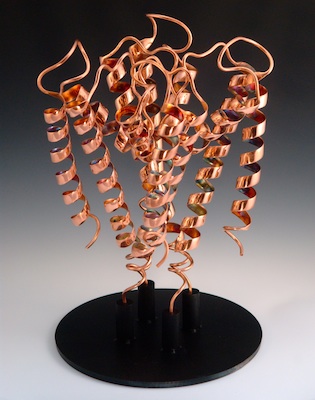
Michael Tyka, KcsA Potassium Channel, Copper and Steel, 2011

Mike Tyka is not the first scientist to see artistic potential through his microscope, but he’s taken his love for the structure of protein molecules much farther than most – not only learning metalworking to make beautiful copper sculptures, but creating a studio/makerspace to do it in.

Tyka earned a PhD in Biophysics in 2007 and went  to work as a research fellow studying the structure and dynamics of protein molecules.  His particular area of interest is protein folding, and he has written computer simulation software to better understand the process.  Tyka says that “protein folding is the way our genetic code is interpreted from an abstract sequence of data into the functional enzymes and nano machines that drive our bodies.”

Tyka got interested in sculpture in 2009 when he helped design and construct Groovik’s Cube, a 35ft tall, functional, multi-player Rubik’s cube.  The cube will soon be on view at New Jersey’s Liberty Science Center as part of its Beyond Rubik’s Cube Exhibit.

Although the Groovik’s Cube project gave him his first taste of art-making, building a giant welded steel cube hardly prepared him to make exquisite replicas of complex biological forms.  So he took to the internet. “I learned almost everything I needed from youtube and from jeweler friends. I didn’t have a space to work so I got together with some friend and founded an artspace (Seattle’s ALTSpace) and acquired or built all the tools I needed.”

Tyka was obviously very familiar with the protein forms and knew how he wanted them to look. He chose to work in copper, a warm, soft metal, because he wanted the sculptures “to look smooth, soft, liquid. Proteins are not solid objects, they’re more like jelly, they move and vibrate. I wanted to reflect that property somehow.”

You can see Mike Tyka’s work at the Hutchinson Cancer Institute in Seattle and at Science House in New York, and see lots more photos on his website. You can follow him on twitter @mtyka

The Art of Science: Bouncing Beethoven Off The Moon

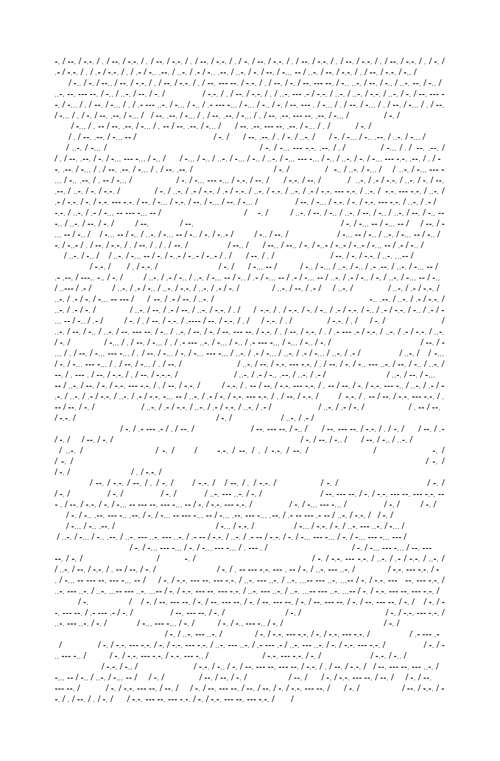
Some of The Moonlight Sonata as received in code from the moon.                    Katie Paterson, 2007
Some of The Moonlight Sonata as received in code from the moon.
Katie Paterson, 2007

For centuries, artists have been inspired by the beauty and mystery of the moon, and for the last 50 years, by the tantalizing possibility of traveling there.  An exhibition in London, The Republic of the Moon, takes those imaginings a few steps further. The show, at Bargehouse in London’s South Bank, “combines personal encounters, DIY space plans, imaginary expeditions and new myths for the next space age,” says its organizer, Nicola Triscott of The Arts Catalyst.

One especially intriguing piece is a sound and data based work called Earth – Moon – Earth, by Scottish artist Katie Paterson.  Paterson translated Beethoven’s Moonlight Sonata into Morse code and “bounced it off the moon” via Earth-Moon-Earth (EME) transmission.  The artist explained:  “The moon reflects only part of the information back – some is absorbed in its shadows, ‘lost’ in its craters … Returning to earth fragmented by the moon’s surface, it has been re-translated into a new score, the gaps and absences becoming intervals and rests. In the exhibition space the new ‘moon–altered’ score plays on a self-playing grand piano.” (You can listen to a clip of it here)

(Full disclosure: I thought Paterson was totally making this EME stuff up. A brief consultation with my friends Google and Wikipedia, however, convinced me that it is indeed possible to bounce a signal off the moon’s surface and people have been doing so since the 1950s. Incidentally, streaming Beethoven to the moon sounds like a perfect project for noted music-and-moon-lover Newt Gingrich. But I digress. )

Is Paterson’s piece a metaphor for the cultural loss that often seems to go hand-in-hand with scientific progress?  Maybe. It’s also intriguing that she chose Beethoven, not only for the “moonlight” theme, but because he couldn’t even hear all the notes himself.

If you’re in London, you have a few more days to catch The Republic of The Moon before it closes on February 2nd.  You can also see her work in upcoming shows in Berlin and Adelaide, Australia or on her website.