Meet the Lake Titicaca Frog

Lake Titicaca resides between Bolivia and Peru at an extremely high altitude. One animal that has evolved to live in the environment is the Lake Titicaca frog (Telmatobius culeus) whose Latin name possibly started as a joke during an expedition in the late 1800s. Because there is sparse oxygen at high altitudes this frog has tons of extra skin to increase the surface area for oxygen absorption. While the average size of the frogs in the lake home has decreased over time, so too has the overall population and the IUCN now considers this animal as critically endangered. In the past, frog legs of Telmatobius culeus were eaten by visitors and locals alike, and animals were often used in local medicines. As a result of the IUCN status many locals are turning from cooking frog legs for dinner to becoming conservationists. Click on the link to watch the video!
ARKive video - Lake Titicaca frog - swimming underwater and eating shed skin

“Meet the…” is a collaboration between The Finch & Pea and Nature Afield to bring Nature’s amazing creatures into your home.

Meet the Arboreal Salamander

There is a recent natural history article in the Journal of Herpetology (click here for the link from D. E. Lee et al., 2012) describing the Arboreal Salamander (Aneides lugubris). The authors have characterized the basic life history traits of this salamander by capture-mark-recapture studies covering a 4 year span. This information is important for many areas of future research, but specifically this will aid in future conservation endeavors.

Oh yeah and this little guy has TEETH!

Basic life-history information like this is still lacking in many species because it is difficult to find funding. Check out the link above to read more about this salamander or click here to see more California salamanders.

“Meet the…” is a collaboration between The Finch & Pea and Nature Afield to bring Nature’s amazing creatures into your home.

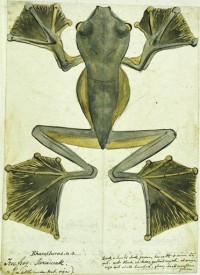
The Art of Science: Wallace’s Flying Frog

Flying-frog-Sarawak-1855-by-Alfred-Russel-Wallace-200x275

Last week, the Natural History Museum in London unveiled a digital archive of the letters of 19th century naturalist Alfred Russel Wallace, the co-discoverer with Charles Darwin, of evolution by natural selection. The archive, introduced on the 100th anniversary of Wallace’s death, naturally focuses on his writings, but also contains some paintings and drawings. Wallace, who spent years in far-flung places collecting specimens, didn’t have the option of pulling out a camera to document his finds. He often sketched or painted his discoveries, including this lovely watercolor of a flying frog which he painted in Sarawak. It may not be Audubon-level in its artistry and detail, but it’s a useful scientific illustration which also has great personality and charm.