Via Chris Woolston at Nature, I ran across last week’s discussion about the role of beauty in technical scientific prose. Writing over at The Tree of Life, Stephen Heard offers several examples of beauty in scientific writing, and he calls on the community to encourage beauty in scientific writing:
[E]xamples of beautiful scientific writing do seem to be unusual; and those that exist aren’t well known. I don’t think it has to be this way. W could choose to change our culture, a little at a time, to deliver (and to value) pleasure along with function in our scientific writing.
I’ll second the idea that we should encourage beauty in scientific writing, but with a big caveat: we absolutely shouldn’t try to do this by making our technical writing more belletristic. We don’t need to drop in hokey metaphors or cloying phrases — that’s what would happen if you encouraged most scientists to write beautifully. Continue reading “On Beauty in Technical Science Writing”
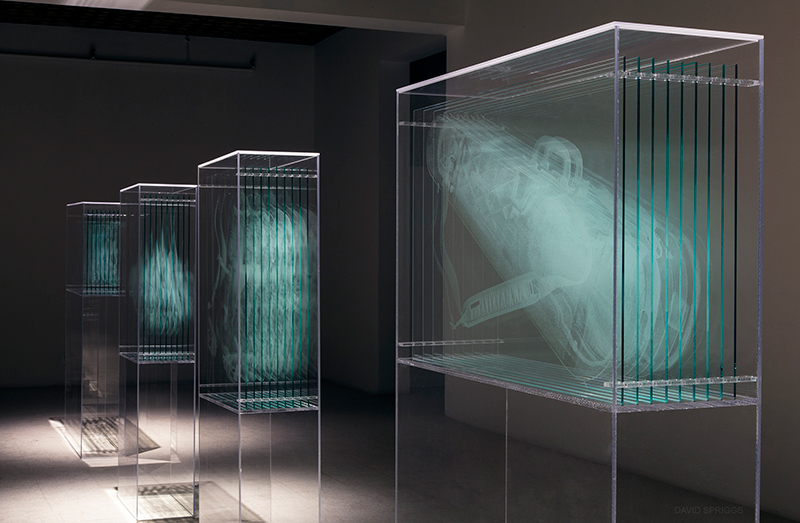
David Spriggs, Profile, Type A – Briefcase, 2014, Glass and Lucite
Transparency, both physical and metaphorical, is the central preoccupation of David Spriggs’ artwork. In his 2014 exhibition, Transparency Report, he took classic 21st-century images of personal possessions inside a security scanner and turned them into haunting and gorgeously crafted art.
Spriggs creates his artwork by layering images in space – in this case by engraving multiple sheets of glass which are displayed in spaced layers in lucite cases to reveal the three-dimensional forms. While we generally link the idea of transparency with openness and honesty, these works reveal a darker side of transparency, in which individuals give governments and corporations the right to literally see through us and our personal belongings.
Spriggs will further explore the intersection of optics and surveillance in an upcoming show entitled Prism – referring to both the optical apparatus and the NSA surveillance program – from January 29 to May 9 at Montreal’s Arsenal Contemporary Arts.
Installation view from David Spriggs, Transparency Report
I’ve never been to the American Museum of Natural History (it’s on the “to visit” list!) but now the museum is coming to me via the magical medium of YouTube. AMNH has launched a video series called Shelf Life, through which you can get a behind the scenes tour of parts of their collection.
The show debuted in November, with an episode on collections in general (and fish in particular). Two more episodes have since gone up, one per month. The production quality of the videos is really good, but they managed to stay within the YouTube attention span.
I can’t help but wonder, though, if they modeled it after the Field Museum’s (acquired) Brain Scoop series, but it is clearly a different concept, with different people on screen in every episode. Each episode is also accompanied by a web page with more information, so it’s more in depth than just the videos. I really liked the turtles and taxonomy episode and web page.
It’s good to see another museum embrace online video to share their collection, and I can’t wait until February’s episode, which is all about the olinguito!



 The Finch and Pea