
This week, Science for the People is learning more about the groundbreaking work and too-short life of Alan Turing, the brilliant mathematician, codebreaker and philosopher who laid the groundwork for the modern age of computing. They spend the hour with Oxford University Senior Research Fellow Andrew Hodges, talking about his book “Alan Turing: The Enigma.”
Happy Birthday, Charles Darwin!

February 12th is the birthday of pioneering biologist Charles Darwin*, who developed and presented the first mechanism to explain evolution that actually worked – namely, natural selection. Today would be Darwin’s 206th birthday, if he wasn’t long dead. Today is a great day to remember not only Darwin’s massive contribution to our understanding of Nature, but also to reflect on the countless people who influenced him, helped expand or develop on his ideas, challenged him, or simply helped carry his bags – for example, spare a thought for the gardener who tended Darwin’s much written about garden. These individuals that simply make things possible surround any discovery, no matter how large or small.
Of chief importance was Darwin’s voyage on the HMS Beagle, chronicled in his The Voyage of the Beagle. The magnitude of the task of such a voyage can be well represented in this image of the HMS Beagle beached to repair the keel and copper plating. They just had to get the ship onto the beach in the correct orientation, lean it over to one side, make repairs, lean it over to the other, make more repairs, then get the whole thing back into the water without breaking anything – not in a proper dry dock – but on a beach on the coast of South America. No biggie.
Both for fun and because the effort required to create this is a metaphor for the effort of the HMS Beagle‘s crew, we thought we would show you the scene in Legos. Lego builder James Pegrum recreated a scene originally drawn by Conrad Martens, who was also traveling on the HMS Beagle as their artist-in-residence, and later engraved by Thomas Landseer. If you want to build your own HMS Beagle, you should consider voting to support Luis Peña’s Lego Ideas HMS Beagle project.
*There is an effort to get February 12th officially recognized as “Darwin Day”. While I am all for this concept in principle, one of the major supporters of this effort has been the American Humanist Association. They run “darwinday.org” and have pushed for Congressional resolutions to recognize Darwin Day. They, however, also named Lawrence Krauss as their 2015 Humanist of the Year, ignoring Krauss’ history of support for his buddy Jeffrey Epstein, who happens to be a convicted pimp and pedophile. So, I’m sticking with “Happy Birthday, Charles!”
HT for “Beached!”: The Brothers Brick
Art of Science: Xavier Cortada explores Physics and Marine Biology

Xavier Cortada is an artist whose interests spread across many areas of science. His works have included projects at both the North and South Poles, and his subjects have ranged from DNA nucleotides to subatomic particles. This month, Cortada’s work is on display in two very different exhibitions.
The first, at Chcago’s Fermilab Art Gallery, focuses on art as a means of education and outreach, and features artists who have collaborated closely with scientists. Cortada is showing five large “digital tapestries” that he created as a fellow at CERN that portray the five search strategies which the CMS (compact muon solenoid) experiment used to discover a new Higgs-like particle. The exhibition, which also features work by Michael Hoch, Peter Markowitz, and Lindsay Olson, is open through April 22.
In a completely different vein, Cortada and a group of botanical illustrators have teamed up to create an exhibition called In Deep with Diatoms on display at the Frost Art Museum at Miami’s Florida International University, though February 22. The artists used traditional watercolor techniques to explore the unique and complex beauty of diatoms, single-celled aquatic microorganisms.
If you can’t make it to either show, you can see more of Cortada’s work on his website.
Garbage – Part 2: Earthships
Part two of my garbage-themed science travel series. This week, a place I visited after seeing it on a documentary.
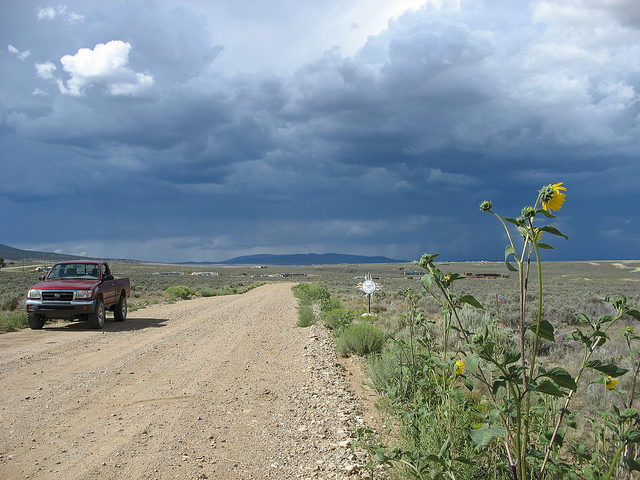 In 2007, I saw the documentary Garbage Warrior at its premier at the Hot Docs film festival, and three years later it inspired a detour to Taos on my way to a conference in Albuquerque.
Garbage Warrior tells the story of Michael Reynolds, a renegade architect who developed a way to build sustainable homes out of garbage. It sounds crazy, it sounds disgusting, but the homes are beautiful and the way they are designed, built, and developed is experimental in not just the architectural sense, but also scientifically experimental: They try things, and if it doesn’t work, they change parts until it does work. Reynolds’ early customers didn’t always understand that aspect of “experimental” and complained when things didn’t work, but over time the buildings have become better and better.
The houses are called Earthships, and this is what they look like:
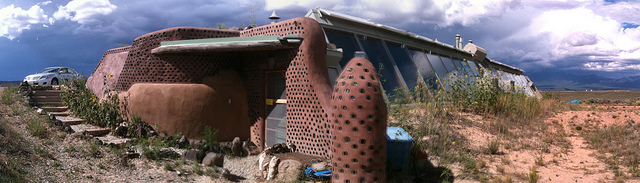
I stayed in this particular Earthship for one night in 2010, in between two conferences. I wrote up my experiences for WorldChanging Canada at the time, so you can read a bit more there as well. Continue reading “Garbage – Part 2: Earthships”
Airwolf
I like Lego. I like Airwolf*. That is all.

*Seriously. It is my ringtone, but only if I think you are awesome.
 The Finch and Pea