Interrailing through Europe with Borodin and Mendeleev

Long ago, in a kingdom that no longer exists, a bohemian traveller was mistaken for a fugitive revolutionary, and arrested.

Borodin (left) and Mendeleev (right)

The traveller was Russian chemist and composer Alexander Borodin. He was on his way to Italy with his friend Dmitri Mendeleev. Both men were researchers in the chemistry department of the University of Heidelberg, where they learned the ropes from Robert Bunsen (inventor of the bunsen burner) and Emil Erlenmeyer (inventor of the erlenmeyer flask). In a few years, Mendeleev would develop his own classic staple of chemistry labs – the periodic table – but now he was taking a break from science, and making his way to Italy with his friend.

They travelled light, and brought very little clothes with them. “We wore only blouses, so that we would look like artists”, Mendeleev has said of this trip. “That’s not a bad idea in Italy, because you can get along very cheaply that way. We took hardly any shirts with us, and had to buy new ones when the need arose; we gave these away to the waiters in place of tips. We absolutely let ourselves go in Italy, after the stifling cloistered life of Heidelberg.”

Picture these two men, dressed in their artists blouses, walking across large parts of Switzerland. Looking nothing like the academics they were in Heidelberg, they reached the Kingdom of Lombardy-Venetia. This kingdom no longer exists. The area is now Northern Italy, but was then part of the Austrian Empire, and Austrian police were on the lookout for a political fugitive.
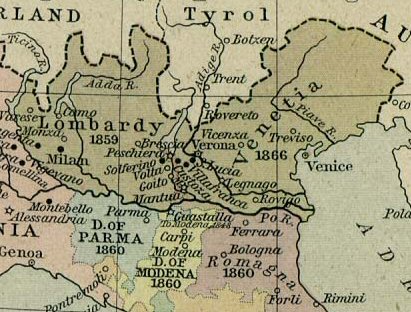
LombVen

Seeing a bohemian figure who matched the description of the revolutionary they were told would cross the border that day, the police arrested Borodin.

He was not at all the man they were looking for. Borodin had led a quiet and privileged life, filled with books, music, and education. After graduating from medical school in St Petersburg, he moved to Heidelberg to study chemistry. He spent all of his free time making music, and had already composed several pieces for piano, voice, or string ensembles. Much later, years after his untimely death at a costume party, Borodin would posthumously win a Tony Award for composing the original score used in the musical Kismet. He was a chemist, a musician, a Russian prince’s illegitimate son, a women’s rights activist, and an educator – but not a member of an Italian revolutionary movement.

By the time the police realised their mistake, the real fugitive had taken advantage of the distraction, and crossed the border. When Borodin and Mendeleev finally boarded their train, they were greeted with cheers and applause by the Italian passengers, for unwittingly helping a member of the revolution escape.

We don’t know the identity of the mysterious fugitive, but at the end of the Austro-Prussian War in 1866, the Kingdom of Lombardy-Venetia was no more. The region became part of Italy, which it still is. And somewhere along the way, two Russian chemists on a low budget holiday may have played a very minor role in shaping the political situation in 19th century Northern Italy.

Source: the book “Borodin”, by Serge Dianin, translated by Robert Lord (1963). Mendeleev’s words about their outfits are quoted in the book, but originally from another book by M.N. Mladentsev and V.E. Tischenko, called “Dmitry Ivanovich Mendeleev. His Life and Work, Vol I.” (1938). The photo of Borodin and Mendeleev is a crop from a larger photo including two other chemists – Gitinsky and Olevinsky. The original photo was taken in 1860 – the year this story takes place. Lombardy-Venetia map in the public domain, via Wikimedia.


Science for the People: A Special Hell

sftpThis week Science for the People is talking about the use – and appalling misuse – of genetics in pursuit of human perfection. We’ll speak to Claudia Malacrida, sociology professor and eugenics researcher, about her book A Special Hell: Institutional Life in Alberta’s Eugenic Years. We’ll also talk to Hannah Brown, postdoctoral researcher at the University of Adelaide, about the ethical issues raised by the creation of a genetically modified human embryo.

*Josh provides research & social media help to Science for the People and is, therefore, completely biased.

Science Caturday: You Did Not

reddot

The science world was riveted this week by the unraveling of the career of Michael LaCour, a PhD student in Political Science at UCLA. First, a high-profile study he worked on was retracted from Science magazine after his senior co-author learned that LaCour had likely faked his survey data. Then it was revealed that LaCour had lied on his CV about grants and awards he had received, among other things. This led to the creation of the excellent #CVredflag hashtag on twitter. On Thursday, Virginia Hughes reported in Buzzfeed that LaCour had probably faked yet another study, about media bias.  All of this is sad for science (and embarrassing for Science), but it’s a helpful reminder that if a study or a CV looks too good to be true, it probably is.

You can’t do transformative science without wasting money

This is a great statement by Eric Lander from an interview he gave to James Fallows at The Atlantic last year:

“When will genomics cure cancer?”

Young scientists who need to look at 100,000 cancer samples, or do functional tests inhibiting all the genes in the genome, or explore the use of chemicals in ways they never could before—they need an NIH [National Institutes of Health] that is able to place bets. With sequestration, and the NIH budget falling by about 25 percent in real terms over the past decade, the people reviewing grants naturally become more conservative. When there’s less money, reviewers don’t want to run the risk of wasting money on something that doesn’t work.

I’ve got to tell you, if you aren’t prepared to waste money on things that might not work, you can’t possibly do things that are transformative. Because for every successful transformative idea, there’s five times as many nonsuccessful transformative ideas. Nobody knows how to figure out in advance which ones they’re going to be.

I don’t agree with everything Lander says in the interview – specifically, the statement that we’ll have a “complete catalogue” of disease genes in another five or six years has no basis in reality. But overall, he makes some great points about the transformative potential of genomics.

Art of Science: The Curious Craft of Growing Ears

Diemut Strebe, Sugababe, 2014

Dutch artist Vincent van Gogh famously cut off his own ear. Now, another artist, Diemut Strebe, has made him a new one from tissue engineered cartilage. Strebe took genetic samples from Lieuwe van Gogh, a descendant of the artist’s brother Theo van Gogh, and created a new ear, titled Sugababe.

The harvested cells were grown onto a 3D printed scaffolding made to resemble the ear Van Gogh is to said to have cut off in 1888. The ear is displayed in a case containing a nutrient solution which could, in theory, last for years. Visitors to an exhibition in Germany last year could “talk to” the ear through a microphone which converted their voices into nerve impulses. (OK, sure, whatever. It can’t hear.)

Earmouse1
Vacanti and Langer’s Mouse

Strebe is just the latest in a line of artists and scientists who have freaked people out by growing ears. The first were Robert Langer of MIT and Charles Vacanti of Harvard, who in 1995 succeeded in growing a pretty convincing-looking ear on the back of a mouse.  Although the ear represented a huge advance in tissue engineering, the undeniable creepiness of the image worked against it. Critics pounced on the mouse as a sign of the imminent arrival of human-animal hybrids and a bustling trade in body parts, even taking out ads in the New York Times to denounce the new technology. In fact, the technique has mainly been used to help children born with missing or underdeveloped ears and people who have lost their ears to fire or trauma.

Stelarc, Ear on Arm, 2006-

The most famous engineered ear in the world resides on the inner arm of performance artist Stelarc. His ongoing “Ear on Arm” project began in 2006, when surgeons inserted a “biocompatible scaffold” under the skin of his left arm. Since then he has undergone numerous procedures to upgrade it.  In a 2012 interview with Wired, he noted “At present it’s only a relief of an ear. When the ear becomes a more 3-D structure we’ll reinsert the small microphone that connects to a wireless transmitter.” In any Wi-Fi hotspot, he said, it will become internet-enabled. “So if you’re in San Francisco and I’m in London, you’ll be able to listen in to what my ear is hearing, wherever you are and wherever I am.” (An update on Stelarc’s website indicates that the microphone was successfully inserted and used, but later caused a serious infection and had to be removed.)

Stelarc says his project “sees the body as an extended operational system,” a subject with obvious relevance in a world where we’re tethered to our smartphones day and night. Alas, his experiences with surgeries and infections indicate that, for most of us, keeping the tech on the outside of our bodies is a safer option. And the revulsion that has greeted all three of the artificially grown ear projects I’ve described indicates that society has no great longing to change that.