Proud to be an American?

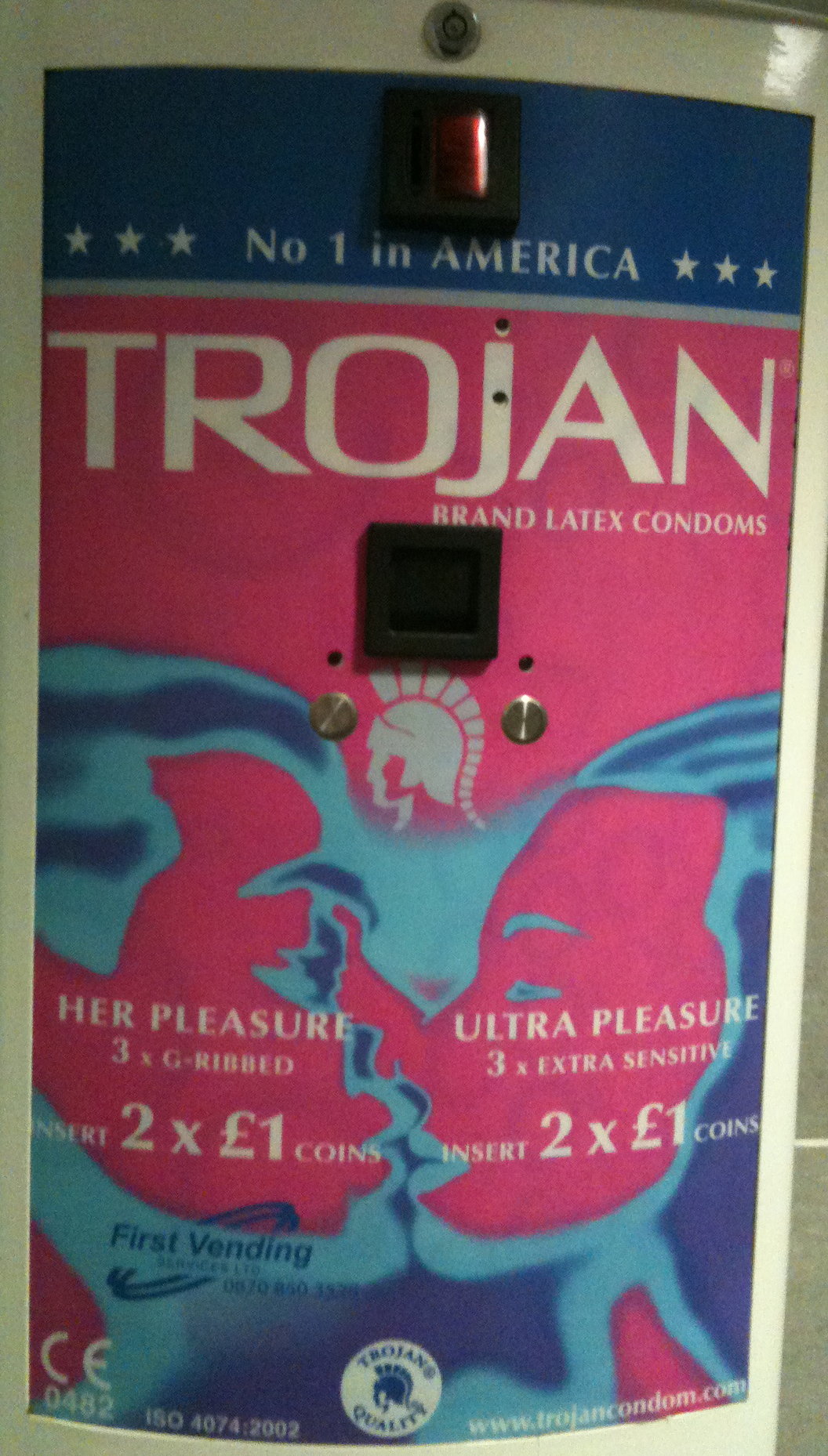
As seen in a Darwin College (University of Cambridge - Cambridge, UK) bathroom.

Not that Trojan Condoms being “No. 1 in America” is particularly surprising, but I did not realize this was a relevant endorsement for British college students making a consumer choice in the competitive contraception marketplace. Apparently, my homeland is world renowned for our refined sensibilities in this area.

As an aside, shouldn’t “most effective” trump “most popular”?

Disappointment

I’m always extremely disappointed by Brits with poor vocabularies. It’s like discovering that Henry Ford was a bad driver*.

*Which he probably was, since they hadn’t invented traffic yet.

Mao Wuz Here: The Great Leap, Uh, Forward?

Originally posted at Science 2.0 on 16 December 2009.

I came across this graph from the US Census Bureau on io9. They project the linear trend after 1965 out to 2050, assuming no major changes, which is always dangerous. The short story is that the Ehrlichian fear of massive overpopulation may not come true due to worldwide reductions in population growth. The human population might peak in the not so distant future. I might have to rethink my prediction of when evolution will finally vanquish creationism/intelligent design.


But, let’s ask the real question. What the hell happened in 1960? Continue reading “Mao Wuz Here: The Great Leap, Uh, Forward?”

This sounds like my problem…

One physicist’s experience trying to model the EGF signaling pathway with a 48-parameter ODE model

Cerione explained that none of the parameters are known to better than a factor of between two and ten, and that it was so boring to measure them that he couldn’t pay anyone to do so. The model has 48 total parameters!…

We could fit to the data and make predictions, but with 48 free parameters could we trust our answers? To see if an answer was trustworthy, we did statistical mechanics in model space. (Doing a Monte Carlo in parameter space, it turns out, is called stochastic Bayesian analysis.) As I had suspected, the parameters varied over huge ranges. In fact, every parameter varied by over a factor of fifty, and many varied over factors of many thousands. Remember – all of these parameter sets still fit the existing experimental data.

Check out Cornell physicist James Sethna’s page on ‘sloppy models’, where he explains how to deal with biological systems that have dozens of parameters, most of which, thank God, don’t actually matter.

Calvin on General Relativity

Calvin & Hobbes by Bill Watterson