
Nearly 20, 000 people were beating on the doors of a venue that would hold less than 10, 000 shouting “Let us in!” Tickets for the second night had all been printed with the same date as the first. The police waded into the crowd and ordered the opening act, Paul “Huckerbuckers” Williams to stop shortly after he began. A man was stabbed as the confused crowd dispersed. On the surface, The Moondog Coronation Ball, March 21, 1952 in Cleveland, was a total disaster. Continue reading “Celebrating the 60th Anniversary of the first Rock and Roll show with…biological classification and Guided by Voices?”
Math Madness #2: The “Jinx” & The “Choke”
During their 2009 game against Villanova, Duke guard John Scheyer was getting ready to take his fifth foul shot of the game. He’d made all four previous attempts. Announcer Verne Lundquist made reference to Scheyer’s high career free throw success rate (86%). Scheyer missed the shot, causing Lundquist to publicly flagellate himself for jinxing Scheyer.
Scheyer was one of the best foul shooters to ever play for Duke (3rd best). An 86% success rate is so high that we expect Scheyer to make any given free throw. Yet, at the moment of Lundquist’s apology, Scheyer was 4 for 5 (80%) from the line. Even over that small sample set, his short term 80% success rate was effectively identical to his career rate of 86%.
Verne didn’t jinx Scheyer. He just made a statement that, by chance, happened to coincide with a normal, probabilistic event. Superstitions get started that way. Continue reading “Math Madness #2: The “Jinx” & The “Choke””
Graphic History of the Dystopian Novel
Goodreads blog has a nice graphic timeline of the dystopian novel. The genre appears to have peaked in the mid-40’s, the mid-50’s, and well, now. The difference between now and the 50’s, according to the graphic, is that today’s swath of dystopian books aimed at teenagers features more romance, is inspired by the “vapidity of pop culture”, and is rated more highly by women than by men. That’s probably because zombie apocalypses are notably missing from the timeline.
Boy of Destiny
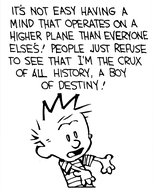 My post-Science Online 2012 interview with Bora Zivkovic is up at Scientific American Blogs. Hopefully, it conveys Calvin’s breadth of vision without the egomania and intense narcissism.
Apocalypse 1954: Hero’s Walk
Cold War Geopolitics in Space
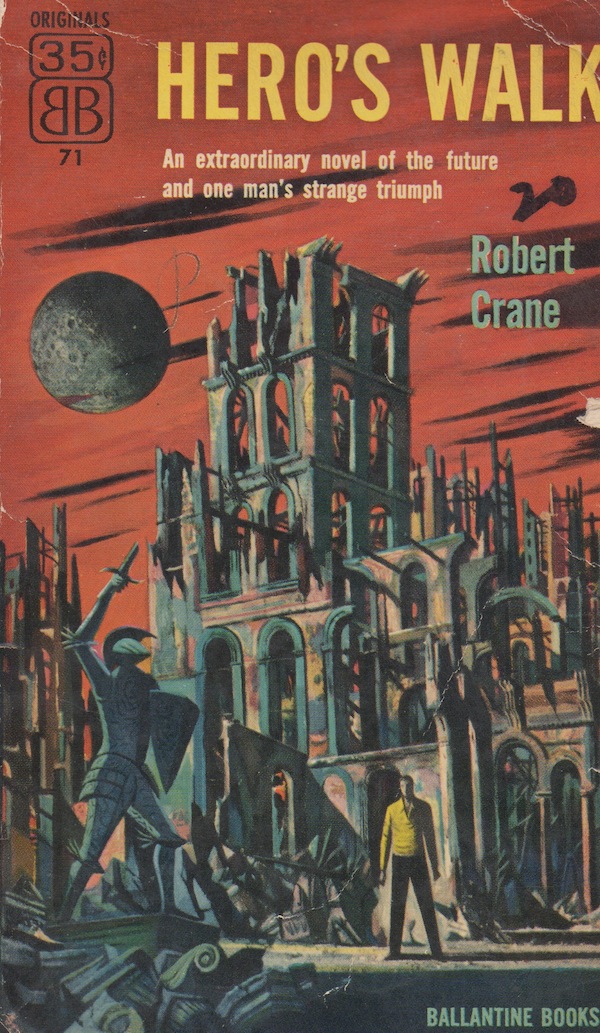 Hero’s Walk, Robert Crane, 1954
Humanity has united under a world government called InterCos, and has set out to boldly colonize the rest of the solar system. But strange, disturbing radio transmissions from space may be an alien warning against humanity’s imperialist ambitions. The politicians wrangle over the meaning of the transmissions, and use the issue to do what politicians always do – further their own power. Disregarding the frantic warnings of a desperate scientist who sees the alien threat, InterCos moves ahead with colonization, until the alien bombs start to fall. Hero’s Walk is basically a Cold War parable, published in the same year as the famous Oppenheimer security hearing, a critique of the reckless brinkmanship of the political leaders that threatened the world with the nuclear annihilation that scientists like Oppenheimer were warning about. Continue reading “Apocalypse 1954: Hero’s Walk”
 The Finch and Pea