
Very old cave art shows how technology drives science

The exciting science news in this week’s issue of Science is that some cave art in Europe is much, much older than previously thought, dating back to the earliest humans in Europe. The new dates make it more plausible that some of this art was created by Neanderthals, although that is speculative.

While old cave art is cool, you may be wondering, why are they just now getting around to figuring out these old dates? The answer is, the technology finally got good enough to do it. The Uranium-thorium dating was done by scraping off a few milligrams of calcite deposits that had formed over the cave art. Since the calcite deposits formed on top of the art, dating those deposits gives you a minimum age for the art.

When Uranium Thorium dating was first invented, you needed tens of grams of sample, but the sensitivity of the technology has now improved 10,000-fold. You can take tens of grams of sample out of priceless cave art, but you can take a few milligrams.

And so, the new dates are not the result of some brilliant new, abstract, deep insight – they’re the result of amazing improvements in technology. Science is driven at least as much by technology as it is by ideas.
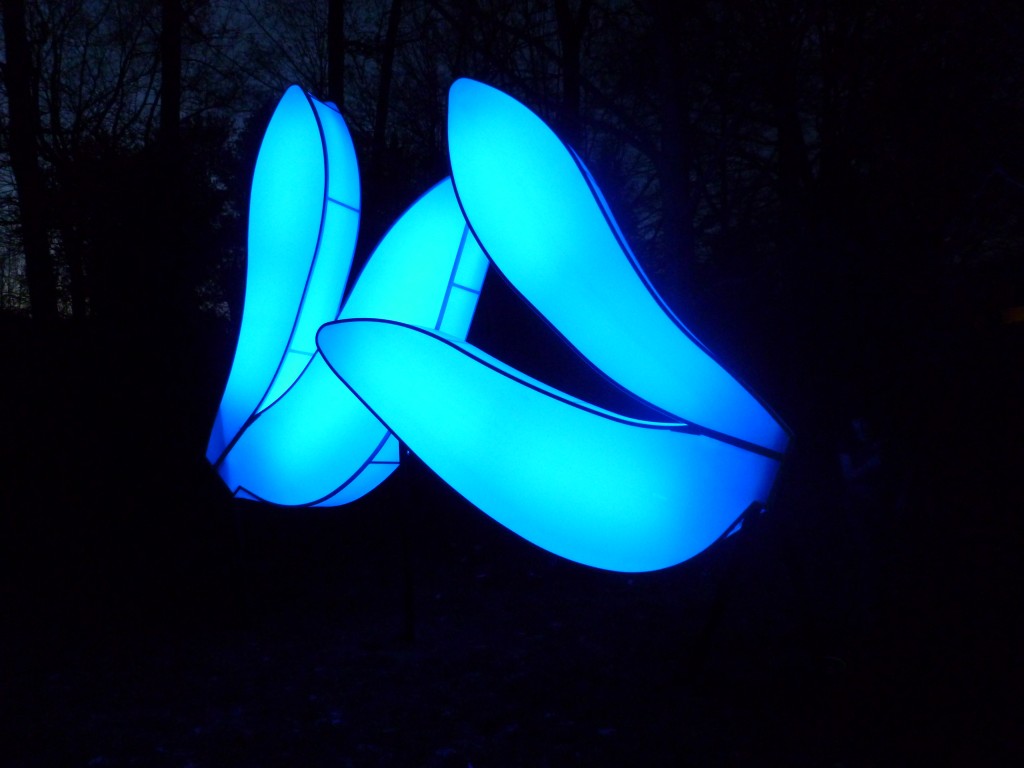
The Art of Science – Love Motel for Insects

Love Motel for Insects - DC

Love Motel For Insects is an outdoor light installation by Brandon Ballengée in the shape of giant dragonfly wings. The piece, which uses ultra-violet lights on blank fabric to attract insects, creates an opportunity for public interactions with nocturnal arthropods.  Ballengée, an American artist who has been working with environmental themes for years, began creating pieces to attract insects in Central America in 2001.

The dragonfly-wing sculpture seen here, which was on display at the Smithsonian’s National Zoo in Washington DC from March 24- June 10, 2012, is one of many such “love motels” that Ballengée has built.  According to the artist, ” Love Motel for Insects is an ongoing series of outdoor installations intended to construct situations between humans and arthropods. The works use ultra-violet lights on enormous blank canvases to attract insects and create an opportunity for public interactions with rarely seen nocturnal arthropods.  At each location, the Love Motels for Insects become the backdrop for community events such as picnics, biodiversity festivals, graffiti jams, scientific investigations, musical events and even local film screenings relating to local insect species.”

Currently, a piece in the shape of a luna moth is on display in New York City at the  sculpture court of  Jim Kempner Fine Art, at 501 West 23rd Street from June 9 through August 4 2012. Click here for more information. You can find out more about Ballengée’s other environmental artwork at this website.

What’s cooler than information and entropy?

The answer is, of course, not much. A subject near and dear to my heart: Evolution, Entropy, and Information, over at Cosmic Variance, referencing John Baez’s great series on information geometry (latest entry here).

For a project I’m working on, I’ve lately been considering the various ways your DNA can be considered to contain information, and how we can use information content to read DNA sequences. Information theory has of course been used for a long time to find functional sequences in DNA (see this classic paper). This is what we call bioinformatics, but there are also more physical reasons to use information theory to understand biology. There are deep relationships between information, thermodynamics, and computation (PDF), which we can use to understand how the thermodynamic system of the cell processes information contained within DNA.

There will be more on this in the future, but in the mean time, go check out the links.

Sunday Poem

In memory of Ray Bradbury, this week’s Sunday poem is “To Know What Isn’t Known, That’s Mine”, from his 2002 collection I Live By the Invisible, published by Salmon Poetry (buy the book*, support poetry and small indie publishers).

From my perspective as a scientist, the title of the poem alludes to science, but it also alludes to the process of writing. Bradbury begins by explicitly suggesting that writing has the same aim as science. The rest of the poem, while clearly referring to the struggle of the imagination engaged in by writers, also aptly describes the mental wrestling of scientists.

Read this poem and remember why Bradbury was acknowledged as the lyricist of science fiction.

To know what isn't known, that's mine,
My job, refining blood
To find what's good and bad in it,
What in the quick cell lies,
What dies or lives or lingering
Provides the key where all the good stuff hides.
I do not know it, cannot find it, so I try
With words to jump the pheasants forth Continue reading "Sunday Poem"

Even Boltzmann had trouble with probability

Boltzmann was one of the genius founders of statistical thermodynamics, and yet the subtleties of probability tripped him up:

From “Compendium of the foundations of classical statistical physics” by Jos Uffink:

He introduced the probability distribution as follows:

“Let (v)dv be the sum of all the instants of time during which the velocity of a disc in the course of a very long time lies between v and v + dv, and let N be the number of discs which on average are located in a unit surface area, then

N ϕ(v)dv

is the number of discs per unit surface whose velocities lie between v and v + dv” Continue reading “Even Boltzmann had trouble with probability”