Aging of the scientific workforce

Another snippet from from Paula Stephan’s How Economics Shapes Science (Harvard University Press, 2012). Everyone interested in a science career should read this book.

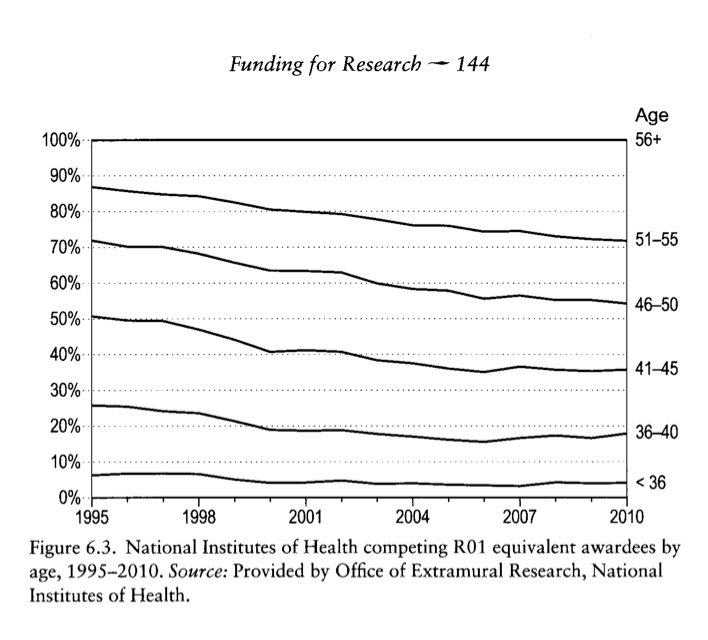
This figure shows how younger scientists have been squeezed out of funding, while the over 55 group has grown:

The state of R01 funding and how we got here

A snippet from Paula Stephan’s How Economics Shapes Sciencep. 141-143, Harvard University Press, 2012:

“The NIH Doubling: A Cautionary Tale”

It is tempting to assume that money is the answer to many of the problems that plague peer review and, more generally, the university research enterprise…

But anyone who thinks so should be careful what they wish for. The doubling of the NIH budget between 1998 and 2002 ushered in a host of problems…

Faculty were spending more time submitting and reviewing grants. Although early in this century 60 percent of all funded R01 proposals were awarded the first time they were submitted, by the end of the decade only 30 percent were awarded the first time… [T]here is little evidence that the increase translated into permanent jobs for new PhDs, as had been the case in the 1950’s and 1960’s when government support for research expanded. Continue reading “The state of R01 funding and how we got here”

Science Summer Books

Science has it’s annual summer books issue out this week.

Be sure to check out the review Darwin’s Devices: What Evolving Robots Can Teach Us About the History of Life and the Future of Technology by yours truly: “Evolution and Robots.”

A teaser:

I am envious of those who when asked what they work on can respond, “I study the evolution of robots.” John Long (a vertebrate physiologist at Vassar College) is one such researcher, and reading Darwin’s Devices is like listening, over drinks, to a voluble, engaging, and funny scientist tell you about his work. On occasion, his jargon gets a little heavy, he will toss in an unexplained concept, or he will digress about his youthful dreams to join the Navy. But for the most part, Long draws you into a compelling and wide-ranging conversation. This includes discussions of the mechanics of fish backbones, how we practice science, the nature of evolution, what it means to be intelligent, our dystopian robot future, and, most important, the crucial role of good models in science.

Beginning of the end of AIDS

This is amazing, given that it has been only 30 years since AIDS first started to have global repercussions, and given how very little we knew about viruses in the early 80’s:

Diane Havlir, M.D., and Chris Beyrer, M.D., M.P.H, The New England Journal of Medicine:

We are at a moment of extraordinary optimism in the response to the human immunodeficiency virus (HIV). A series of scientific breakthroughs, including several trials showing the partial efficacy of oral and topical chemoprophylaxis1,2 and the first evidence of efficacy for an HIV vaccine candidate,3 have the potential to markedly expand the available preventive tools. There is evidence of the first cure of an HIV-infected person. And most important, the finding that early initiation of antiretroviral therapy can both improve individual patient outcomes and reduce the risk of HIV transmission to sexual partners by 96%4 has led many to assert what had so long seemed impossible: that control of the HIV pandemic may be achievable.

The Art of Science – Crowdsourcing Sheep

Aaron Koblin is an American tech-design prodigy who gave a TED talk in his 20s and now has an amazing job with Google. So why was he paying people 2 cents a pop to draw pictures of sheep on computers? I’ll let him explain in his own words.

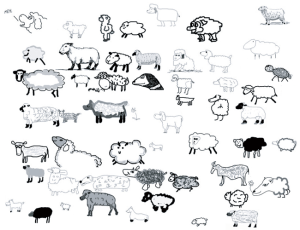
“The Sheep Market is a collection of 10,000 hand-drawn sheep from online workers collected through the Mechanical Turk. The Mechanical Turk is a web service created by Amazon to provide “artificial artificial intelligence,” now known more commonly as “crowdsourcing.” I was immediately intrigued by the concept of using thousands of idle brains, and have long been impressed by projects like SETI@home, which use idle CPU time on people’s computers to tackle problems too big for a single machine or cluster. This however, was different; these aren’t idle boxes, these are people. I wanted to visualize this and think about this kind of system, which will inevitably become more common.”  (source)

Koblin created a tool for recording drawings and posted the tool online paying $.02 (USD) for each worker’s sheep.  He was able to view, approve, and reject each sheep (662 drawings didn’t meet “sheep-like” criteria). Finally, he gathered all 10,000 sheep into a matrix on a website, which he describes as “a market place for inspecting and collecting the individual sheep.”

The resulting artwork has been exhibited in Spain, Japan, the US, the Netherlands and Australia. You can examine it at the macro and micro level (even see how each sheep was drawn) at the Sheep Market website and see many more projects at Koblin’s own site.