
Nightmare data

The lovely and affable Tyler Dukes* has successfully pitched a session for the Science Writers 2012 meeting in October on dealing with “nightmare documents”:

Investigative science writing like this isn’t unique — but it’s a lot more rare than it should be…it’s expensive and time consuming. And more and more often, it’s becoming an unavailable option to news organizations looking to cut costs…In late March, I issued a broad-based call for what I called “nightmare documents,” the sorts of opaque public records that can be a real pain for journalists trying to use them in their reporting…Impossible-to-analyze databases. Government records hidden behind clunky Web interfaces. Unsearchable public reports digitized on ancient scanners.

I’ve encountered the same problem, not as a journalist, but as a researcher – datasets that are “shared” or “publicly available” that are almost unusable due to poor formatting and annotation. Although many journals require datasets to be made available, the requirements for useful formatting and annotation, even at public data repository sites, are usually laughable. And, most busy researchers can only be bothered to meet those minimal standards (eg, “Do you think that is good enough for them to let us publish? Cause I got a grant due.”).

I am happy to say that this is an issue of which Open Data advocates are well aware and are taking concrete steps to address.

*We say nice things about people who want to interview us; and by “us” I mean “me”. Mike says positively horrid things about everyone he talks to.
Is scientific writing designed to suck?

I disagree with this at Scientific American:

The conventions of scientific writing have two goals: to convey authority, and to demonstrate the author’s objectivity. Conventions that convey authority include a standardized article structure (Introduction, Methods, Results, Conclusion); booster words (Scientific articles contain more booster words [clearly, obviously] than other research articles, but less hedge words [may, seem, possibly].); and invocations of doom (To justify experiments articles often begin with overblown sentences like “As we all know, all species are dying.”).

Conventions that convey objectivity include the erasure of scientists as actors in their own experiments via past passive voice (e.g. “the chemicals were heated” versus “I heated the chemicals”) and the use of nominalizations or zombie nouns, which make actions themselves less visible by presenting their results as states of being (Compare “The rate was a reflection of population density increases,” to “The rate reflects an increased population density.”). – “Scientists as Writers”, Laura Jane Martin

Let’s be clear that we’re talking about research papers here, and not popularization of science. The goals of scientific convention are to present your data and make arguments as clearly and efficiently as possible.

When I read a scientific paper I’m not asking myself, ‘are these authors objective?’ Frankly, I don’t care whether they’re objective or not. Objectivity is overrated. I want to 1) understand what the authors did, 2) judge whether their methodology is sound, and 3) decide whether I agree with their arguments about the data.

Actually, as Laura Jane Martin points out, “today’s conventions emerged in a seventeenth century attempt to make scientific writing clearer.” So in fact I don’t disagree with her. Continue reading “Is scientific writing designed to suck?”

The law of supply and demand applied to NIH funding

Demand for funding has increased, but something tells me that the supply is not going to adjust. From the AAAS this week:

NIH Blog Highlights Increases in Research Grant Applications. On her blog Rock Talk, NIH Deputy Director for Extramural Research Sally Rockey posted data on NIH grant applications over the past decade-plus—specifically, competing applications for investigator-initiated research project grants (meaning they were not submitted in response to a specific request for applications). Total direct costs requested in such applications went from $4.4 billion in FY 1998 to $13 billion in FY 2011. The amount of money awarded in that pool doubled, from $1 billion to $2 billion. Put another way, in FY 1998 the demand for research dollars was 3.6 times the supply. By FY 2011, demand was 6.5 times the supply. The largest factor in this change is a rise in the number of applicants — from 19,000 to 32,000.

The solution – reduce demand by attrition, as people realize this career path is insane.

The Art of Science: Mika Aoki

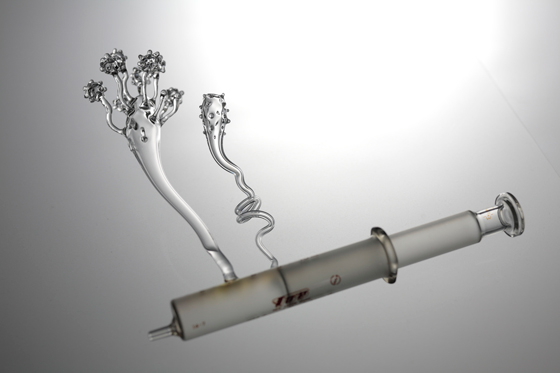
Mika Aoki is a Japanese artist working mainly in glass. Her work, which features crystal-clear groupings of spore- and cell-like objects, treads a line between science and fantasy. Of this piece, Syringe, from 2009, Aoki says, “I got this theme from the idea of a sperm bank. Sperm donations are classified according to educational background or appearance. Great expectations are entrusted to microscopic life which can be sucked up by syringes. From this point of view, I notice that my personality is breathing within each cell of my body.” (source)

A viewer who didn’t know Aoki’s intent might see other possibilities in this piece, however – perhaps the specter of hospital-acquired infections or the idea behind vaccinations, of injecting ourselves with viruses to protect ourselves from them.

You can see more of Mika Aoki’s work at her website.

“Science writing in the Age of Denial”

I don’t know how I missed news of this April event at the University of Wisconsin, but no matter – video is online:

Science writers now work in an age where uncomfortable ideas and truths meet organized resistance. Opposing scientific consensus on such things as anthropogenic climate change, the theory of evolution, and even the astonishingly obvious benefits of vaccination has become politically de rigueur, a litmus test and a genuine threat to science. How does denial affect the craft of the science writer? How can science writers effectively explain disputed science? What’s the big picture? Are denialists ever right?