Scientists, journalists and policy-makers gathered in Washington, DC this week for the International Summit on Human Gene Editing at the National Academies of Science. The meeting, which NAS co-hosted with the Chinese Academy of Sciences and the U.K.’s Royal Society, was billed as a global discussion of “the scientific, ethical, and governance issues associated with human gene-editing research.” In particular, the summit focused on the implications of the emergence of CRISPR, a new gene-editing technique which is cheaper, more versatile and more precise than any currently in use.
This topic is a little complex for cats, so we’ll let the experts help out. Ed Yong, in The Atlantic, outlines the basics of the technique and what scientists are working on to make it even better, while Tina Saey writes in Science News about the significant safety and ethical issues and the guidelines in place for further development.
While scientists work on the fancy new stuff, cats will continue to use their traditional techniques for editing your jeans – shedding, clawing and nomming.
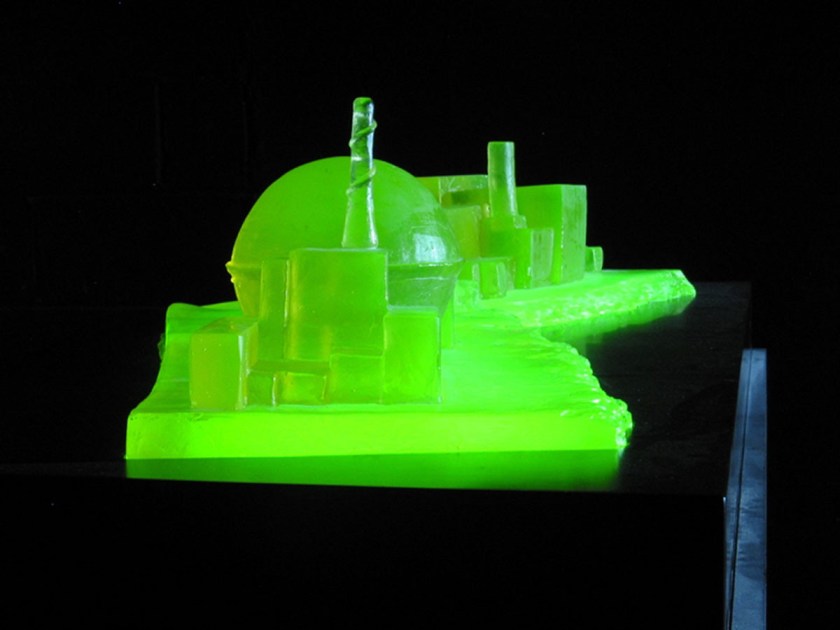
Dounreay Power Station, Kate Williams and John Lloyd, Uranium Glass, 2006
Kate Williams, a London-based sculptor, describes her medium as “glass and light”. She explores the scientific, cultural and artistic elements of both in her Glass Nuclear Power Station Project, a series of sculptures of nuclear power stations made from cast uranium glass in collaboration with John Lloyd.
Williams created small cast-glass replicas of four nuclear power plants. Three are real plants in Europe (Sizewell, Dounreay and Doel) while the fourth is Springfield, the fictional workplace of Homer Simpson. Says Williams, “We wanted to celebrate these post war monuments to cheap unlimited power. They act as eulogies to collective human desire and its consequent disenchantment. In their de-commissioning they are being eradicated from the landscape but their legacy lives on in our imaginations and memories” and of course also in the form of nuclear waste.
The sculptures are cast in uranium glass, which is pretty much what it sounds like – a type of glass to which uranium has been added for color and fluorescence. Williams describes the glowing yellow-green of the sculptures when lit as “both unsettling and attractive, which somehow represents our complicated relationship with radiation.”
The Glass Nuclear Power Station Project is on view at Compton-Verney in Warwickshire, England through December 13 as part of the exhibition Periodic Tales. You can read more about Kate Williams at her website.



 The Finch and Pea