Art of Science: A high-Tech Ode to Vanishing Species

luola2_b
Kirsi Kaulanen, Luola, Stainless Steel and Light, 2011

Absence and loss can be tricky concepts to convey in visual art, but sculptor Kirsi Kaulanen has found a way. In her 2011 sculpture Luola (Cave), Kaulanen uses industrial materials and modern technology to affectingly express the disappearance of the natural world. To highlight the loss of plant species in her native Finland, Kaulanen built a three-sided structure of stainless steel and used lasers to cut the shapes of plants in danger of extinction. She uses lights to throw the silhouettes of the plants onto the surrounding walls, creating an effect of shadows, or shades, like the ghosts of dead flowers. Visitors can enter the cave, combining their shadows with those of the plants, as a reminder that one day, we too will be gone.

You can see more of Kaulanen’s work at the Korundi cultural center in Rovaniemi, Finland, or at her website.

Sciart Caturday

teapotscarf

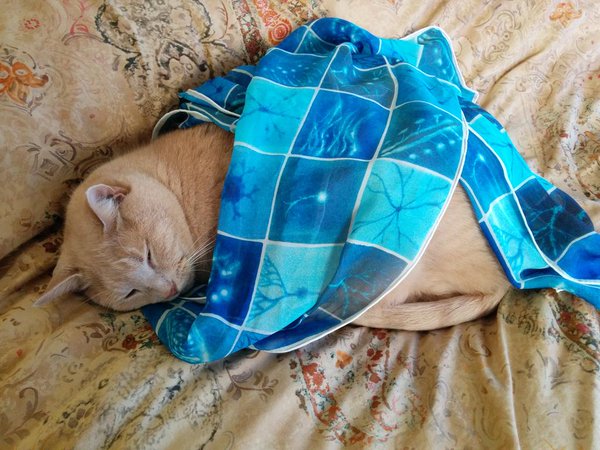
Teh science kittehs have a week off while I sell art at DC’s Downtown Holiday Market. Only Teapot the kitteh is still working, modeling one of my science scarves. If your cat (or hoomin) would like one too, you can find them here.


Science for the People: Where do Camels Belong?

sftp51dorvo2v9l-_sl250_This week on Science for the People, we’re discussing ecosystems, biodiversity, and whether or not “invasive” outside species are really as bad as they’re made out to be. We’ll spend the hour speaking to Dr. Ken Thompson, lecturer in the Department of Animal and Plant Sciences at the University of Sheffield, about his book Where Do Camels Belong? Why Invasive Species Aren’t All Bad.

Science for the People is now part of the Skepchick Network.

Don’t forget to support the Science for the People on Patreon to keep the sciencey goodness flowing toward your ear holes.

*Josh provides research help to Science for the People and is, therefore, completely biased.

Art of Science: Time and Ice Melt Away at COP21

eli2

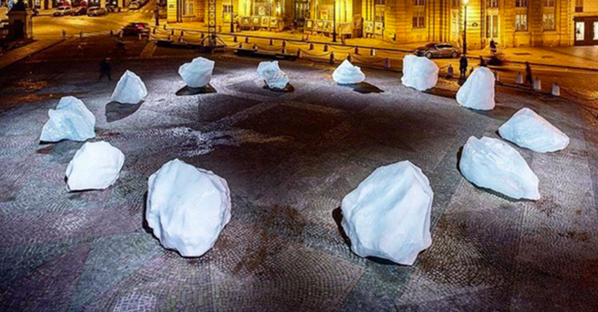
If you‘re hosting a big gathering, you can always count on Olafur Eliasson to bring the ice. Two years after he brought chunks of an Icelandic glacier to MoMA PS1 in New York, Danish-Icelandic artist Eliasson has trucked 80 tons of Greenland glacier to Paris, where the UN Climate Summit (COP21) is being held.

The installation, now melting slowly in front of the Panthéon , is called Ice Watch. The twelve boulders of ice are arranged like a watch, or clock face, to indicate the passing of time. Visitors can see the ice dwindle over the course of the summit, observing for themselves the disappearance of ice which has endured for centuries. You can see photos and video of the gradual melt on Studio Olafur Eliasson’s Instagram account. (So far they seem to be holding up pretty well.)

Eliasson, who created the work in collaboration with geologist Minik Rosing, specifically chose calved chunks of icebergs made of compressed snow for the installation, to highlight the importance of ice in preserving history.  As Rosing explained to the New Yorker, “Inside the iceberg, you see snow layers in sequence as you go back in time. Because it is compressed, the air between the snowflakes that fell thousands of years ago is trapped in tiny bubbles.”

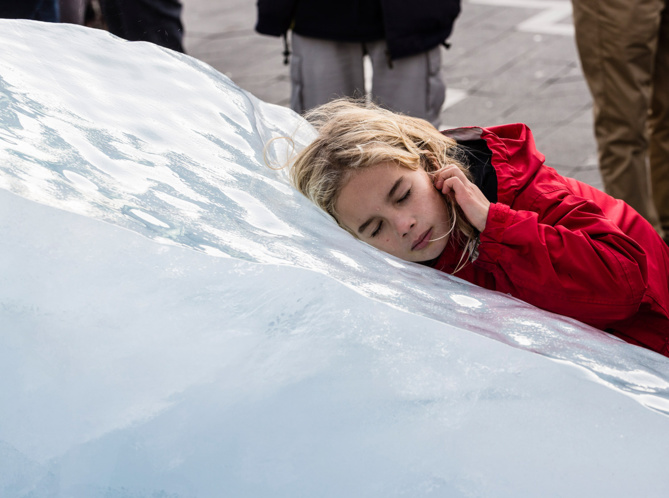
Besides watching the melting, visitors to Ice Watch can hear the ice cracking as it releases air that is thousands of years old. Says Eliasson, “It is a little pop that has travelled fifteen thousand years to meet you in Paris, and tell the story of climate change.”


listenice

Of Mice and Men – a poem

Every line in this poem is the title of a scientific article. References below. Reposted from easternblot.net.
mouseOf mice and men?1

Of mice and men.2
Of mice and men, metals and mutations.3
Of mice and men, corticosteroids, and vicarious participation.4
Of mice and men–universality and breakdown of behavioral organization.5
Of mice and men: the riddle of tubular regeneration.6

Of mice and men: the human sciences and the humanities.7
Of mice and men: skin cells, stem cells and ethical uncertainties.8
Of mice and men. 9

Of mice and men, rats, and atherosclerosis. 10
Of mice, cats, and men: is human breast cancer a zoonosis?11
Of mice and men. 12

Of mice and men: a model of HIV encephalitis.13
Of mice and men: murine models of anti-GBM antibody nephritis.14
Of mice and men: genetic skin diseases of keratin.15
Of mice and men. Honesty and integrity in medicine.16

Of mice and men.17
Of digital mice and men. 18
Of cholesterol-free mice and men. 19
Of (stressed) mice and men.20
Of (only) mice and men.21
Of mice and men…but so much more too!22

Of mice, men, and physicians.23
Of mice, men, and trypanosomes.24
Of mice, men, and cholesterol.25
Of mice, men and the genome.26

Of mice and men, and chandeliers.27
Of mice and men…and elephants. 28
Of mice and men – and lopsided birds. 29
Of mice and men: the road to tolerance. 30

Of mice and men: the evolving phenotype of aromatase deficiency.31
Of mice and men: an introduction to mouseology or, anal eroticism and Disney.32

Of mice, and other beasts, and men. 33
Of mice and men (and cows and cats)34
Of mice–and rats, dogs, rabbits, cats, and monkeys–and men.35
Of fruit flies, mice, and men: the illicit review of science. 36
Of flies, mice, and men.37
Of mice and men.38

Of mice and men…and broken hearts.39
Of mice and men: the tale of two therapies.40

Of mice and men: the mice were right.41

Continue reading “Of Mice and Men – a poem”