Held: Genes are products of nature

Today the US Supreme Court rules that there cannot be patents on genomic DNA information (PDF – 139kb), only modified DNA products like cDNA. Note that the decision was effectively unanimous, the opinion was written by Thomas, and Scalia’s concurrent opinion is essentially an admission of ignorance in the specialty field. I have not had time to read the full opinion, but at initial review this seems like a very reasonable result. Naturally occurring DNA sequences are, well, natural. Sequences modified with intent may be patent eligible. It will be interesting to see in the future if discovery of naturally occurring sequences that are identical to patented sequences modified naively to match a natural variant will invalidate patents.

Myriad’s DNA claim falls within the law of nature exception.Myriad’s principal contribution was uncovering the precise location and genetic sequence of the BRCA1 and BRCA2 genes…Myriad did not create or alter either the genetic information encoded in the BCRA1 and BCRA2 genes or the genetic structure of the DNA. It found an important and useful gene, but groundbreaking, innovative, or even brilliant discovery does not by itself satisfy the §101 inquiry…Myriad’s patent descriptions highlight the problem with its claims: They detail the extensive process of discovery, but extensive effort alone is insufficient to satisfy §101’s demands. Myriad’s claims are not saved by the fact that isolating DNA from the human genome severs the chemical bonds that bind gene molecules together. – SCOTUS (PDF -139kb)

Get ya some….Experience

Image courtesy of Elyce Feliz

Would you like to know what those evil reviewers are saying about your first RO1 submission? Want to learn what separates fundable and unfundable grant submissions? Apparently, there’s a program for that! The Early Career Reviewer Program recruits new principal investigators (PIs)(regardless of whether a researcher has ever received NIH funding) to join study sections relevant to their field and participate in the review process. Continue reading “Get ya some….Experience”

Meet the Alligator Snapping Turtle

Alligator Snapping Turtle, Photo Credit: Melissa MB Wilkins (CC BY-NC 2.0)

The Alligator Snapping Turtle (Macroclemys temmincki) is the largest freshwater turtle. It has a pointed break and a vermiform (wormlike) tongue, which acts as a lure for fish as the turtle sits on the murky bottoms of ponds and bodies of water.

Check out a video of the Alligator Snapping Turtle feeding courtesy of ARKive.

“Meet the…” is a collaboration between The Finch & Pea and Nature Afield to bring Nature’s amazing creatures into your home.

Trying to explain “Fair Use”

If I have learned one thing from reading Cory Doctorow’s novels, it is that you do not want to be sued by Disney. That means that you probably want to be familiar with the Fair Use concept from Copyright Law. I’m not a copyright lawyer. The odds indicate that you are not a copyright lawyer. This means that neither of us is truly familiar with the Fair Use concept from Copyright Law.

Fortunately, the American University Center for Social Media has published a Set of Principles in Fair Use for Journalism:

This document is a statement of principles to help journalists in the United States interpret the copyright doctrine of fair use. It is intended for anyone who engages in the set of practices that entails creating media of any kind that refers to real-life events of public interest, in service of public knowledge, whether that person is a full-time professional or an individual who takes it upon himself or herself to report about specific issues or events…Fair use is the right to use copyrighted material without permission or payment under some circumstances—especially when the cultural or social benefits of the use are predominant.

It is intended for “journalists”, but I’m not really sure what that means anymore, either. Heck, they happily punt on the definition too. If you ever feel the urge to write things related to copyrighted material, you probably want to review this.

*Hat tip to Ellyn Angelotti at Poynter.


The Art of Science: Shimmer and Shift

butterflyaschenk
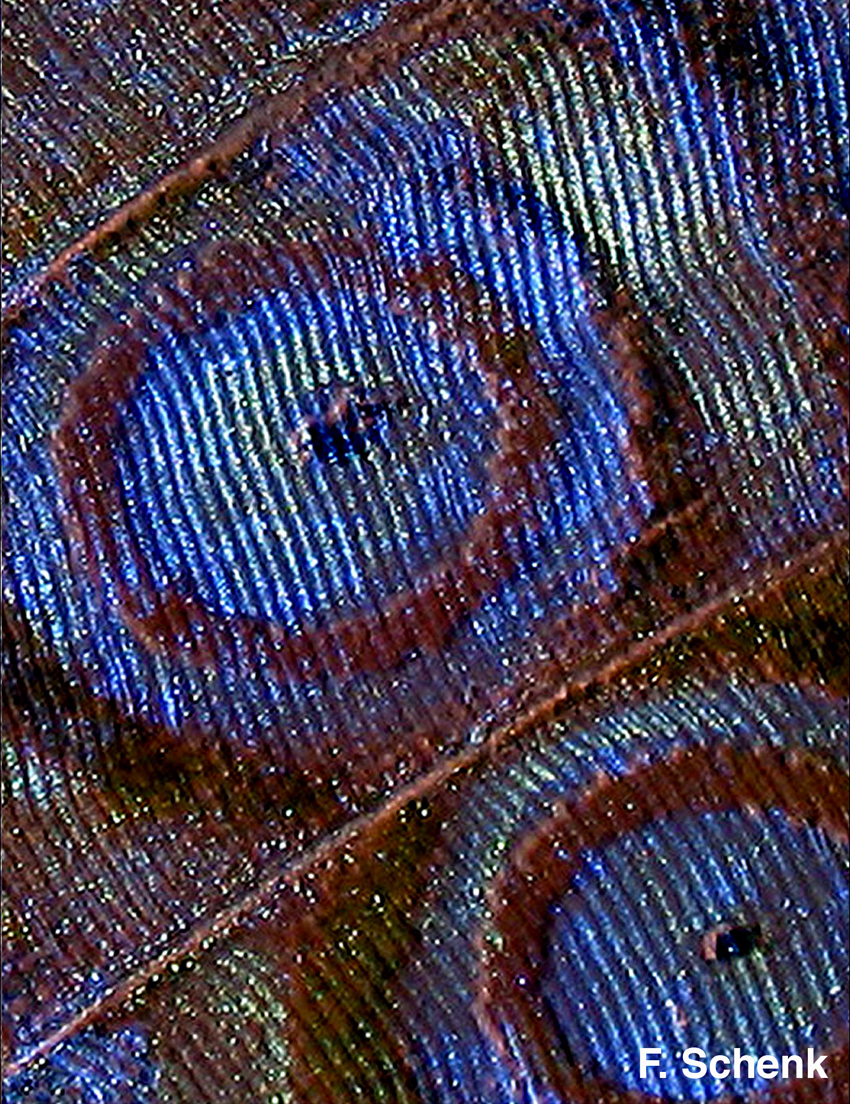
Detail of painting of butterfly wing from The Art of Iridescence, 2010-11

Like many painters, Franziska Schenk is inspired by what Darwin called the “endless forms most beautiful” of the natural world, and the dynamic processes of evolution, predation and camouflage. As she delved deeper into her work, she became particularly interested in iridescence, the property that allows some surfaces to appear differently colored depending on the angle or light in which they are viewed. Generations of painters have developed techniques to suggest the effect of iridescence – Schenk decided to apply a little science. Continue reading “The Art of Science: Shimmer and Shift”