Professionally, I wear a lot of hats. Personally, I very rarely wear hats, except for in the dead of winter, which rarely occurs here in South Carolina, because my head is very large, and finding hats (but not commas) that fit is very hard. One of those hats is was as the “researcher” for the science podcast, Skeptically Speaking.
There are loads of salamanders that don’t necessarily fit into our idea of a salamander. The amphiuma is one example. There are three species of one-, two- and three-toed salamanders and all are fully aquatic. Depending on the species they can be between 33 and 110 cm, but their legs stay T-rex style. They inhabit the southeastern United States, and although relatively common they are sadly understudied.
Here is a video to learn more:
Even though the legs are vestigial, the amphiuma is still able to traverse across land.
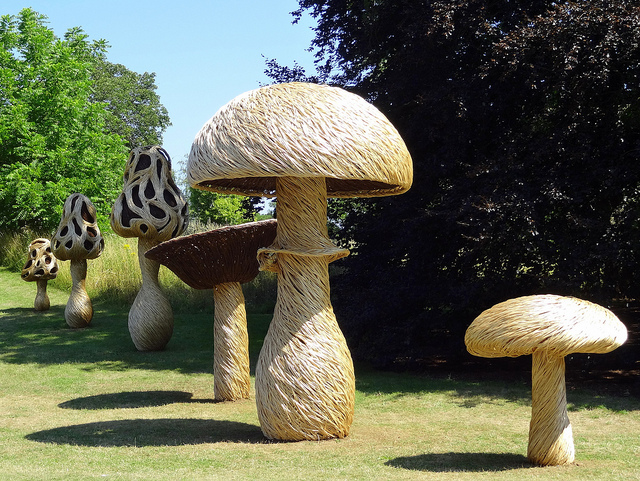
Gigantic fungi have sprouted in London’s Kew Gardens, thanks to sculptor Tom Hare, who created an installation called Fungi Fairy Ring for the IncrEdibles exhibit, a celebration of “autumn’s edible delights” that runs through November 3rd. Working with mycologists from Kew’s Fungarium, Hare created a series of sculptures made from woven willow, representing seven different species of native edible fungi. The sculptures, which tower up to 12 feet, are based on close collaboration with scientists to ensure that they not only portray each type of fungus accurately, but also show various stages of their life cycles. Not to mention that their giant size makes them ideal to use as backdrops for photos of full-sized humans as gnomes and fairies.
They also provide a perfect visual for the UK’s first National Fungus Day, which takes place this coming Sunday, October 13. It will be celebrated at Kew with a full program of events including tours of the Fungarium, fungi-spotting walks, model-building and mushroom soup. Many other events are happening in other cities – see ukfungusday.co.uk for details
I think this post might be better categorized as Have “Science” Will Travel. A few weeks ago I went up to Maine to see some nature and get my lobster on. In my search for interesting things to do, I came across the International Cryptozoology Museum. At first I thought it was a museum of micro-organisms (my grasp of Greek prefixes may not be what it should)…but oh my, it was so much better than that. Cryptozoology is actually the study of and search for animals whose existence has not yet been proven (Like Nessie…or Bigfoot). Continue reading “The International Cryptozoology Museum”

 Professionally, I wear a lot of hats. Personally, I very rarely wear hats, except for in the dead of winter, which rarely occurs here in South Carolina, because my head is very large, and finding hats (but not commas) that fit is very hard. One of those hats is was as the “researcher” for the science podcast, Skeptically Speaking.



 The Finch and Pea