Things that I’m not thankful for: this week in Pacific Standard, I argue that Congress is like my former landlord, who did a major remodel on his rental property and then let his investment rot away due to neglect. The NIH budget is now substantially lower than it would have been if there had been no budget doubling, and instead, it grew at its previous, pre-doubling historical rate of 3.3% in real dollars (see figure). It’s as if the doubling never happened.
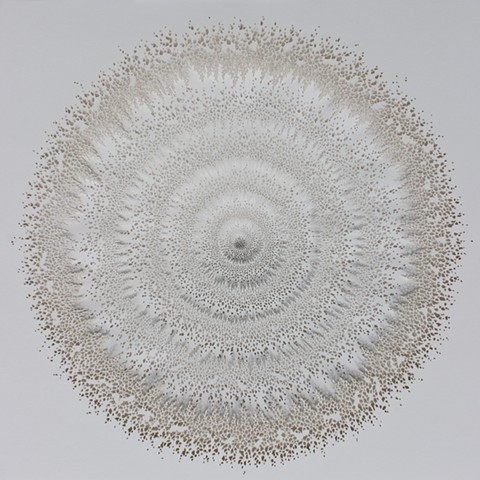
For artist Rogan Brown, the process of making his cut-paper sculptures is as important as the finished product. Each artwork is built from painstakingly cut and assembled pieces of paper – an arduous, time-consuming task. Says Brown, “The finished artifact is really only the ghostly fossilized vestige of this slow, long process of realization. I have chosen paper as a medium because it captures perfectly that mixture of delicacy and durability that for me characterizes the natural world.”
I would add that by working only in white, Brown amplifies the impact of his incredibly complex works, putting the focus squarely on what Darwin called “endless forms most beautiful.”
Clone, 2012
Brown says he is inspired by natural shapes and patterns “from the microscopic to the macroscopic, from individual cells to large scale geological formations”. While his art, and the process of study that precedes each piece, pay tribute to scientist-artists such as Ernst Haeckel, Brown does not seek to replicate nature. He rather describes his pieces as explorations: “Everything has to be refracted through the prism of the imagination, estranged and in some way transformed.”
You can see more of Brown’s work on his website and buy originals and prints here.
In 1958, Brussels was host to Expo ’58, the World’s Fair. The most famous structure left from the fair’s site is the Atomium, a 335-feet high model of the molecular structure of iron. To be precise, it’s a model that includes a unit of 9 iron atoms that forms the smallest repeating unit of a body-centered cubic lattice.
Representative Lamar Smith supports legislation to make NSF ensure each grantee is pursuing science in the national interest. Image courtesy of Wikipedia.
A particularly concerning piece of legislation is making its way around the House of Representatives. This bill would require that the National Science Foundation (NSF) justify each grant it awards with respect to its contributions to protect the “national interest”. Earlier in the year, a similar bill was proposed with an extremely limited definition of what would meet “national interest” criteria. While the current bill has expanded its definition of national interest to include economic competitiveness, health and welfare, scientific literacy, partnerships between academia and industry, promotion of scientific progress and national defense, legislation like this should be getting all scientists up in arms.
Predicting which avenues of science will lead to major breakthroughs in health or energy is almost impossible. This bill would severely limit early exploratory work that has yet to prove it is in the national interest. This political interference in the operation of the scientific enterprise is a very dangerous door to open. Decisions of what is in the national interest can very quickly become influenced by party politics and the interests of lobbyists. While it is important that NSF funds good proposals of sound science, requiring immediate association with national interest will lead to exaggerated claims by scientists and the exclusion of some of the future’s greatest breakthroughs.
Whether you are a scientist or not, reach out to your representative and let them know how this qualifier will negatively affect the scientific enterprise in the United States. If you don’t know who your representative is, you can find that information here.



 In 1958, Brussels was host to Expo ’58, the World’s Fair. The most famous structure left from the fair’s site is the


 The Finch and Pea