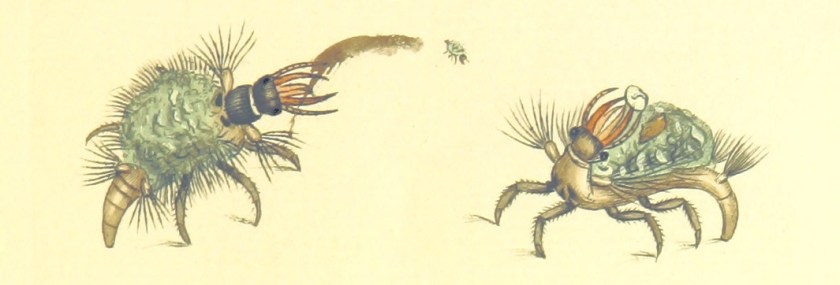
There was a time when, to be a biologist, you either had to be able to draw well (or be able to may someone to do your drawing for you). Toilets also did not flush. It was a rough time. You can revisit some of that magic at The British Library’s Flickr page where there are literally oodles of images from old books provided free from copyright restrictions, because the books are old.
I don’t know what this critter is*, but I am glad that I am a lot bigger than it is. I think I’m bigger than it…
*It literally comes from a tome entitled The British Miscellany: or, coloured figures of new, rare, or little known animal subjects, etc. vol. I., vol. II
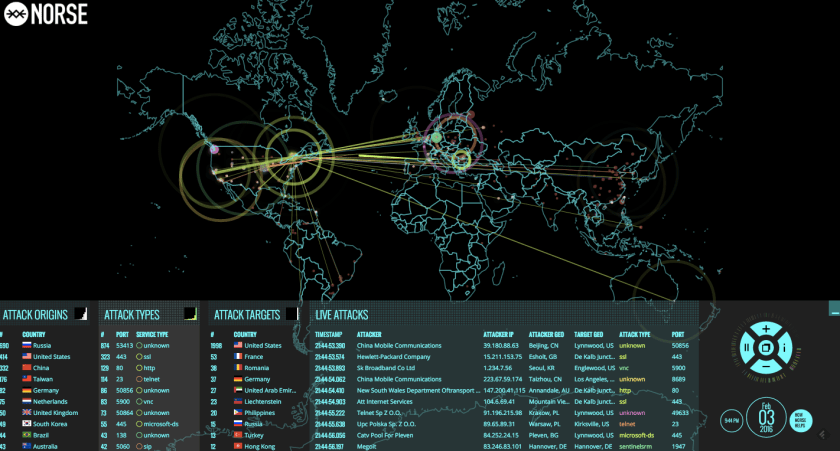
The Norse Attack Map provides a real time depiction of worldwide internet attacks from a network of “honeypots”. Informative, maybe. Hypnotic, definitely.
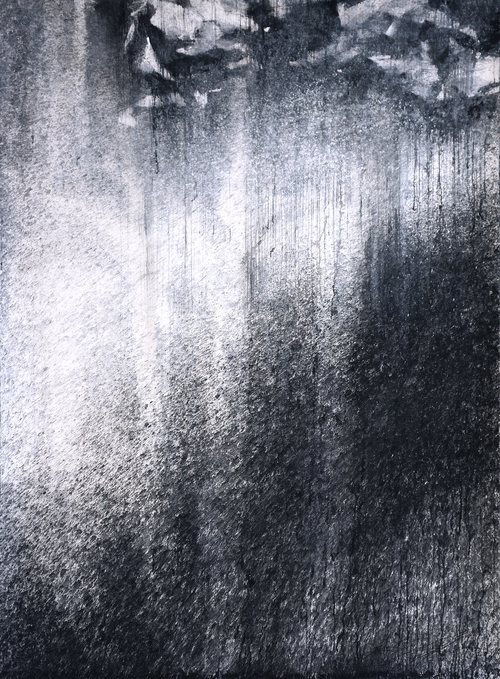
Ekaterina Smirnova, 67P V, Watercolor on Paper, 2015
Some painters grind their own pigments, but Ekaterina Smirnova is the first artist I know of who makes her own water. Smirnova was inspired by the landing of the robotic probe Philae on comet 67P Churyumov–Gerasimenko in 2014. When she learned that scientists had discovered that the water on the comet is very different from the water on Earth, she decided to try to generate water that is similar in composition to the water found on 67P and use it in her paintings.
Smirnova found out that the water on 67P was heavy water, containing D20, or deuterium oxide. Since it’s not the kind of thing you can pick up at the grocery store, Smirnova set about McGyvering a system to make some in her studio, using electrolysis. (blog) That didn’t produce quite the results she wanted, so she bought some from a nuclear energy source and mixed until she was satisfied.
The artist says that through her work she studies the relationship between humans and the universe. She is particularly interested in the vapor that is released when the comet passes close to the Sun, forming the comet’s tail.
67P VII, Watercolor on Paper, 2015
The focus on vapor and spray carries through to her painting technique: “I use splashing techniques, vaporizing watercolor paint before it hits the paper, this allows me to create an effect of mist, little droplets of water streaming with a strong force to the dark vacuum of space. Painting most of the work without touching paper with a brush, I use 30 to 40 layers, which helps to create complex textures on the painting.”
Next month, Smirnova will show her 67P-inspired work, including a musical collaboration to an audience of scientists at the 50th ESALAB Symposium which will be held in Leiden, in the Netherlands. If you can’t make it there, she’ll be showing in New York later this year.
Despite heavy competition, Microsoft co-founder Paul Allen emerged as obnoxious billionaire of the week, amid reports that his 300-foot luxury yacht destroyed 14,000 square feet of protected coral reef near the Cayman Islands.
According to the Cayman News Service, the anchor chain of Allen’s yacht, the MVTatoosh, caused “extensive damage” to the reef earlier this month. The incident comes just five months after Allen announced that he would provide funds for research to “stabilize and restore coral reefs” through his Seattle-based company, Vulcan.
A spokesman for Vulcan said Wednesday that the boat’s mooring position was “explicitly directed” by the local port authority and that Allen was not on board at the time. It added that Vulcan and the ship’s crew had immediately moved the ship from the affected area and were “actively and cooperatively working with local authorities to determine the details of what happened.”
Well, OK…but still, bad billionaire! Coral is precious. Fat Cats should be more careful.
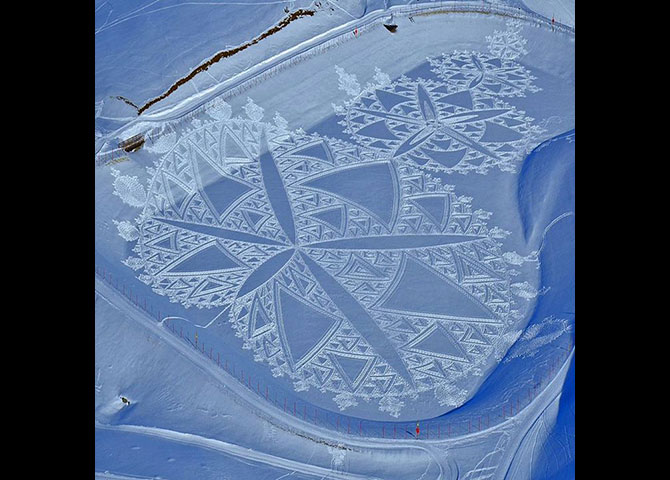
In the wake of snowstorm Jonas, the east coast of the US has been consumed with snow math – counting up the number of inches that fell, the miles of roads plowed, and the days of work lost – but that’s basic arithmetic compared to Simon Beck’s advanced snow mathematics.
A Mandelbrot Set in progress
For more than a decade, Beck has made elaborate designs in snow, mainly in the French Alps, using only snowshoes and a compass. He started out making mandala-like circular shapes, but moved on to much more complex designs over the years. Beck told Discovery News that he started incorporating fractal patterns into his work after reading James Gleick’s book “Chaos: Making a New Science.”
Each image takes him up to 11 hours to make, as he walks 25-30 miles to make a design of about 100 meters square. Beck says that he started making snow art mainly as a form of exercise, but it has now become his life’s work. You can see much more at his website.





 The Finch and Pea