Eggnog – Alcohol & raw eggs make the season bright [Repost]

Originally posted on 21 December 2012, the Traditional Egg Nog recipe has passed independent replication by Josh Witten.

My father is a very clever man. Long ago, as a Christmas Eve was coming to a close and we were preparing to plate up our milk and cookie offering to Santa, my dad stopped us with a suggestion. Arguing that, because our name was near the end of the alphabet, we were going to be one of the last houses Santa visited. Therefore, the jolly old elf would be very cold and tired of milk. Instead, we should leave him some bourbon to warm him up. It didn’t take long for our young minds to realize that a warmed up and happy Santa was much more likely to leave us better loot. As it happened, Dad had some of Santa’s favorite bourbon (parents know these things), which by amazing coincidence was also my dad’s favorite. I would hazard to say that this was the creation of our family’s traditional Christmas drink: alcohol.

In the spirit (or spirits) of my family’s holiday tradition, this post is going to celebrate my personal favorite Christmasy holiday drink: eggnog. Continue reading “Eggnog – Alcohol & raw eggs make the season bright [Repost]”

Christmas Shuffle [Repost]

The Best of ChristmasOriginally posted on 20 December 2012.

Last year our eldest daughter (then 3, now 4), The Frogger, fell in love with the song “Rudolph the Red-Nosed Reindeer”. This year she is obsessed with “A Holly Jolly Christmas”. It is no coincidence that both songs are performed by Burl Ives in the Rankin/Bass classic Rudolph the Red-Nosed Reindeer.

Cut to me, in the car, frantically pushing buttons to cycle through CDs and play Burl Ives singing “A Holly Jolly Christmas” in order to fulfill the heartfelt request of my child. Experienced parents will know that there are a variety of potential motivations for such behavior beyond simply avoiding a tantrum, for example cutting short a half-hour of repeatedly yelling the same three lines of the song with 73.21% accuracy.

Having found the correct CD and as I pushed buttons to get to the right track, I began to wonder if I was taking the shortest route to my song of choice. There are three possible routes to any given track on my car’s CD player. Continue reading “Christmas Shuffle [Repost]”

Science Caturday: Happy Winter Solstice

solsticecat

Today, December 21, 2013, marks the winter solstice in the northern hemisphere.

According to our friends at Wikipedia, “The axial tilt of Earth and gyroscopic effects of the planet’s daily rotation keep the axis of rotation pointed at the same point in the sky. As the Earth follows its orbit around the Sun, the same hemisphere that faced away from the Sun, experiencing winter, will, in half a year, face towards the Sun and experience summer. Since the two hemispheres face opposite directions along the planetary pole, as one polar hemisphere experiences winter, the other experiences summer.

More evident from high latitudes, a hemisphere’s winter solstice occurs on the shortest day and longest night of the year, when the sun’s daily maximum elevation in the sky is the lowest….The seasonal significance of the winter solstice is in the reversal of the gradual lengthening of nights and shortening of days.” (source)

Our science kitteh has kindly agreed to cut back his daily napping from twelve hours to ten for the occasion, with the proviso that he can attack the Christmas tree with impunity during the year’s longest night.

Meet the Marsupial Lion

1

Thylacoleo carnifex was a marsupial lion with weird teeth that was tearing up Australia from the late Pliocene to the late Pleistocene.

Here is a rendering of a cave drawing which is probably the worst cave drawing of all time:

figure2big

This is so bad that initially I assumed it was a cave drawing BY a marsupial lion.

Anyway, check out this National Geographic video to learn more:

“Meet the…” is a collaboration between The Finch & Pea and Nature Afield to bring Nature’s amazing creatures into your home.

The Art of Science: The Squeaky Reed

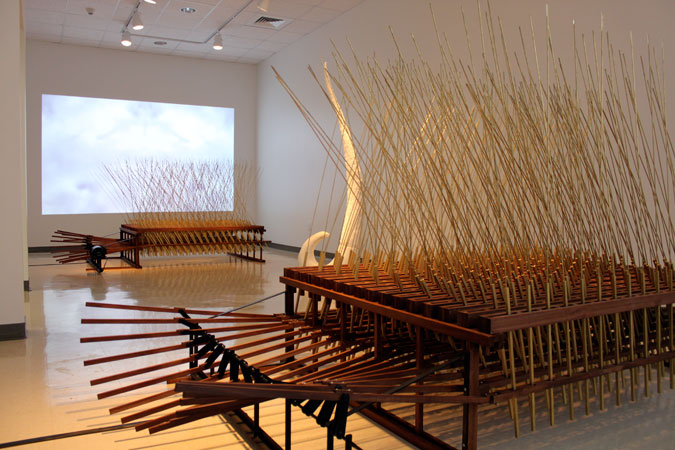
John Douglas Powers, Ialu, 2011

The new exhibit of kinetic sculpture at the MIT Museum is called 5000 Parts, which seems like a very low estimate when you consider the work of John Douglas Powers, who creates forms that mimic fields of grain and ocean waves, among other natural patterns of movement.

His sculpture Ialu, included in the show, is made of hundreds of wooden sticks or reeds mounted on beams which are moved by a motor. The reeds sway gently before a video of a cloudy sky. Unlike the idyllic scenes they conjure up, Powers’ sculptures squeak, clatter and groan as they move (watch video of the piece in motion here).  Although in some ways his evocation of the patterns of nature is uncanny, its artificiality is also on full display.

In his materials and gestures, Douglas pays tribute to nature. But his embrace of the mechanical, his unwillingness to hide the machinery, he nods to the extent – and limitations – of human ingenuity.

5000 Parts also features work by Arthur Ganson, Anne Lilly, Rafael Lozano-Hemmer, and Takis. It runs through November 2014 at the MIT Museum in Cambridge, Massachusetts.