But this research has found levels of complexity far deeper than Spemann would have conceived, and just as Spemann’s experiments told us how much we didn’t know, so today, we are faced with a whole new set of problems generated by our solutions to older ones.
Surveying the field in 1927, Spemann remarked:
We still stand in the presence of riddles, but not without hope of solving them. And riddles with the hope of solution – what more can a scientist desire?”
The challenge still remains.
*…and, admittedly, tortured sentence structure.
UPDATE: Hat tip to my human genetics research partner, Dr. Jennifer Taylor.
Don’t worry. Mike is still in charge of post-apocalyptic science fiction reviews.
But, let’s face it. Science doesn’t always pay well. Graduate school doesn’t. Post docs certainly don’t. Adjunct teaching? Don’t make me laugh. Science communication can be more feast than famine.
What I am trying to say is that the odds are good that you are living in a small apartment with a small kitchen and on a small food budget. In which case, good friend of The Finch & Pea‘s executive chef, Joel Gamoran, has got you covered in the first episode of his new cooking web series “Kitchen Wasteland”.
Joel was also kind enough to take some time to explain the science behind his recipe to me.
Me: What is happening when you add the pepper to the pan on it’s own?
Joel: The black pepper undergoes two major reactions happening when toasting in the dry pan. First, essential oils are released when agitated with heat. This is what gives the spice the smell that fills the kitchen. Second, oleoresins are released, which gives the spice a toasty and unique flavor.
Me: What is the water doing to soften the pasta and why can you get away with using so little?
Joel: The water’s boiling temperature of 212F triggers the starch molecules in pasta. The pasta swells. It also releases starch into the water making the cloudy thick substance chefs know and love as starchy water. The starch in the water makes the liquid really viscous and it coats whatever it touches. In the case of a pasta dish, it makes a most thick and concentrated sauce that absolutely shames the conventional method of cooking pasta.
WORST PICK UP LINE EVER, but amazing group of frogs.
The genus Pleurodema contains 15 species and is within the family Leptodactylidae and subfamily Leiuperinae. These so-called four-eyed frogs live in South America and possess a pair of inguinal poison glands that resemble eyes.
What is the purpose of having poison “eyes” on your bum? First of all, why not? I would do it if I could. Seriously…..
More importantly, we look to the behavior to answer this question. When the animal is threatened it raises its rear (which then appears like the head with eyes and whatnot!) and if the predator attacks it will get a taste of some poison. The damage from the attack will be mitigated and as we all know it is easier to deal with a bite to your hindquarters than the face.
Check out these frogs calling below:
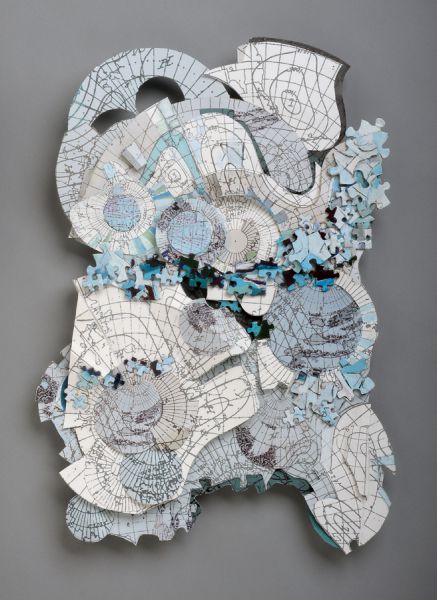
Northern Waters, by Massachusetts-based artist Phyllis Ewen, is a series of sculptural drawings looking at water as “a life force that resist being controlled.” Ewen builds her 3D images by scanning maps, charts and photos and then cutting them and building them into layers, adding paint and text, most recently in puzzle-piece shapes.
Ewen’s work explores the ways in which “life-giving waterways have been contested, diverted, polluted, and exhausted by human intervention.” In the case of Northern Waters, the oceans and glaciers are being profoundly reshaped, not by the obvious interventions of dams and agriculture, but by the effects of human-caused global warming.
Some of Ewen’s sculptural drawings are included in a global-warming themed exhibition called Thaw, at the Dorsky Gallery in Long Island City, NY, through April 6. You can see lots more of her work at her website.



 The Finch and Pea