The Art of Science: Beyond Air Guitar

Simon Blackmore, Weather Guitar, 2006

Air guitar a little low-tech for you? Try Simon Blackmore’s Weather Guitar, a robotically-controlled flamenco guitar that responds to variations in weather conditions. Blackmore says that the electronic guts of the Weather Guitar, currently on view at the Aldrich Contemporary Arts Museum in Connecticut, were designed to be as flexible and open as possible, so it could be shown (and heard) in many different settings.

The Aldrich Museum’s Richard Klein explains: “Blackmore’s work is characterized by an inventive, DIY approach that draws on influences such as hobby-style electronics, open-source software, and lo-fi aesthetics. The resulting “performative” sculpture and installations are not, however, just about revealing the inner workings of things that are usually invisible, but rather an attempt to tackle the more philosophically thorny questions that surround our increasingly complicated relationship with technology and the power it holds over us.”

Blackmore himself describes the goal of the piece as “an attempt to draw parallels between the scientific inquiry of measuring and quantifying the natural elements, and the romantic notion of the weather acting as a source of artistic inspiration.”

You can see Weather Guitar  and two other pieces by Blackmore at the Aldrich Museum through March 9 and see a video of it on Blackmore’s website.

New additions to the “Have Science, Will Travel” map

You know about the map, right? The map that shows not only all of The Finch and Pea science travel posts (except for Gallifrey…) but also science travel posts from elsewhere on the internet.

A few recent additions to the map:

The map!

Science Caturday: Cosmos Kitties explain teh Universe

cosmos

Sorry kitties, that’s not quite how it happened. Luckily, we’ll get a refresher on the origins of the universe when the reboot of Carl Sagan’s classic Cosmos series kicks off on March 9, with new host Neil DeGrasse Tyson. In the meantime, you can read this terrific article by Joel Achenbach in Smithsonian Magazine about Sagan’s impact and legacy.

lolcat via cheezburger.com

Meet the Foam Nest

Physalaemus petersi communal foam nest in Ecuador  (Photo Credit: Mónica Guerra)
Physalaemus petersi communal foam nest in Ecuador
(Photo Credit: Mónica Guerra)

Reproductive modes in frogs vary greatly, as do the ways in which they deposit their eggs. The túngara frog, Physalaemus pustulosus (=Engystomops), which is the main focus in my lab constructs a “foam” nest–an adaptive character which I’ve become interested in exploring. Foamy substances are produced by some insects, tunicates, fish and, perhaps most famously, frogs.

Foam nests may be constructed by frogs in trees, underground burrows, on top of water, or nearby water sources. This phenomenon has evolved independently several times in both old and new world frogs, living in tropical and subtropical areas. Continue reading “Meet the Foam Nest”

The Art of Science: Mike Tyka Folds Proteins in Copper

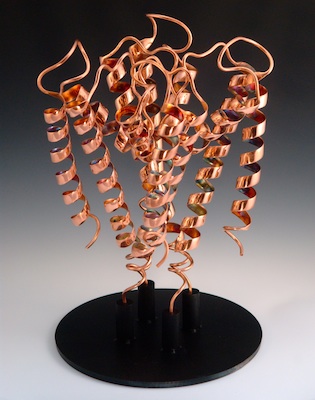
Michael Tyka, KcsA Potassium Channel, Copper and Steel, 2011

Mike Tyka is not the first scientist to see artistic potential through his microscope, but he’s taken his love for the structure of protein molecules much farther than most – not only learning metalworking to make beautiful copper sculptures, but creating a studio/makerspace to do it in.

Tyka earned a PhD in Biophysics in 2007 and went  to work as a research fellow studying the structure and dynamics of protein molecules.  His particular area of interest is protein folding, and he has written computer simulation software to better understand the process.  Tyka says that “protein folding is the way our genetic code is interpreted from an abstract sequence of data into the functional enzymes and nano machines that drive our bodies.”

Tyka got interested in sculpture in 2009 when he helped design and construct Groovik’s Cube, a 35ft tall, functional, multi-player Rubik’s cube.  The cube will soon be on view at New Jersey’s Liberty Science Center as part of its Beyond Rubik’s Cube Exhibit.

Although the Groovik’s Cube project gave him his first taste of art-making, building a giant welded steel cube hardly prepared him to make exquisite replicas of complex biological forms.  So he took to the internet. “I learned almost everything I needed from youtube and from jeweler friends. I didn’t have a space to work so I got together with some friend and founded an artspace (Seattle’s ALTSpace) and acquired or built all the tools I needed.”

Tyka was obviously very familiar with the protein forms and knew how he wanted them to look. He chose to work in copper, a warm, soft metal, because he wanted the sculptures “to look smooth, soft, liquid. Proteins are not solid objects, they’re more like jelly, they move and vibrate. I wanted to reflect that property somehow.”

You can see Mike Tyka’s work at the Hutchinson Cancer Institute in Seattle and at Science House in New York, and see lots more photos on his website. You can follow him on twitter @mtyka