Science Caturday: Thar She Blows (Up)

whalecat

The biggest science story online this week was very big indeed.   About 60 tons, in fact.  The gigantic carcass of a blue whale has washed up onto the beach in Trout River, Newfoundland, and some fear it could explode. The whale carcass, which is estimated to be 81 feet long, has been swelling for several days due to the buildup of methane gas inside the body. And yes, as many of us learned this week by watching disgusting but riveting videos, a dead whale can explode.

Luckily, our scicomm friends are on the case.  Marine ecologist Andrew David Thaler, aka Southern Fried Scientist, set up a website called HasTheWhaleExplodedYet.com,  which instantly went viral.

And,  to prove that even a swollen dead whale can be a teaching tool, Aatish Bhatia wrote this terrific post  using physics to work out the velocity of guts spewing from an exploding whale.


Ball Pit of DOOM!

“Ball Pit” by eldeeem (CC BY-NC-SA)

A fellow graduate student in my thesis lab at Washington University in St. Louis once told me about a fraternity brother of his who had a ball pit in his room at the frat house. I believe this LEGO creation from eldeeem is a metaphor for how creepy and gross that would be.

*Hat tip to Tromas at The Brothers Brick

The Cutting Edge

If you are in the DC area tomorrow, the AAAS is hosting an interesting event that piggybacks off the Voyage of Discovery art installation by Jessica Beels, Ellyn Weiss, and our own Michele Banks called Cutting Edge: Art & Science of Climate Change:

Join AAAS for an evocative exchange as artists and scientists come together to interpret the effects of climate change on the poles…This live event features talks by two leading Arctic researchers, followed by a panel discussion on communicating climate change to the public.

“Cutting Edge: Art and Science of Climate Change” coincides with the art installation, “Voyage of Discovery,” currently in the lobby of AAAS headquarters. This remarkable exhibition, featuring works by Michele Banks, Jessica Beels, and Ellyn Weiss, explores a “hypothetical journey” to the poles where climate change has caused the ice to recede, reawakening life that has been frozen for millennia.

Cutting Edge will be held on Thursday, May 1 at 6:30PM at the AAAS Headquarters in Washington, DC.

The Art of Science: Lemurs out on a Limb

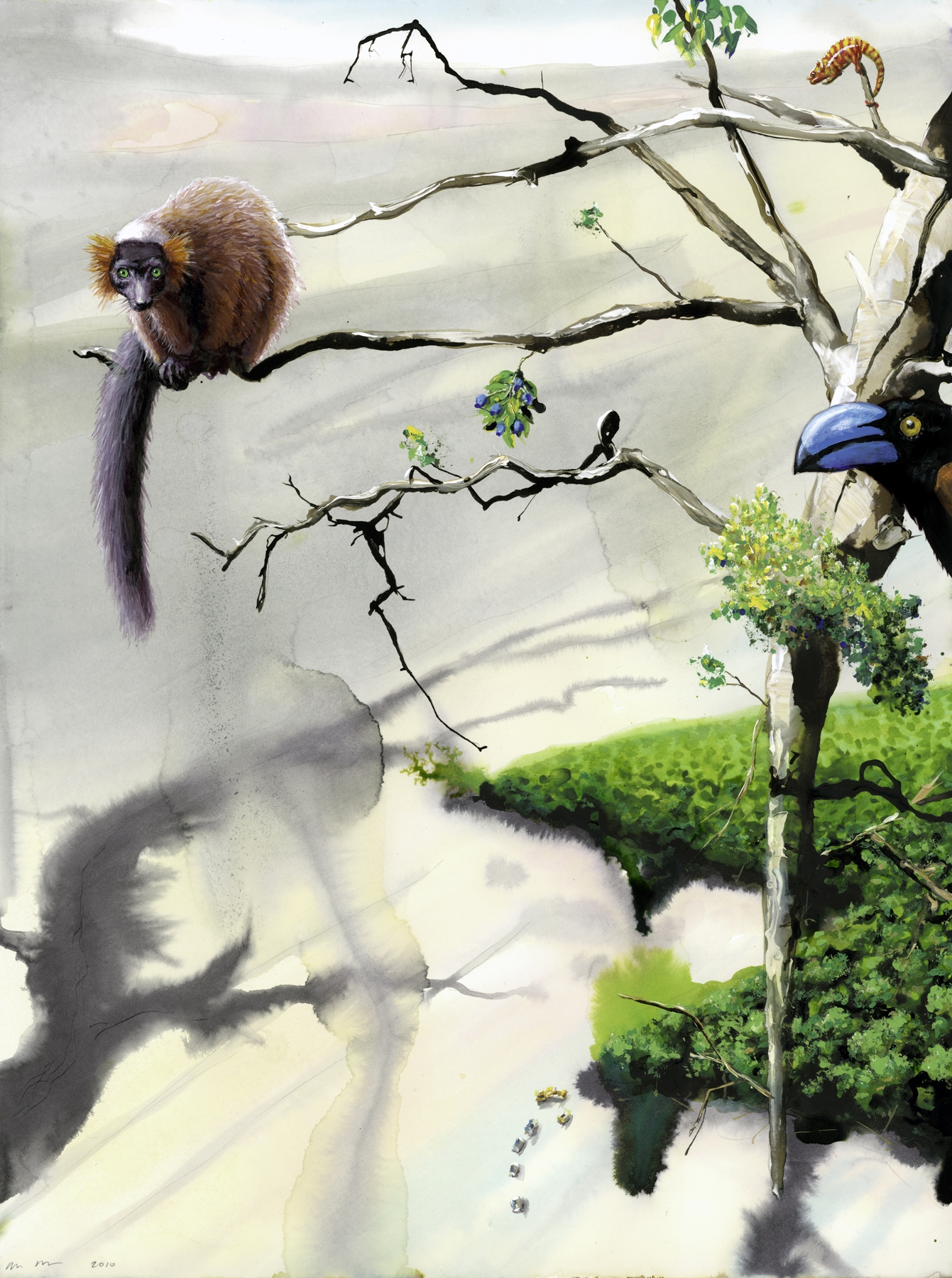
Alexis Rockman, Fragments
Alexis Rockman, Fragments, 2010

About 100 species of lemurs live on the island of Madagascar. The astonishing diversity of lemurs in this one location has allowed scientists to make important advances in evolution and island biogeography. Unfortunately, habitat loss and hunting are threatening their survival.  According to the International Union for Conservation of Nature (IUCN) lemurs are the world’s most endangered mammals, with up to 90% of all lemur species face extinction within the next 20 to 25 years.

The Lemur Conservation Foundation (LCF), is a small, Florida-based non-profit dedicated to the preservation and conservation of the Madagascar primates, is hosting a show of art featuring lemurs.

Vanishing, an exhibit featuring works from LCF’s permanent collection, includes works by 17 artists, including Alexis Rockman, who contributed Fragments, a painting depicting an imagined future of a devastated lemur habitat.

Rockman, well known for his dystopian visions of an earth ravaged by pollution and climate change, traveled to Madagascar in 2009 with LCF. He later painted Fragments, a lovely but unsettling image of a rare red ruffed lemur on a bare branch of a tree that offers little shelter or sustenance.

LCF founder Penelope Bodry-Sanders hopes the art exhibit will help people “understand the awfulness of extinction—without that, there is little hope for the future of lemurs and life itself in its magnificent diversity. “

Vanishing is on exhibit at Art Center Sarasota in Florida from May 22 – June 27. More information is here.


Chilean National Museum of Natural History

I first heard about the Chilean National Museum of Natural History last year, when they were a finalist for the museum category of the Shorty Awards – basically the Oscars of social media. Although they weren’t able to beat The Brain Scoop in the same category that year, the museum’s social media presence is indeed impressive.

800px-MNHN_Diego_Alarcon
The building is also impressive! (Photo via Wikimedia Commons, by Diego Alarcón.)

Why didn’t I know them if they were so adept at social media? Well, despite thinking of myself as relatively well-travelled and globally aware, I’d really only ever visited European and North American natural history museums. And I thought that was enough. After all, these museums often had exhibits about other countries. I was recently in a replica Japanese supermarket in London’s NHM exhibit about earthquakes. Surely museums can show the work of all countries? Continue reading “Chilean National Museum of Natural History”