
The Art of Science: Mourning Loss, Celebrating Survival

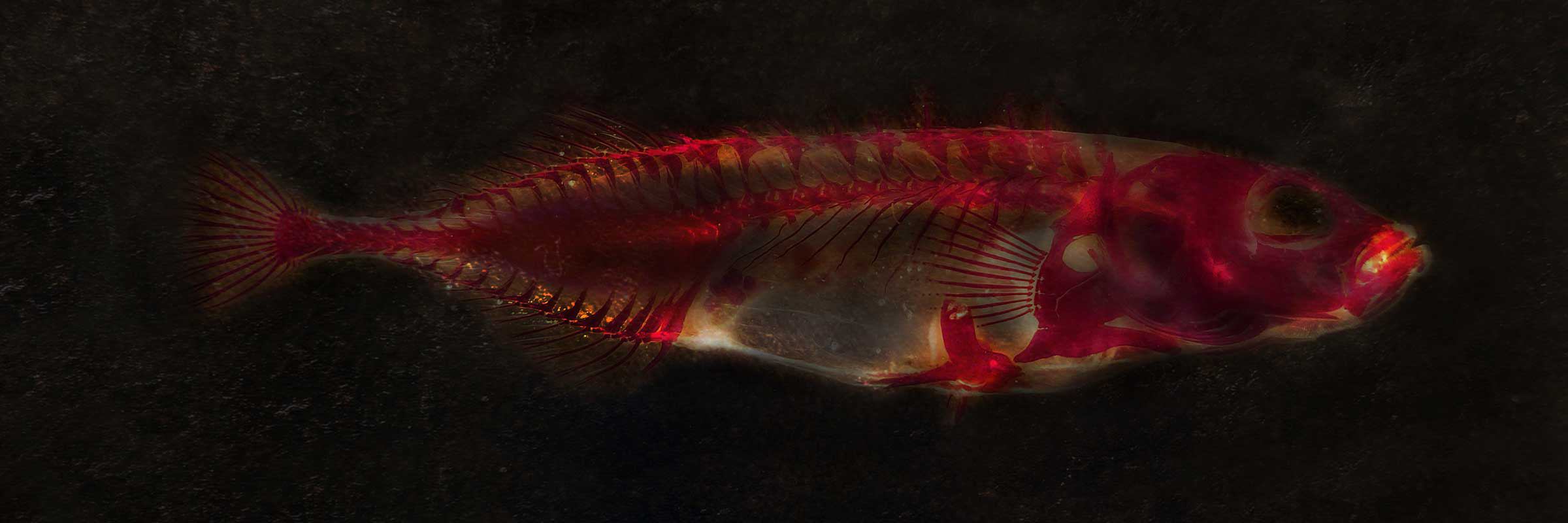
Brandon Ballengée - Ti-tânes - Mnemosyne, 2013
Brandon Ballengée, Ti-tânes – Mnemosyne, 2013

The work of Brandon Ballengée, an artist, biologist and environmental activist, often focuses on the damage that humans do to nature.  For example, he has worked for years on both art and scholarship based on the rising occurrence of developmental deformities and the decline in populations of amphibians. A major 2013 installation, Prelude to the Collapse of the North Atlantic, looked at catastrophic declines in marine diversity.

The photo-based installation Ti-tânes, however, takes a different view.  Ballengée here was inspired by the Titans of Greek mythology, metaphorical representations of the forces of nature who were eventually overthrown by the more human-like gods, but nonetheless survived, banished to austere lands.

The artist explains:

With the Ti-tânes series, I aim to portray ancient animal species, which are able to survive (perhaps even thrive) in habitats environmentally impacted by human activity. Such organisms have endured millions of years and are now adapting to today’s ecological degradation.

For the works in this exhibition, three nine-spined stickleback (Pungitius pungitius) collected from the a polluted canal in Chamarande (France) were chosen as subjects and carefully stained using Alizarin red dye, which adhered to bone, then cleared using digestive enzymes to make surrounding tissues transparent. From the biological research side this was done to analyze specimens for any developmental abnormalities that in life we could not have seen. Secondly, this treatment was performed as an artistic choice – as clearing and staining is a way to change the way we are able look at such organisms, how we perceive them – they are abstracted yet made more clear. Next they were photographed on coal (literally fossilized carbon) meant to recall ancient life as well as changes to today’s climate made through the continued burning of such fossil fuels.

These artworks are meant as portraits of the individual fish, as each is unique as each of us. Through size (making them larger than life) they are scaled so the human viewer sees them at a magnitude beyond our ordinary bodily scale – grandiose and sublime like nature herself. Metaphorically they are meant to recall the ancient lingering nature deities surviving in banished now degraded environs. Viewed as skeletons they are not meant to represent death but instead life persisting in ecosystems made preternatural by human activity.

The Ti-tânes series is currently on exhibit at the Museum Het Domein in Sittard, The Netherlands, as part of Seasons in Hell, a retrospective exhibition of Ballengée’s artwork, through June 29, 2014. An online virtual tour of the exhibition is available here.


Zapping Brains, Seeing Scenes

Photo by thisisbossi (CC BY-NC-SA 2.0)

More than fifteen years ago, neuroimagers found a region of the brain that seemed to be all about place. The region lies on the bottom surface of the temporal lobe near a fold called the parahippocampal gyrus, so it was called the parahippocampal place area, or PPA. You have two PPAs: one on the left side of your brain and one on the right. If you look at a picture of a house, an outdoor or indoor scene, or even an empty room, your PPAs will take notice. Since its discovery, hundreds of experiments have probed the place predilections of the PPA. Each time, the region demonstrated its dogged devotion to place. Less clear was exactly what type of scene information the PPA was representing and what it was doing with that information. A recent scientific paper now gives us a rare, direct glimpse at the inner workings of the PPA through the experience of a young man whose right PPA was stimulated with electrodes. Continue reading “Zapping Brains, Seeing Scenes”

The meter and the metric system

Outside number 36 of the Rue de Vaurigard in Paris is one of only two remaining meter standards installed in the late 18th century to get the people of Paris used to the new metric system, introduced in 1795.

OLYMPUS DIGITAL CAMERA
Meeting the meter, summer 2003. (Own photo).

The metric system became mandatory in France in 1799, and spread across the world. Until then, people had been using variable units of measure for length, weight and time that made communication difficult. If a tradesman sold you a “foot of fabric”, he basically got to decide how long a foot was to him, or use a local definition which might not correspond to the use of length at his destination market town.

In 1960, the metric system was further formalized as the International System of Units (SI system). That system has a built-in clause that says that they will always use the best available standard to set each unit.

Continue reading “The meter and the metric system”

How many genes were we supposed to have?

In my Pacific Standard column this week, I note that over the course of the 20th century our concept of the gene went from being an abstract unit of heredity to an increasingly restrictive molecular definition. The advantage of this molecular definition is that it made genes countable; the drawback is that it is ill-suited to describe the heterogeneous collection of DNA elements that make up our genome. We’re now in the somewhat ironic situation where more function in our genome falls outside of these conventional genes. As other have noted before, the physical and ‘genetic’ definition of a gene are in tension.

Before we sequenced the human reference genome, how many genes did people expect us to have? Most estimates made in the 1990’s put the number between 60,000 and 100,000. One group in 1994 reviewed estimates out there in the literature, which ranged form 20,000 to 100,000, and ultimately favored a prediction in the 60,000-70,000 range. In 1998, Deloukas, et al. published a physical map of 30,000 human genes (PDF) and figured that they had captured nearly half of the complement of human genes. In 1999, Francis Collins was using a number of “80,000 or so.” My molecular cell biology textbook, the third edition of Lodish, et al. (2000) stated that our genomes were expected to contain 60,000-100,000 genes. One estimate, made less than a year before the draft genome sequence was published, noted that “Early estimates suggested that there might be 60,000−100,000 (ref. 1) human genes, but recent analyses of the available data from EST sequencing projects have estimated as few as 45,000 (ref. 2) or as many as 140,000 (ref. 3) distinct genes.” They worked out their own estimate of the total genes in the genome: “Using highly refined and tested algorithms for EST analysis, we have arrived at two independent estimates indicating the human genome contains approximately 120,000 genes.” Continue reading “How many genes were we supposed to have?”

Science for The People: Internet Things

#263 - Internet Things
#263 – Internet Things

This week, we’re looking at controversies over connectivity, both online and in the physical world. University of Ottawa law professor Michael Geist walks us through the arguments over net neutrality. And we’ll speak to researcher Rob van Kranenburg about his book The Internet of Things: A critique of ambient technology and the all-seeing network of RFID.