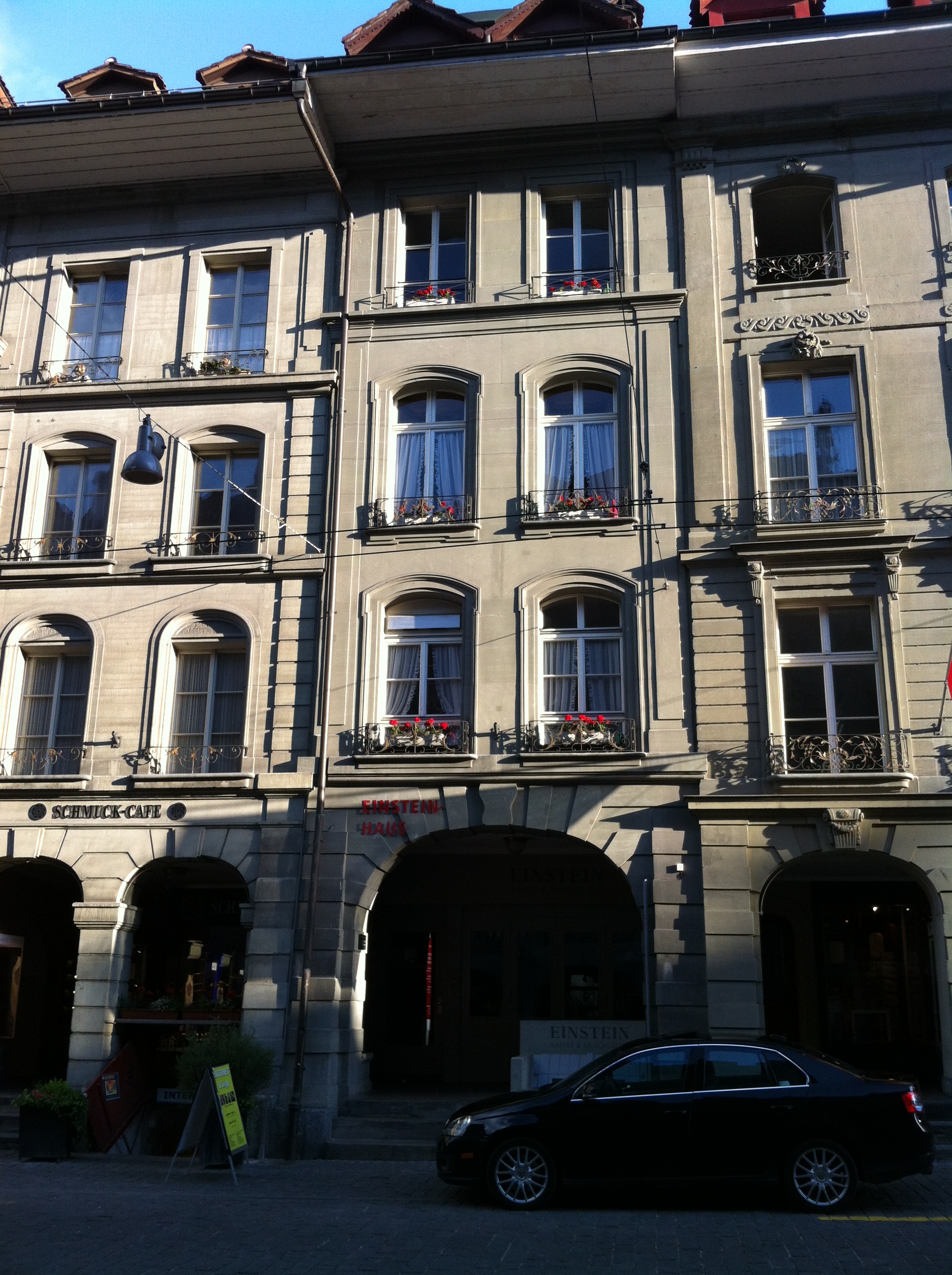
Einstein Haus

2014-05-18 19.32.04I was in Bern for work last week, so I took the opportunity to drop by the Einstein Haus (or Einstein House).

Albert Einstein lived in Bern for several years after graduating from university. He worked at the patent office here, but was simultaneously writing physics papers. The apartment where he lived from 1903 to 1905, right in the center of Bern, is now a  small museum. One floor is the former living area, where you can sit at the dining table and look at family photos on the wall.

2014-05-18 15.25.19

The upstairs apartment has been converted to an exhibit about Einstein’s life. There’s a case with his passport in it, and a famous photo of many well-known physicists at a Solvay convention.

2014-05-18 15.31.41

All along the walls of that floor are panels with information about historical events in Einstein’s life. The first few of them all emphasize how much of a mediocre student he was. He wasn’t terrible, but all through university he seemed to have struggled, which was why he didn’t go straight to academia, but found work in the patent office instead.

One of the last panels was about his life as a musician. I was most interested in that, for my “musisci” project, and on my way out of the museum I bought a small booklet (in German) produced by the museum, all about Einstein and his violin.

The Einstein Haus is a very small and unassuming museum, and from the street you can barely spot it unless you know where you’re going, but well worth a visit if you’re ever in Bern.
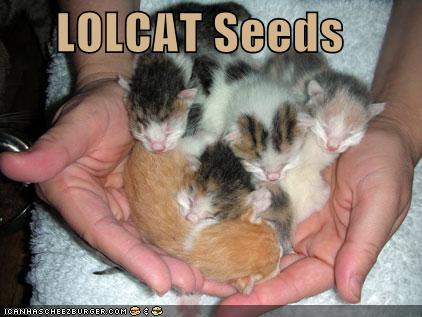

Science Caturday: How to Grow Lolcat Plants

In four easy steps.

seeds

purrtil

fullsun

ready

Ta-Da! Enjoy your beautiful garden-grown lolcat.

Modern Statistics make the absurd appear significant

This is too good not to share, from a preprint by Andrew Gelman and Eric Loken, “The garden of forking paths: Why multiple comparisons can be a problem, even when there is no ‘fishing expedition’ or ‘p-hacking’ and the research hypothesis was posited ahead of time”

Without modern statistics, we find it unlikely that people would take seriously a claim about the general population of women, based on two survey questions asked to 100 volunteers on the internet and 24 college students. But with the p-value, a result can be declared significant and deemed worth publishing in a leading journal in psychology.

The paper is here (PDF).

The Art of Science: Tristin Lowe’s Full-Scale Whale

Tristin Lowe, Mocha Dick, 2009

The beaching – and threatened explosion – of a whale near a small town in Newfoundland last month was a reminder of just how huge, mysterious and fascinating these creatures are to humans.

Artist Tristin Lowe was so intrigued by the tale of a rogue albino sperm whale from the 19th century that he decided to recreate the whale at full scale in felt. Mocha Dick is a fifty-two-foot-long sculpture of a legendary whale that was said to have attacked numerous whaling vessels near Mocha Island in the South Pacific in the early 19th century.

Writing in the Knickerbocker Magazine in 1839, Jeremiah Reynolds described the original Mocha Dick as appearing “as white as wool . . . as white as a snow drift . . . white as the surf around him.” This was especially striking because sperm whales are usually dark gray, brown, or black.  The unusually colored, highly aggressive creature provided the inspiration for literature’s most famous cetacean, Herman Melville’s Moby-Dick, published in 1851.

The “white as wool” description (and Melville’s novel) spurred the imagination of Lowe, who had previously made smaller pieces in felt. To work on this massive scale, he collaborated with the Fabric Workshop and Museum in Philadelphia to make the sculpture: a large-scale vinyl inflatable understructure covered in highly detailed white industrial felt.

Lowe was careful to give the sculpture a personality. He imagined the whale at over forty years old, covered with hand-stitched scars and barnacles. “All of his life is revealed on his skin,” says Lowe. “He wears that.” And like the real Mocha Dick, this 700-lb sculptural whale is well-traveled. Made in 2009, Mocha Dick has been exhibited in galleries and museums in Pennsylvania, Wisconsin, Virginia, Florida, Rhode Island and Massachusetts.

A video with more information about the artist and the piece is here.

And we are going to stop drowning kittens…

by Katie McKissick

The US government just announced that the CIA will no longer use fake vaccination programs as a cover for operations. At a time when anti-vaccination movements have swept the globe, despite the positive effects of vaccinations in limiting previously devastating infectious disease, the US government was actively undermining life-saving, humanitarian programs by using them as cover.

Among the reasons people decline vaccinations is the idea that uniform public health projects must be a nefarious government conspiracy. The fact that the conspiracy theorists are not entirely wrong certainly does not help the fight against infectious diseases.

This is a step in the right direction relative to the previous steps in a horribly misguided direction; but, to my fellow US citizens, the view that our country is a force for good in the world is not an evidence-based position.