
Milton Mermikides, guitar virtuoso and music theorist, spent 4 months living at Charing Cross Hospital being treated for acute lymphoblastic leukemia. This rendition of “Always Look on The Bright Side of Life” (words and music by Eric Idle) was one of many thank yous to the medical staff that helped save his life.
Category: This Mortal Coil
Life on Film

Do you ever get to the end of a whirlwind trip and wish you could actually remember what you did? I’m guessing many of you who attended ScienceOnline2013 have forgotten as much awesome as you remember about the conference. What if there was a way to record your days for nostalgia’s sake or to monitor your lifestyle? You are in luck! This week at South-by-Southwest (SXSW) a Swedish start-up is pitching their tiny wearable camera called Memoto.
Memoto takes two geotagged photos each minute from its position on your collar, on a belt loop, wherever you decide to clip the tiny weather-proof camera. The camera’s battery can last several days and it recharges when you plug the camera into your computer to download all of the pictures taken since the last sync. Now you can record all the moments of the day that you might not think to whip out your smartphone to record. The camera isn’t automatically linked to social media platforms yet, but that functionality is on the horizon.
I think this particular functionality could really test the limits of personal privacy. I personally don’t want two photos per minute of me posted to facebook while I have a conversation with someone. It can also be a huge infringement on patient privacy should someone wear this camera into a hospital and end up imaging someone’s private health information and potentially posting it to the web or even storing it on a server somewhere. Are medical practices even aware that this sort of thing exists?
Another issue linked with the type of data volume (120 photos per hour!) this camera would generate is storage. Memoto offers a remote server storage program for all of your images but it isn’t clear how secure your data will be. Memoto has several blog posts about data security but no firm policy in place yet. Would you be willing to risk having the images of your life exposed to anyone with the gumption to hack into those servers?
The idea of self-tracking is really intriguing but,I think I might be depressed to know how many photos a day are of my computer screen.
Right Answer, Wrong Question
Author’s Note: Post was written without access only to the abstract, not the full text, of the journal article in question. Note that the argument is not with the methods or results of the research, but with how the research question has been presented.
University of Chicago Medicine & Biological Sciences tweeted the following tweet on Twitter today highlighting the work of post-doc Laure Ségurel on genetic risks for Type 2 Diabetes:
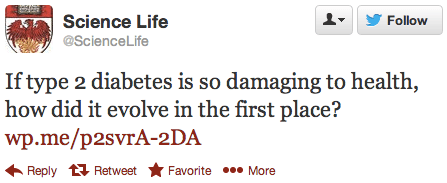
The work itself is interesting in its own right. Investigating the population genetic history of genetic markers associated with Type 2 Diabetes risk could have multiple applications, beyond the high level of intellectual interest.
The question used to frame the research, however, troubles me, because it plays to general misconceptions about the evolutionary dominance and efficiency of natural selection in humans:
Why is this deleterious disease so common, while the associated genetic variants should be removed by natural selection? –Ségurel et al (Eur J Hum Genet. 2013 Jan 23. doi: 10.1038/ejhg.2012.295)
The roots of mental illness

There’s been a lot of buzz in the media this week about a new study on the genetic component of some mental illnesses. This is the largest genome wide association study of the genetic component of mental illness to date (33,332 affected individuals and 27,888 control individuals had their genomes examined for single base pair genetic differences. The affected individuals were diagnosed with one of five disorders: autism spectrum disorder, attention deficit-hyperactivity disorder, bipolar disorder, major depressive disorder, or schizophrenia. This particular study focused on finding genetic changes that were common to all five disorders as opposed to any genetic changes that cause the individual disorders. The genetic associations uncovered by this study were shocking to many in the field.
Science Caturday: New Treatments for Old Kitties

Note: We usually feature lolcats here on Science Caturday, because we love both cats and science (and we like to LOL). But today we haz a more serious kitty science post.
Most cats love to be stroked, but many older cats suffer from osteoarthritis, a condition that owners may not notice and can make even petting painful. Scientists at the University of Montreal recently published a study in the journal Research in Veterinary Science on how to recognize and treat osteoarthritis in cats. “Osteoarthritis frequently affects cats’ elbows, backs and hips and joints in the hind limbs, and its prevalence increases dramatically with age. More than 80 % of cats older than 11 years old have it,” explained lead author Eric Troncy of the university’s Faculty of Veterinary Medicine. Continue reading “Science Caturday: New Treatments for Old Kitties”
 The Finch and Pea