
On a rainy day in London, Eva and friends went on a quest to find the DNA sculptures scattered around the city by Cancer Research UK.
Category: The Art of Science
The Art of Science: Radical Elements
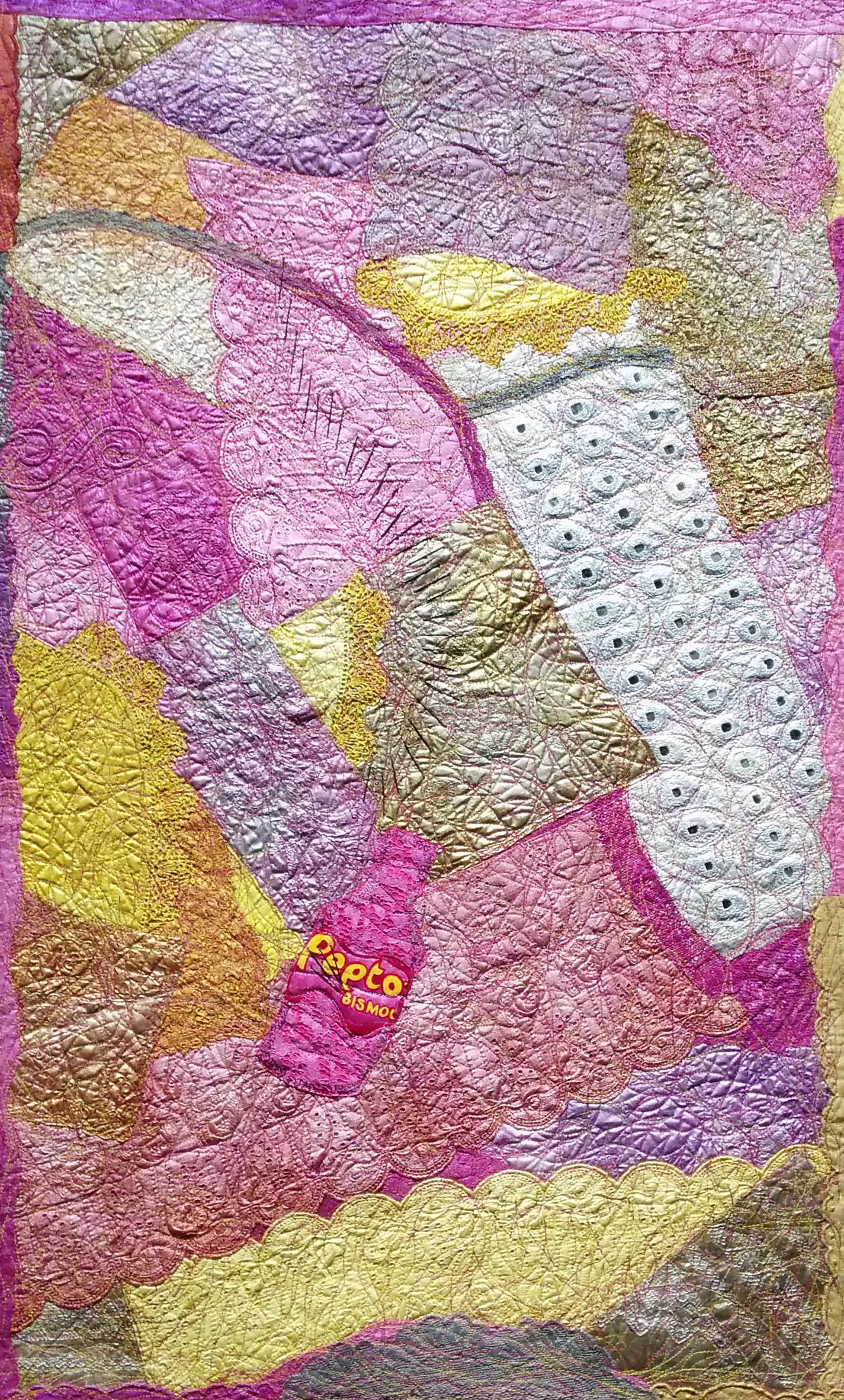
Soft materials meet hard science in Radical Elements, an exhibition at the National Academy of Sciences featuring 40 contemporary art quilts, each inspired by a different element from the periodic table. The works in the show, organized by Studio Art Quilt Associates, explore the elements in many ways, ranging from their industrial uses to personal memories associated with them. For example, Barbara Schulman’s piece, A Pepto Bismuth Story (below), started with the “beautiful crystalline structure” and iridescent colors of the element, which reminded the artist of her mother’s hankies and lace, so she incorporated them into the design along with bismuth’s best-known consumer product, Pepto-Bismol.
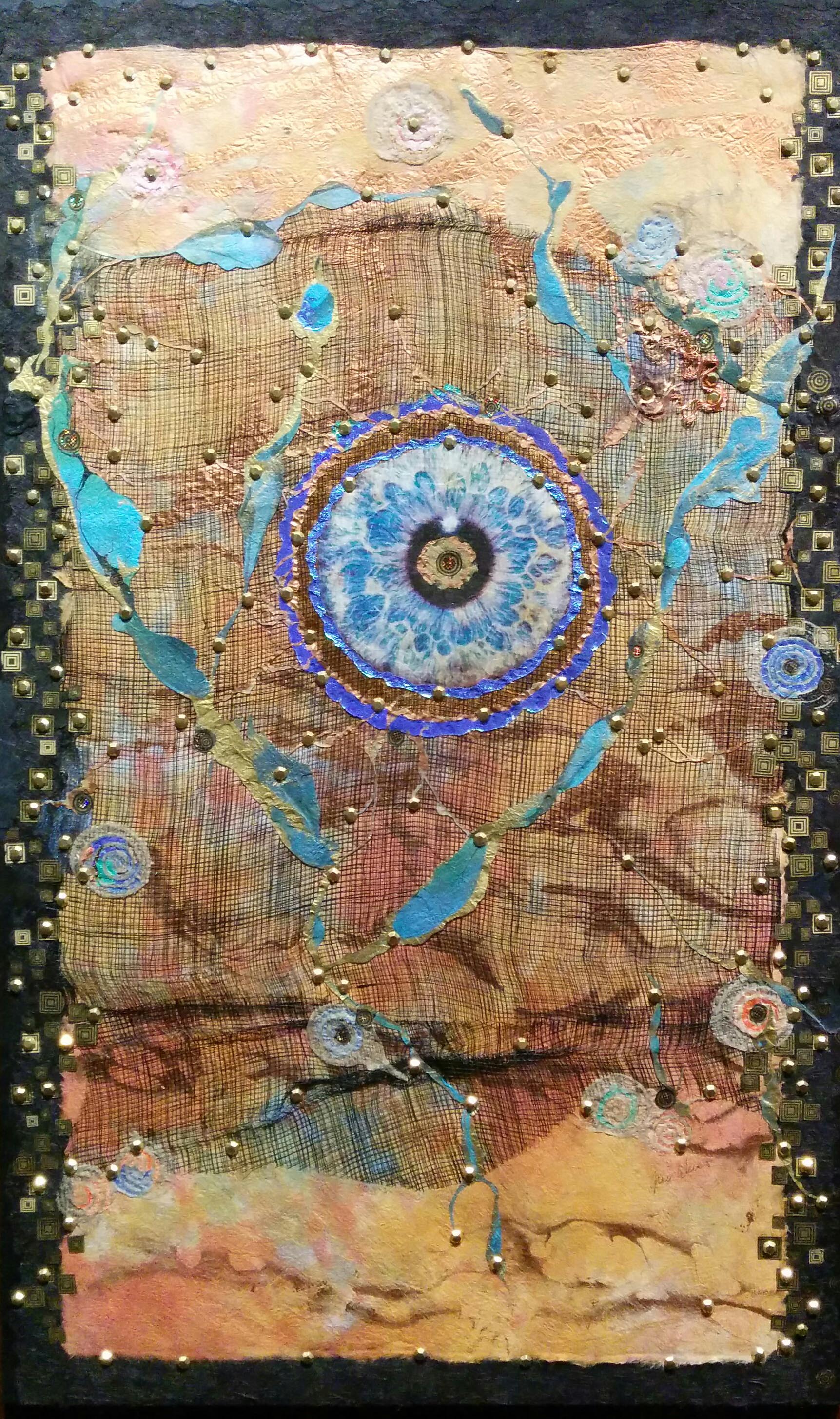
Grace Harbin Wever’s Iridium – My Darkness to Light II (above), takes a more strictly scientific idea, although she expresses it in a highly artistic, indirect way. The artist, a former cell biologist, was intrigued when she learned that iridium microelectrodes had been successfully implanted into the human brain as part of studies in vision and perception. A range of materials, including holographic fabric and copper wire, surround the central eye image, nodding to the juxtaposition of the natural and the man-made that characterizes recent advances in the field of vision.
Indeed, very few of the quilts on display stick to the traditional materials of fabric, thread and batting. Materials used range from duct tape and aluminum foil to keyboard keys and dining utensils. Curator Jill Rumoshosky Werner notes, “In a relatively short period of time, the field of art quilting has undergone a fundamental change. The primary focus has shifted from decorating the surface of a quilted wall hanging to a much broader acceptance of ideas, styles, and materials.”
Radical Elements is on exhibit at the NAS Building in Washington, DC, through October 19th. Many of the quilts can be seen online here.
The Art of Science: Culture and Monoculture
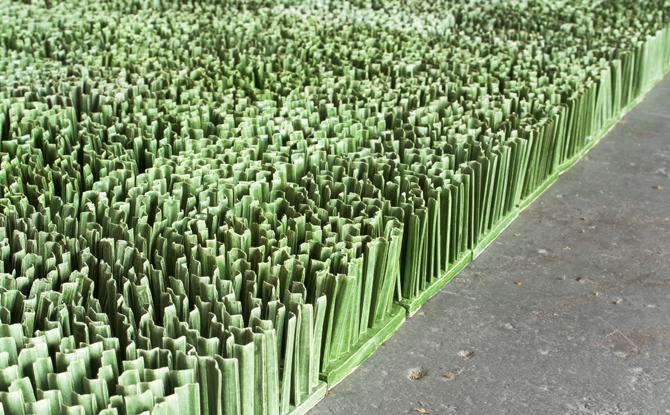
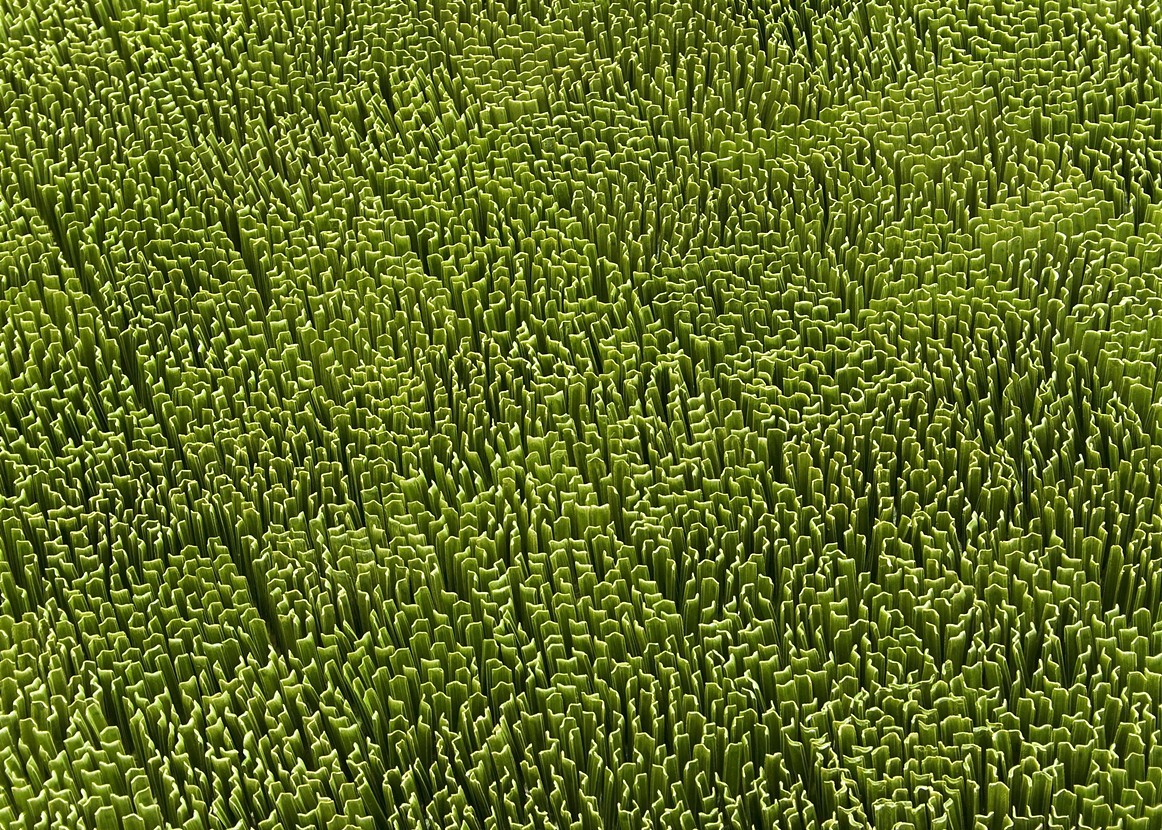
Dawn Holder’s Monoculture is a porcelain replica of that American ideal, the perfect green lawn. Holder explains that she focused on the lawn because of its “multivalent nature.”
“It is a “natural space” in that it is comprised of plants and landforms, yet the lawn is a wholly artificial construct, a highly controlled space requiring labor, chemicals, and specialized equipment to maintain. I am fascinated by suburban America’s desire to construct this hybrid artificial-natural landscape and what it signifies in terms of time and resources. I think the lawn is our culture’s fantasy version of the natural world.” (source)
Holder’s piece, made from individually formed, glazed and fired pieces of porcelain, is also, of course, a “highly controlled space” that requires a lot of labor to create and maintain.
“The toil involved in the manufacture of these repetitive pieces mirrors the tedium of shaping and cultivating the landscape…Breakage and repair have become part of the labor of maintaining much of the work.” (source)
Holder’s piece is on exhibit at the National Museum of Women in the Arts, in Washington, DC, as part of a show called Organic Matters—Women to Watch 2015. The work seems especially timely as drought and climate change call into question whether humans can – or should – continue to exert this kind of control over the natural environment.
Perhaps one day, maybe sooner than we imagine, a museum will be the only place to see a perfectly tended green lawn.
Organic Matters continues at the National Museum of Women in the Arts through September 13.
The Art of Science: Decay All The Way
Artists have explored the beauty of decay for hundreds of years. Images of dying flowers and falling-down buildings are potent reminders that life is fleeting and that nothing we build will last forever. But of all the painters and poets that have pointed out this bittersweet fact, few get down to the nitty-gritty of decay quite like Sam Taylor-Johnson.
In her 2001 video piece Still Life, Taylor-Johnson (Formerly Sam Taylor-Wood, and yes, the same one who directed 50 Shades of Grey), presents a classic Renaissance tableau of a bowl of fruit on a table, sets up a camera and lets nature take its course. As the bacteria build up, the fruit begin to shrink and collapse upon themselves.
Unlike a traditional painter, who would typically suggest decay by showing fruit or flowers just past their prime, but still beautiful, Taylor-Johnson keeps the camera rolling until the all that’s left is a rotting black pile topped with angelic white mold, buzzed about by fruit flies.
One of the things that’s fascinating about watching the process is how the fruit keeps moving, at first shrinking and then seeming to regrow as the bacteria multiply furiously. It’s a truly visceral display of the circle of life. If you like this piece, and you have a really strong stomach, watch Taylor-Johnson’s video A Little Death of a dead rabbit (another classic art image) being devoured by insects.
If you’re in the DC area, you can see Still Life as part of the Super Natural exhibition at the National Museum of Women in the Arts until September 13.
Beatles-inspired author photos
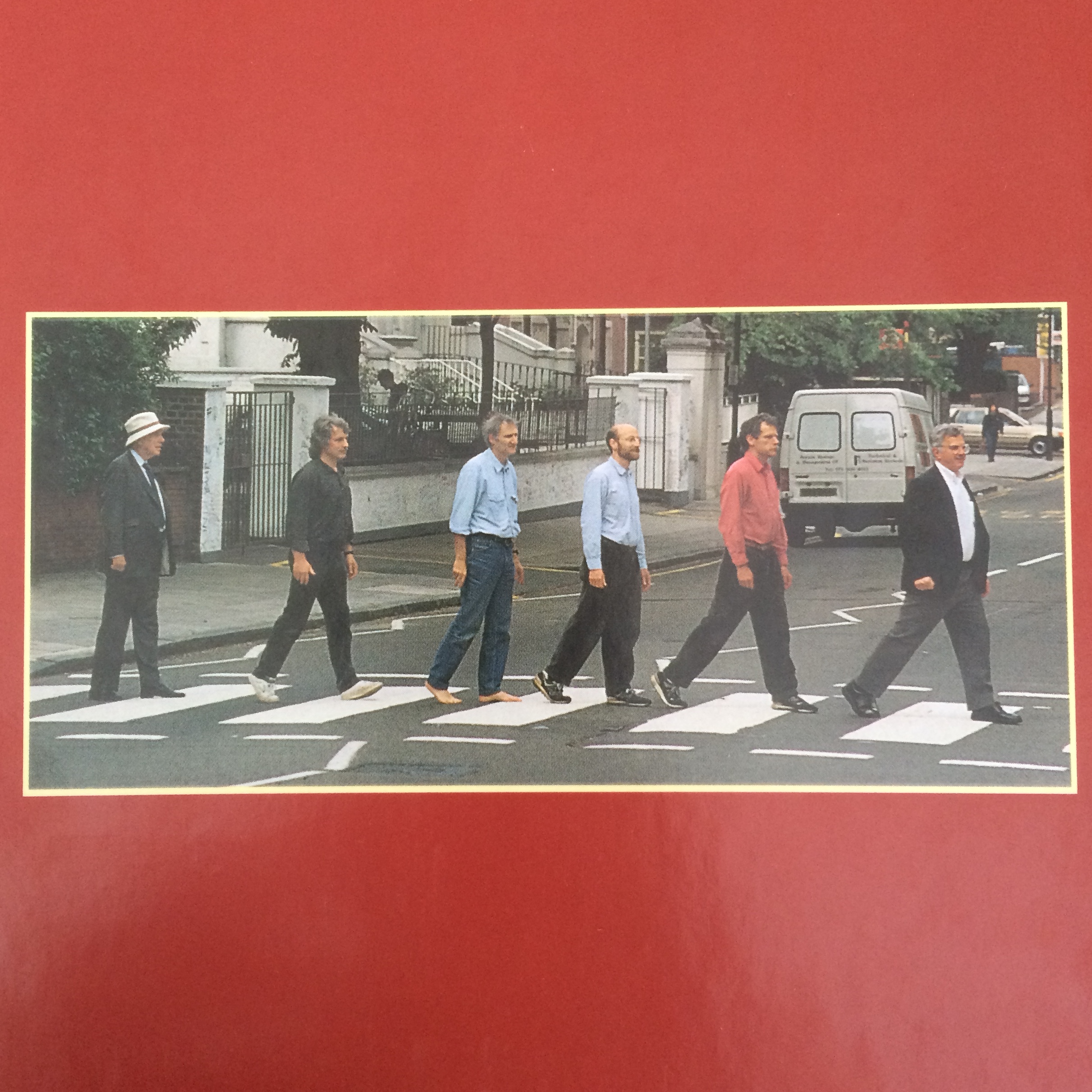
In 1994, Bruce Alberts and his co-authors released the third edition of their popular textbook Molecular Biology of the Cell. On the back cover, all the authors are photographed crossing Abbey Road, because they worked on the book just around the corner from the famous crossing.
When they published another text book, Essential Cell Biology, they stuck with the joke and took a photo in the style of With The Beatles.
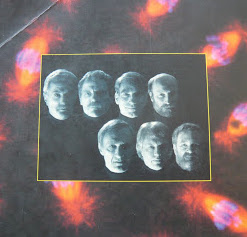
Now committed to a running gag, almost all subsequent editions of both textbooks have included author photos in the style of a Beatles album. I’ve listed them all on easternblot.net, with sliders to compare them to the corresponding album. I couldn’t get the sliders to work on this blog, unfortunately, but I will leave you with my favourite author photo, of the fourth edition of MBOC. Who do you recognize in the collage?
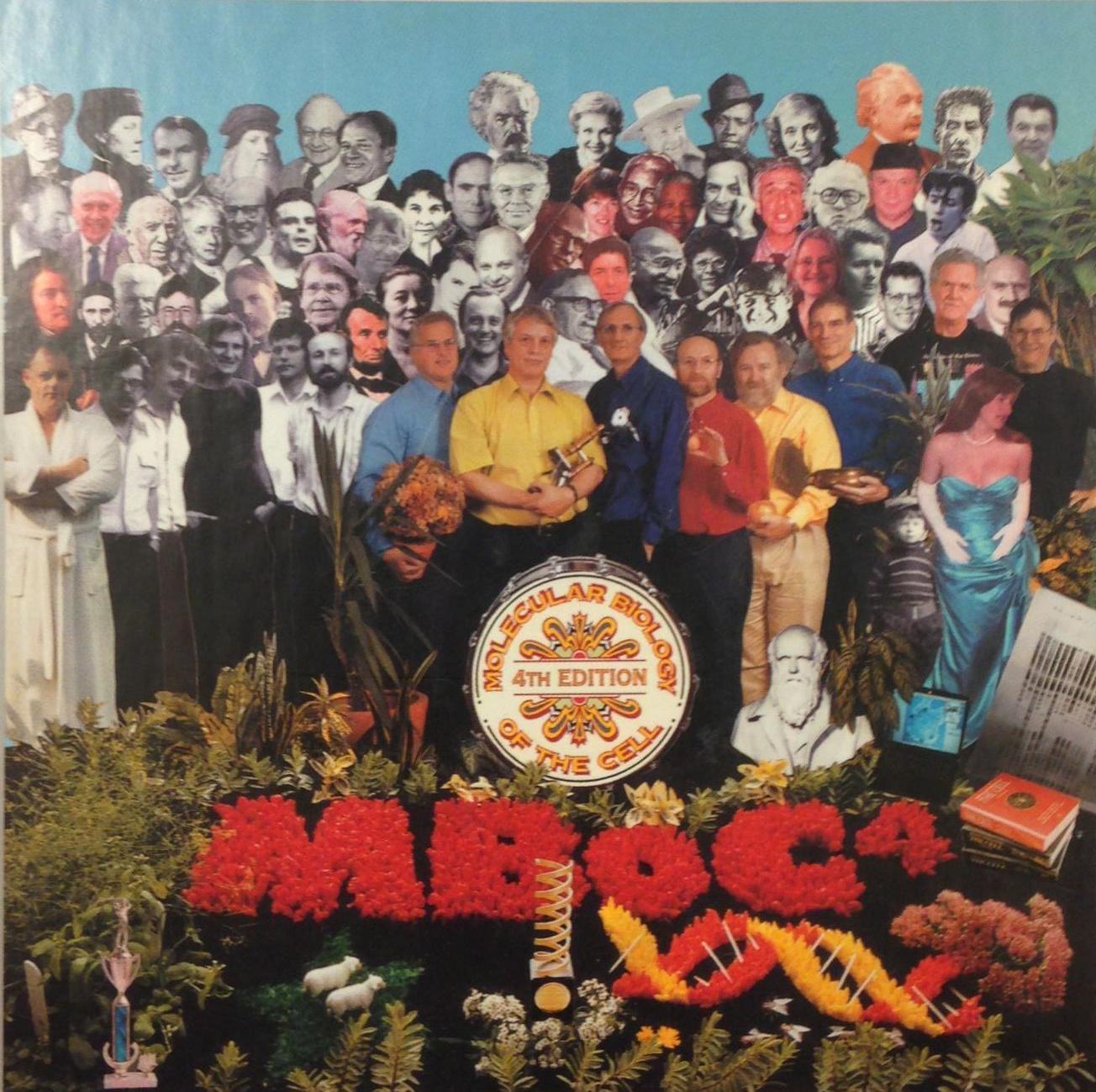
Images: Abbey Road parody: I photographed the back of my copy of Molecular Biology of the Cell, 3rd edition (1994). With The Beatles parody: This image comes from the blog of Svenn, who misidentifies it as the second edition of Essential Cell Biology – it’s the first (1997). Sgt Pepper parody: I found this posted on Reddit by a user called hookp. Don;t know if they took the photo, but it’s the back of the 4th edition of Molecular Biology of the Cell. All books published by Garland Science, and obviously all images are inspired by the Beatles.
 The Finch and Pea